I’ve used AR glasses to survive economy flights for 5 years — these are the only Prime Day deals worth your money
I tested every pair on sale right now
As well as access to these exclusive Prime Big Deal Days savings, you can get free Prime shipping, access to Prime Video streaming, Prime Music, Amazon Luna gaming, unlimited cloud photo storage and a whole lot more. Plus, college students get 6 months free and 50% off membership.
For the last five years, I have logged thousands of miles on long-haul flights testing nearly every pair of the best AR glasses on the market. No more staring down at a phone, Steam Deck or laptop on a tray table for eight hours — just a 150-inch OLED monitor at eye level that makes my economy seat feel more like business class.
And with Amazon’s Prime Big Deal Days officially kicking off, the market is flooded with so-called “discounts” that are ultimately deceptive. I’ve cut through the noise, and here is the ultimate fluff-free guide to the only deals actually worth your money — on glasses I’ve tested (and love), whether you’re a curious beginner or a hardcore travelling gamer.
Prime Day AR glasses deals: Quick links
- RayNeo Air 4 Pro: was $299 now $239 @ Amazon
- Xreal xbx a01+: was $299 now $254 @ Amazon
- Viture Luma Pro: was $499 now $359 @ Amazon
- RayNeo GT Max: was $429 now $364 @ Amazon
- Viture Beast: was $549 now $529 @ Amazon
- Xreal One Pro: was $599 now $549 @ Amazon

30 day free trial! If you want to get a pair of AR glasses or any Prime Big Deals Day offer, you'll need Amazon Prime. You also get access to Prime Video, Prime Music and fast, free delivery too!
Read moreRead less▼
The BS detector: check the price history
So before you click “add to cart,” the first thing you need to know is that not all Prime Day percentages are real — especially at the lower-end.
- The genuine drop: The Xreal xbx a01+ has dropped to $254 from its original $299 price. This is a clean, event-specific historic low, and turns these glasses from a good buy to a great one.
- The imposter: You will see the Viture Pro 2 heavily advertised at $299 with banners claiming a 21% saving off a $379 reference price. But $299 has always been the standard everyday price — it is an incredible piece of hardware, but you are not getting a special October discount.
To be clear, $299 is still a great price, but not every deal is actually a deal. Let's dig into it below.
Who should buy what?
So after clocking over 50,000 miles testing all the glasses on sale right now, which ones are best for you? Let me break it down for you.
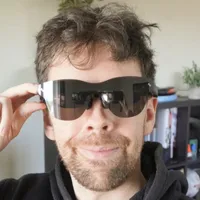
Why it matters: If you just want a massive screen strapped to your face without breaking the bank, this is the cheapest entry point that doesn’t compromise on visual fidelity. You get AI SDR-to-HDR upscaling, 120Hz refresh rate, and crisp Bang & Olufsen audio for under $250.
Specs: HueView 2.0 1080p micro-OLED displays, up to 1200 nits of perceived brightness, 120Hz, 46-degree field of view, HDR10, 5.8 x 1.9 x 6.7 inches, 2.7 ounces
Read moreRead less▼
Why it matters: Viture has the best color science in the category, making AAA games and movies pop brilliantly. But its killer feature is the built-in Myopia dials to adjust focus and the deepest electrochromic dimming I’ve seen — allowing you to electronically black out the lenses and block out the glare from an open airplane window next to you.
Specs: Sony 1200p micro-OLED displays, up to 1,000 nits, 120Hz refresh rate, 52-degree field of view, built-in Myopia dials, 3DoF head tracking, 5.8 x 1.8 x 6.8 inches, 2.8 ounces
Read moreRead less▼
Why it matters: This is the heavy hitter. That X1 chip unlocks all the advanced spatial features on-device, 3DoF, alongside a massive 57-degree field of view for that full premium home theater on your face. On top of that, the chip gives you 2D-to-3D local conversion of content that works really rather well!
Specs: Sony 1080p micro-OLED displays, up to 700 nits, 120Hz refresh rate, 57-degree field of view, X1 spatial chip built-in, 3DoF head tracking, 5.9 x 2.0 x 6.8 inches, 3.1 ounces
Read moreRead less▼
Why it matters: The gaming final boss of AR glasses — the Viture Beast raised the bar for premium immersion with a massive 58-degree field of view and ultra-bright 1,250-nit micro-OLEDs running at 1200p/120Hz. Throw in 9-level electrochromic lens dimming and native 3DoF anchoring, and you’ve got an ultra-wide, stable display that pulls you into your games wherever you are.
Specs: Sony 1200p micro-OLED displays, up to 1,250 nits, 120Hz refresh rate, 58-degree field of view, 3DoF head tracking, 5.8 x 1.8 x 6.8 inches, 3 ounces.
Read moreRead less▼
The smart glasses you *actually* want
It’s easy to get lost in the marketing weeds of “spatial computing” and “mixed reality.” But at their core, AR glasses are the ultimate life hack for the modern commuter — lightweight, completely private monitors that fit in a sunglasses case.
And the beauty of the versatility of options is that you don’t need to care about picture tracking. The option is there, and that’s great, but if you’re brand new to this category, it’s not important. You just need to care about never having to crane your neck over a cramped 13-inch laptop screen on a cross-country flight ever again.

Follow Tom's Guide on Google News and add us as a preferred source to get our up-to-date news, analysis, and reviews in your feeds. Make sure to click the Follow button!
More from Tom's Guide

Get instant access to breaking news, the hottest reviews, great deals and helpful tips.
Jason brings a decade of tech and gaming journalism experience to his role as a Managing Editor of Computing at Tom's Guide. He has previously written for Laptop Mag, Tom's Hardware, Kotaku, Stuff and BBC Science Focus. In his spare time, you'll find Jason looking for good dogs to pet or thinking about eating pizza if he isn't already.
Next Badge:
More Comments/Likes Until Your Next Badge
You must confirm your public display name before commenting
Please logout and then login again, you will then be prompted to enter your display name.