NordVPN and Proton VPN are two of the biggest names on our best VPN list, and for good reason – both impressed in every core test we put them through, from privacy and speed to streaming and app quality. They each earned 4.5 stars in our independent reviews, and either would serve most people well.
The differences between them are real, though. NordVPN is the more well-rounded package: it leads on streaming unblocking, offers a broader range of security extras, and has better customer support. Proton VPN hits back with faster speeds, a stronger privacy foundation, a viable free version, and open-source apps that put it ahead for the genuinely privacy-conscious user.
We tested both thoroughly – running speed tests, throwing streaming sites at them, and stress-testing their apps across multiple devices. Here's what the data actually shows, and which one deserves your money.
NordVPN vs Proton VPN: Specs
| Header Cell - Column 0 | NordVPN |
Proton VPN |
|---|---|---|
Number of servers: |
8,000+ |
20,000+ |
Server countries: |
167 |
149 |
Maximum simultaneous connections: |
10 |
10 |
Money back guarantee: |
30 days |
30 days |
Lowest monthly cost: |
$3.49 |
$2.99 (free plan available) |
NordVPN vs Proton VPN: Plans, pricing and trials
Proton VPN takes a different approach to pricing than most of its rivals – one plan, all features included, starting at $2.99 per month on a two-year subscription.
NordVPN starts lower than you might expect at $3.49 per month, but that's for its Basic tier, which is a more stripped-back package. Move up to NordVPN's Complete or Prime plans and the price climbs considerably.
| Row 0 - Cell 0 | NordVPN |
Proton VPN |
1-month price |
$14.99 |
$9.99 |
1-year monthly price |
$5.49 |
$3.99 |
2-year monthly price |
$3.49 |
$2.99 |
Renewal price |
$11.59 per month |
$6.99 |
Money-back guarantee |
30 days |
30 days |
Free trial |
7 days (iOS/Android) |
Free plan available |
Proton gives you everything from day one – NetShield, Secure Core servers, and other core VPN features. There aren't any extra add-ons, but if you choose the Unlimited plan, you'll get premium access to Proton Mail, Proton Drive, Proton Calendar, and more.
NordVPN gates its best extras behind higher tiers, though Threat Protection Pro and the password manager that come with Plus and above are genuinely worth having if you'll use them.
Both VPNs increase their rates on renewal, but NordVPN does so much more egregiously. Either way, set a reminder before your plan expires rather than letting it auto-renew.
NordVPN offers a 7-day mobile trial; Proton goes further with the fully functional Proton VPN Free if you want to test before committing.
NordVPN vs Proton VPN: Security, privacy and logging
Both NordVPN and Proton VPN have strong privacy credentials, but they come at it from different angles.
NordVPN operates out of Panama, outside EU and US jurisdiction, and backs its no-logs policy with six independent audits – the most recent completed by Deloitte in February 2026. Every server is RAM-only, meaning nothing is stored permanently.
On top of the core VPN, NordVPN offers Double VPN for routing traffic through two servers, and Onion over VPN for the most sensitive use cases.
Its Threat Protection Pro feature – available on Plus plans and above – topped our malware and phishing blocking tests, blocking 90% of phishing sites and 70% of malware sites when we tested it in September 2026.
Proton VPN is headquartered in Switzerland, which sits outside both EU and US jurisdiction and has some of the strongest data privacy laws in the world. Its no-logs policy has been independently audited 5 times, most recently in June 2026.
All apps are fully open-source – something NordVPN can't match – and its Secure Core servers route traffic through hardened data centers in Switzerland, Iceland, or Sweden before connecting to your destination.
NetShield, its built-in threat protection, blocked 32% of phishing sites and just 4% of malware in our testing, well behind NordVPN's Threat Protection Pro.
For most users, both are more than trustworthy enough. If open-source code and Swiss jurisdiction matter to you, Proton has the edge. If you want stronger active threat protection, NordVPN pulls ahead.
NordVPN vs Proton VPN: Speed
| Row 0 - Cell 0 | NordVPN |
Proton VPN |
WireGuard/NordLynx (local) |
1,427 Mbps |
1,475 Mbps |
WireGuard/NordLynx (US-UK) |
939 Mbps |
1,548 Mbps |
OpenVPN (local) |
633 Mbps |
449 Mbps |
OpenVPN (US-UK) |
1,093 Mbps |
413 Mbps |
Proton VPN is the faster of the two on its best protocol. When we tested both using WireGuard – NordLynx in NordVPN's case – Proton edged ahead locally at 1,475 Mbps against NordVPN's 1,427 Mbps, and pulled significantly further ahead over long distance, hitting 1,548 Mbps on our US-UK run compared to NordVPN's 939 Mbps.
For most users that gap won't be felt day-to-day, but if you're regularly connecting to distant servers, Proton has a clear advantage.
On OpenVPN the result flips. NordVPN recorded 633 Mbps locally and a strong 1,093 Mbps over long distance, while Proton managed 449 Mbps and 413 Mbps, respectively.
OpenVPN is a less common choice these days, but worth noting if you need it for router setup or obfuscation.
Either way, both are fast enough for anything you throw at them.
NordVPN vs Proton VPN: Streaming and torrenting
Both NordVPN and Proton VPN feature on our guide to the best VPNs for streaming, and there's less separating them here than you might expect from two VPNs at different price points.
NordVPN unblocked every streaming service we tested across all regions – Netflix, Amazon Prime, Disney+, BBC iPlayer, ITV, Channel 4, 9Now, and 10 Play all passed without issue.
The only hiccups were YouTube US and Amazon Prime in Australia, though both worked fine everywhere else. It remains one of the most consistent streaming VPNs we've tested.
Proton VPN was close behind. It unblocked Netflix across all regions, along with Disney+, BBC iPlayer, ITV, Channel 4, 9Now, and 10 Play. It ran into trouble with Amazon Prime in Australia, Canada, and Japan, and needed a server switch to unblock Disney+ in the UK – minor issues rather than outright failures.
When it comes to torrenting, both support P2P on most servers. NordVPN automatically switches you to a compatible server if it detects torrent traffic.
Proton supports port forwarding on Mac and Windows, which NordVPN doesn't offer – a real advantage if you torrent regularly and want to squeeze out every last bit of speed.

NordVPN vs Proton VPN: Apps
NordVPN and Proton VPN both cover the major platforms – Windows, Mac, Android, iOS, and Linux – and have each undergone significant app redesigns in 2026. The experience on each is good, they just go about it differently.
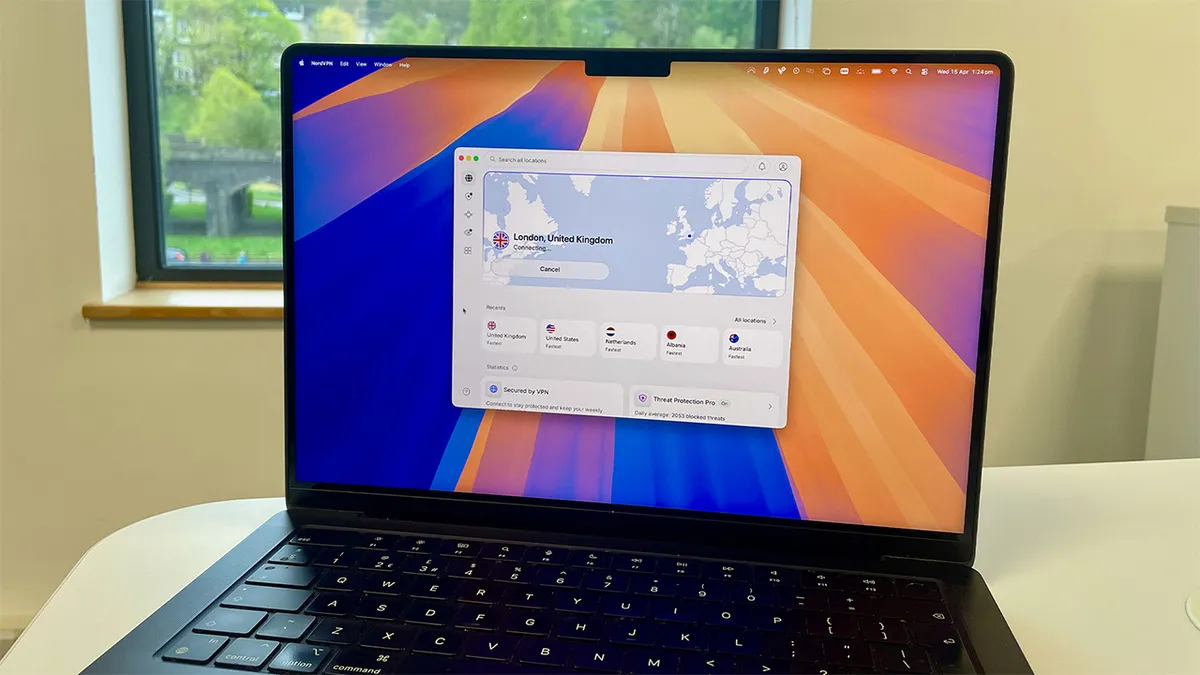
NordVPN's redesigned desktop app cleaned up a previously cluttered interface, moving Threat Protection, Meshnet, and Dark Web Monitor out of buried tabs and into the main screen. The map has been scaled back in favour of a universal search bar, which makes finding servers faster.
On mobile, the map-based interface remains, and it can feel cramped on smaller screens – connecting to a distant server still takes more taps than it should. Split tunneling is available on Windows and Android but missing on iOS and Mac.
Proton VPN's redesign addressed a longstanding gripe – the old mobile apps had a disconnect button where the home button would normally be, leading to accidental dropouts – that's gone now.
The apps are clean and straightforward, with a Profiles feature that lets you save custom server and protocol configurations for quick access.
Split tunneling is available on Windows, Android, Mac, and Linux, giving it broader coverage than NordVPN – though iOS misses out, and the Mac version is still marked as experimental.
On app update frequency, NordVPN pushed 13 iOS updates between March and September 2026; Proton managed five over the same period.
NordVPN vs Proton VPN: Support
NordVPN has the stronger support offering. It runs 24/7 live chat with real agents – every time we tested it, we were connected within a couple of minutes – plus email support and a well-stocked knowledgebase.
The written articles are comprehensive if not always beginner-friendly, and email responses, while slower, came back with targeted advice rather than generic troubleshooting steps.
Proton VPN has live chat too, but it isn't available around the clock, and it's less prominently placed – you have to go looking for it on the website rather than finding it front and centre in the app.
Its knowledgebase is extensive but skews technical, which can make it harder to navigate if you're not already comfortable with VPN terminology. The in-app "report an issue" tab is a useful shortcut for common problems, and you can escalate directly from there if the fixes don't land.
If support responsiveness matters to you, NordVPN is the clearer choice.
NordVPN vs Proton VPN: Which should you choose?
Both NordVPN and Proton VPN are excellent VPNs, and either would serve you well. The decision comes down to what you're actually going to use it for.
Go with NordVPN if streaming is your priority. It unblocked a couple more streaming sites than Proton VPN, and its Threat Protection Pro is the best malware and phishing defence we've tested from any VPN.
The tiered plan structure also means you can start cheap and add extras if you need them. It's the better pick if you want a single service that covers security, privacy, and entertainment without much configuration.
Proton VPN is the stronger choice if privacy is your starting point. Swiss jurisdiction, fully open-source apps, and four independent audits give it a transparency edge that NordVPN can't quite match.
Proton is also the faster VPN on long-distance connections, and its free plan is genuinely usable, which is rare in this space. If you're a more technically minded user who wants full control and maximum privacy assurance, Proton should be your go-to.
Finally, there's very little separating the two in price. Proton works out about $10 cheaper over the course of two years, but offers less in terms of extras. However, NordVPN's renewal pricing is much higher than Proton's, so if you choose NordVPN, make sure you don't get stung by this.
How we test VPNs
Testing VPN is a complex process, and takes up a significant portion of the VPN team's time here at Tom's Guide. We've got a full explainer on how we test VPNs, but here's a quick overview if you're in a rush.
We always get hands-on with the VPNs we review, and never take marketing claims at face value. We test on Windows, Mac, Android, iOS, and Linux, and dig into the settings and code to find any faults that could put you at risk.
We also test connection speeds a minimum of 120 times per provider, and test the streaming performance with dozens of sites including Netflix, Amazon Prime Video, Disney+, BBC iPlayer, Peacock, 10 Play, and many more.
We make sure the support system is useful too, and then we take into account any additional features outside the core VPN product that might be of interest.
We test and review VPN services in the context of legal recreational uses. For example:
1. Accessing a service from another country (subject to the terms and conditions of that service).
2. Protecting your online security and strengthening your online privacy when abroad.
We do not support or condone the illegal or malicious use of VPN services. Consuming pirated content that is paid-for is neither endorsed nor approved by Future Publishing.