Samsung and Apple are the two titans of the smartphone industry, with iPhone 17 Pro Max and the Samsung Galaxy S26 Ultra showcasing the very best mobile technology each company has to offer. If you want to pick up the very best smartphone on sale, odds are you're going to pick up one of these two devices. The question is, which one?
Both the Galaxy S26 Ultra and iPhone 17 Pro Max have everything you might need from a smartphone. Long batteries, durable designs, high-performance hardware, large bright displays, AI features, and are among the best camera phones you can buy.
But the question of which device is better is not quite as simple as picking one of the two. So we put the iPhone 17 Pro Max vs Samsung Galaxy S26 Ultra in a seven-part head-to-head face-off to see if one of them proves to be the stronger option. Here's what we found.
iPhone 17 Pro Max vs Samsung Galaxy S26 Ultra: Specifications
| Row 0 - Cell 0 | Samsung Galaxy S26 Ultra |
iPhone 17 Pro Max |
Display size |
6.9-inch AMOLED |
6.9-inch OLED |
Refresh rate |
1-120Hz |
1-120Hz |
Chipset |
Snapdragon 8 Elite Gen 5 for Galaxy |
A19 Pro |
Memory |
12GB/16GB |
12GB |
Storage |
256GB, 512GB |
256GB, 512GB, 1TB, 2TB |
Rear cameras |
200MP main, 50MP ultrawide, 50MP 5x telephoto, 10MP 3x telephoto |
48MP main, 48MP ultrawide, 48MP 4x telephoto |
Front camera |
12MP selfie |
18MP selfie |
Battery size |
5,000 mAh |
4,823 mAh (SIM) / 5,088 mAh (eSIM) |
Charging speed |
60W wired, 25W wireless |
40W wired, 25W wireless |
Size |
6.44 x 3.07 x 0.31 in (163.6 x 78.1 x 7.9 mm) |
6.43 x 3.07 x 0.35 in (163.4 x 78 x 8.8 mm) |
Weight |
7.55 oz (214g) |
8.22oz (233g) |
Colors |
Cobalt Violet, Sky Blue, Black, White, (Silver Shadow, Pink Gold online only) |
Silver, Cosmic Orange, Deep Blue |
iPhone 17 Pro Max vs Samsung Galaxy S26 Ultra: Price

The iPhone 17 Pro Max was released last September, with a starting price of $1,199. That got you a model with 256GB of storage, though higher storage options are available. 512GB costs $1,399, 1TB costs $1,599, and 2TB will set you back $1,999.
The Samsung Galaxy S26 Ultra went on sale in this March, with a starting price of $1,299 for a 256GB model. 512GB models are available for $1,499, and 1TB will cost you $1,699. There is no 2TB option available, and in the case of all phones, you're paying an extra $100 compared to the iPhone 17 Pro Max equivalent.
Winner: iPhone 17 Pro Max
iPhone 17 Pro Max vs Samsung Galaxy S26 Ultra: Design

The last couple of years has seen Samsung do away with the recognizable, right-angled phone design in favor of something more rounded and distinctly more iPhone-like than previous devices. Though Apple has seemingly countered with a somewhat unique design, that has proved a little controversial.
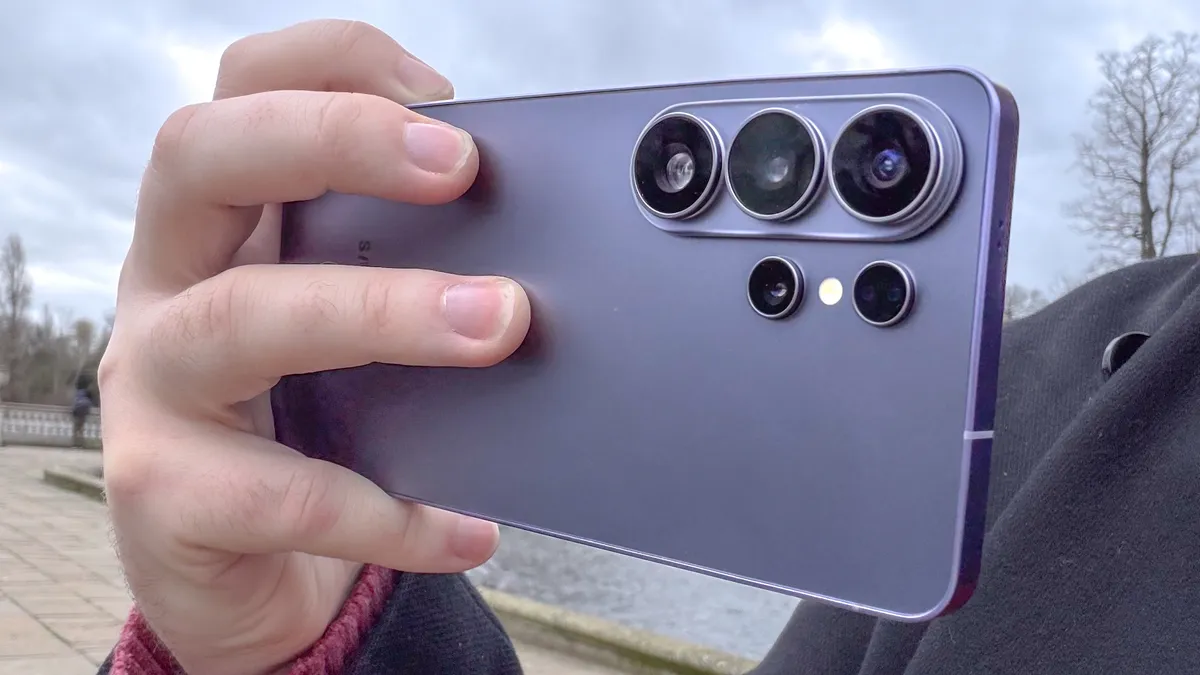
The Galaxy S26 Ultra features a defined camera bump, similar to that of the Z Fold 7, alongside two protruding camera sensors — the secondary telephoto lens and a depth sensor. There's also a built-in S Pen stylus accessible from the base, next to the charging port.
The iPhone 17 Pro Max features the classic three-lens iPhone camera inside a "forged plateau." This is essentially a very large camera bar that stretches the width of the phone, with Apple also promising that the raised edge helps to dissipate heat from inside the phone.
Both phones swapped the titanium frame for strengthened aluminum, and the iPhone 17 Pro Max goes a lot harder on the metal than the Galaxy S26 Ultra. Samsung opted for a full glass back panel, made from Gorilla Glass Victus 2, while the iPhone only employs Ceramic Shield glass on the bottom half of the phone — right in front of the wireless charging coils.
The two phones have similar dimensions, though the iPhone 17 Pro Max is a couple tenths of an inch thicker and one tenth shorter. Apple's device is also is around three quarters of an ounce heavier. Though in both cases it's not something you're likely to notice compared to the Galaxy S26 Ultra.
Winner: Draw
iPhone 17 Pro Max vs Samsung Galaxy S26 Ultra: Display

In line with the near-identical dimensions, both the Galaxy S26 Ultra and iPhone 17 Pro Max feature 6.9-inch OLED displays. Both offer the same 1-120Hz LTPO adaptive refresh rate, though the resolution differs slightly. Samsung opted for a WQHD+ resolution (1440 x 3120) with a 500ppi pixel density. Apple opted for a slightly lower resolution of 1320 x 2868, leading to a slightly lower pixel density of 460ppi.
| Row 0 - Cell 0 | Peak brightness (nits) |
DCI-P3 (%) |
Delta-E color accuracy (lower is better) |
sRGB (%) |
iPhone 17 Pro Max |
1,899 |
77.6 |
0.26 |
109.6 |
Samsung Galaxy S26 Ultra |
1,806 |
106.9 (vivid) |
0.29 (Vivid) |
151 (Vivid) |
There's more to these displays than basic specs on a sheet. We did our own testing to see just how capable each display was, and the results were interesting, to say the least.
The iPhone 17 Pro Max proved to be a little bit brighter, with a peak brightness of 1,899 nits compared to Samsung's 1,806. In both cases, that's significantly lower than the respective 3,000 and 2,600 nits that Apple and Samsung promised us.
But brightness apparently doesn't cover everything. The iPhone 17 Pro Max doesn't cover nearly as much of the color gamut, with a DCI-P3 score of 77.7% and sRGB score of 109.6. In comparison, the Galaxy S26 Ultra's Vivid display mode (which is on by default) hit a 106.9% DCI-P3 rating and a 151% sRGB score.
That said, the iPhone 17 Pro Max had a slightly lower Delta-e score of 0.26 to Samsung's 0.29. In this case, the lower number is the better one, and means the accuracy of Apple's color reproduction is slightly better than what Samsung offers. Though, it's not enough to snatch a win.
If there's one thing that earns the Galaxy S26 Ultra this win here, it's mostly due to its Privacy Display. When activated, it prevents people from seeing what's on the screen unless they're directly looking straight at it. This is unlike anything out there, making it a valuable tool when you don't want people snooping when you're out in public.
Winner: Samsung Galaxy S26 Ultra
iPhone 17 Pro Max vs Samsung Galaxy S26 Ultra: Performance
Apple's A-series chips have long been the reigning champion when it comes to mobile performance. To the point where Apple was able to stick an older model into a laptop, and have it run just fine. But Snapdragon chips have been catching up fast, especially with the custom variants Samsung employs in its own flagships.
So how does the Snapdragon 8 Elite Gen 5 for Galaxy compare against the Apple A19 Pro?
| Row 0 - Cell 0 | iPhone 17 Pro Max |
Samsung Galaxy S26 Ultra |
Geekbench single core |
3,871 |
3,785 |
Geekbench multi core |
9,968 |
11,563 |
3DMark Wild Life Extreme Unlimited (score/fps) |
5,855 / 35.03 |
6,645 / 39.8 |
Quite well, as you can see in the table above. The A19 Pro still beats the Snapdragon in single-core benchmark tests. But with a score of 3,871 to 3,785, there are fewer than 100 points between the two phones — meaning the difference is fairly negligible.
The same can't be said for multi-core testing, with Samsung leaving Apple behind in its dust. Combining the efforts of the Snapdragon cores led to a score of 11,563, while A19 Pro was only able to reach 9,968. It's not to say that this is a bad score, it's just that it isn't as good as what Samsung could produce during the benchmark tests.
Samsung also triumphed in graphics processing, though this is less surprising. Snapdragon chips have been outperforming A-series chips in these tests for a few years now, and it seems Apple hasn't been able to fully catch up just yet.
The Galaxy S26 Ultra scored 6,645 in the 3DMark Wild Life Extreme Unlimited test, alongside an average frame rate of 39.8 fps. Meanwhile, the iPhone 17 Pro Max lagged at 5,855 and 35.03 fps.
Apple may have the slight edge when it comes to single-core benchmarking, but the Galaxy S26 Ultra beat out the iPhone 17 Pro Max in all other benchmarking testing — making it the clear winner.
Winner: Galaxy S26 Ultra
iPhone 17 Pro Max vs Samsung Galaxy S26 Ultra: Cameras

The iPhone 17 Pro Max and Samsung Galaxy S26 Ultra are two of the best camera phones you can buy right now, but how do they actually compare to one another? On paper, it looks like the Galaxy S26 Ultra has the edge, thanks to its 200MP main camera and 5x optical zoom, among other hardware flourishes.
But there's only so much you can glean from specs, and the only way to know for sure is to go out and take some photos — which is exactly what we did.
Looking at outdoor shots during the day, it's a pretty tough call to make. Both phones take good quality photos, but it feels like the Galaxy S26 Ultra has the edge. The photo is darker than the one shot on the iPhone 17 Pro Max, but the extra contrast creates a much more appealing shot of this Chevrolet Corvette E-Ray.
It looks like a similar story with the ultrawide lens at first glance. But while the iPhone 17 Pro Max doesn't quite have the same contrast as the Galaxy S26 Ultra, it does manage to capture more detail in the process. Just look at the brickwork in the far building and you'll see what I mean.
With the selfie camera the Galaxy S26 Ultra ends up looking a little washed out when compared to the iPhone 17 Pro Max. The Galaxy also produced a lot more noise in the shot, and affected the overall quality in the process — making this an easy win for the iPhone.
On the flipside, 40x zoomed in shots are an easy win for the Samsung Galaxy S26 Ultra. The quality is far from perfect on both phones, but when you're talking about zoom levels in excess of 10x magnification, a loss of quality is guaranteed.
The Galaxy's extra optical zoom helps the camera pick out more details and offering up sharper image in the process. The iPhone doesn't do too badly, but there's a noticeably dip in quality when you look at them side by side.
The iPhone manages to pick it back up in the low-light photography test, offering up an all-around better photo than the Samsung Galaxy S26 Ultra. The iPhone 17 Pro Max's photo is bright, clear, and doesn't suffer from the same level of glare off the street lights as the Galaxy.
Both phones have their respective flaws and strengths in the camera department, but in the grand scheme of things they are fairly evenly matched. That said it feels as though the Samsung really needs to up its low-light game, because there's only so far that 200MP main camera sensor can carry you.
However, it's hard to overlook at all the other features that the Galaxy S26 Ultra brings to the table. Not only does it have more shooting modes that appeal to creators, including a pro mode with manual controls, you also have access to way more post-shooting tools on the Galaxy S26 Ultra.
Winner: Galaxy S26 Ultra
iPhone 17 Pro Max vs Samsung Galaxy S26 Ultra: Battery life and charging

It takes a lot to outlast a Pro Max iPhone in the battery department. The ones that do, typically manage it with extra-large battery packs, like the OnePlus 15's gargantuan 7,300 mAh battery pack.
The Galaxy S26 Ultra and iPhone 17 Pro Max are on a fairly even footing this time. The S26 Ultra has a 5,000 mAh battery, while the iPhone 17 Pro Max reportedly has either a 4,823 mAh or 5,088 mAh battery, depending on whether it has a SIM card tray or not. So how do they compare?
| Row 0 - Cell 0 | Average Battery Life (Hrs:Mins) |
Charging % in 15 minutes |
Charging % in 30 minutes |
iPhone 17 Pro Max (eSIM) |
17:54 |
35% |
64% |
Galaxy S26 Ultra |
16:40 (Adaptive) |
41% |
77% |
Just note that we did our testing on the eSIM-only model, which has the larger battery. Having a physical SIM card means a smaller battery, and (we assume) lower battery life.
But as you can see, the iPhone 17 Pro Max outpaces the Galaxy S26 Ultra by over an hour — lasting 17 hours and 54 minutes compared to the S26 Ultra's 16 hours and 40 minutes.
Unsurprisingly, the Samsung Galaxy S26 Ultra beat the iPhone 17 Pro Max in the charging speed tests. With 60W charging at its disposal, the phone was able to regain 41% of its battery life in 15 minutes and 77% by the half-hour mark — whereas the iPhone 17 Pro Max's 40W charging returned 35% and 64% in the same time frame.
Of course, when your battery lasts longer than your rival's, the reduced charging speed doesn't matter quite so much.
Both phones support the same 25W Qi2.2 wireless charging speed, but only the iPhone 17 Pro Max has built-in magnets and can utilize both MagSafe and Qi2 products without a special case.
Winner: iPhone 17 Pro Max
iPhone 17 Pro Max vs Samsung Galaxy S26 Ultra: Software and AI

Software is easily the biggest point of change between iPhone and Samsung phones. iPhone 17 Pro Max runs on iOS 26, while the Galaxy S26 Ultra has One UI 8.5 — based on Android 16. Personal preference plays a big part in this, as does the kind of mobile software you're already used to. But we can talk about the features involved, especially where AI is concerned.
AI is one of the things Samsung has been pushing hard on, in collaboration with Google, with a regular slew of new features and upgrades. Apple, on the other hand, has dropped the ball by comparison. It made a bunch of promises about Apple Intelligence back in summer 2024, but still hasn't managed to fulfil them all. You can blame the stalled progress on Siri for that.
That's not to say Apple doesn't offer a solid range of AI features. There's Visual intelligence, writing assistance tools, notification summaries, ChatGPT support, image generation, call screening, and so on. Plus non-AI features like the Dynamic Island's Live Activities.
The elephant in the room is that the Samsung Galaxy S26 Ultra does all of that and more. In fact, one of the biggest new features to come to the phone is agentic AI, which lets you send your chosen AI off to do certain tasks for you. If you want to order from Dunkin' Donuts using Gemini AI, that's a very real option for you. Plus, you're not limited to Google's AI, thanks to support from Samsung Bixby and Perplexity.
There's also Now Brief and Now Nudge, which analyze your habits and phone use to make your phone a more useful part of your day. Not to mention the upgraded Circle to Search, which can analyze multiple objects on screen for you — in a way that's faster and simpler than Gemini Live or Visual Intelligence.
The truth is, the iPhone is really far behind when it comes to AI and software. Apple may have total control over its ecosystem and can roll out updates more easily, but that doesn't really help when it can't offer anything particularly special or unique.
Winner: Galaxy S26
iPhone 17 Pro Max vs Samsung Galaxy S26 Ultra: Verdict

There's no clear winner when it comes to the face-off between the iPhone 17 Pro Max and Samsung Galaxy S26 Ultra — sacrilegious as some people might find that assessment. Both phones have a lot to offer, even if they fall behind in some categories. Whether that's Samsung offering slightly lower battery life, or Apple not quite reaching the performance heights it once offered.
That said, you can't argue that there are some serious blunders on both sides as well. Apple's AI division is light years behind what Samsung (and google) have come up with, and that gap is only getting larger as time goes on. At the same time, I still find myself baffled that Galaxy Ultra phones have been more expensive than Pro Max iPhones for the past few years.
There's no wrong option here, and it will inevitably come down to personal preferences over the look and feel of the phone. That's in terms of both hardware and software. Because what good is it to have a phone you hate using, or hate the look of?

Follow Tom's Guide on Google News and add us as a preferred source to get our up-to-date news, analysis, and reviews in your feeds.
More from Tom's Guide