3 reasons why you shouldn't buy an RGB LED TV in 2026

RGB LED technology — also known as Micro RGB, RGB Mini-LED and True RGB — is taking the TV industry by storm. This year, Hisense, LG, Samsung, Sony and TCL are all launching their own variation of this display technology.
It’s the next step in the evolutionary line of Mini-LED TVs, and if you take TV brands at their word, it's the next big thing worth spending money on.
But while some of the best TVs of the year might end up being RGB LED-based models, I'm not ready to recommend this tech to just anyone. There are three reasons why I'm holding off on a full-throated endorsement — and only one type of shopper who I think should dive right in at the start of this era.
1. First-generation hardware isn't as ironed-out

In a nutshell, RGB LED technology works in a similar fashion as traditional Mini-LED backlighting. But while garden-variety Mini-LED TVs leverage white- or blue-colored LEDs in conjunction with color filters, RGB LED TVs make use of teeny-tiny red-, green- and blue-colored LEDs. They're clustered into dimmable zones (just like regular Mini-LED backlights), but their added color typically results in better, brighter color volume.
We've seen this advantage borne out in what minimal testing we've already done on RGB LED TVs. They're bright, punchy sets that deliver some of the best color volume we've measured to date, surpassing even some quantum dot-equipped OLED TVs.
I'm willing to bet that, by this time next year, we will be testing and reviewing RGB LED TVs that surpass their first-generation precursors.
But like every first-generation version of high-end display tech, there's plenty of room for improvement. In fact, I'm willing to bet that, by this time next year, we will be testing and reviewing RGB LED TVs that surpass their first-generation precursors in picture quality.
To date, all of the RGB LED TVs I've gotten up close and personal with have exhibited some quirks. When I tested the Samsung R95H just a few months ago, I noticed a steady, recurring flicker during HDR-mastered content. As far as I could tell, this was not the fault of the source material.
Around the same time, when I spent a few minutes eyeing up the LG MRGB95 at LG headquarters, I noticed another type of flickering. Unlike the R95H's flicker, which affected the entire picture, LG's Micro RGB evo TV exhibited an isolated flickering that only seemed to affect a shade of orange-yellow. It persisted even after I paused the Blu-ray demo.
To be perfectly clear, the RGB LED TVs in question were pre-release models. We've yet to test the commercially available versions of these TVs, so for all I know, these issues have been addressed.
But it's been made clear to me by every brand working with this tech that internal processing plays a major role in its performance. And, if I were in the market for a flashy new TV in 2026, I wouldn't be ready to roll the dice on first-generation hardware and software.
2. We haven't seen all of the models yet

While Hisense and Samsung arrived to market first, we're still waiting to get our hands on RGB LED TVs from LG and TCL. At the time of publishing, the only RGB LED TV we've reviewed is the Hisense UR9.
And then there's Sony. The lauded TV-maker has shown off its flagship RGB LED TV at private events behind closed doors, but there's very little we know about this set.
This is notable not just because it's important to get a sense of how these TVs compare to one another, but because Sony takes picture processing very seriously. When it comes to first-generation technology, Sony is the brand I trust the most.
There's also a slate of incoming RGB LED TVs that sit just below the flagship level, like the Hisense UR8 and the Samsung R85H. We know very little about these particular TVs, and they might represent a much better value proposition than the first-generation, flagship-level models that sit above them.
3. Pricing matters
Just as first-generation versions of all-new TV types tend to have some kinks that need ironing-out, they're also typically priced higher than they'll ever be. Here's something you can take to the bank: On average, next-year's version of RGB LED TVs will be more affordable than this year's models.
In fact, we're already seeing this play out as we speak. Take the Hisense UR9, for instance. Just a few weeks ago, this set started at a whopping $3,499 for a 65-inch version. As of a few days ago, the 65-inch UR9 had cratered in price.
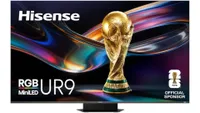
It's not unusual for TVs to steadily drop in price throughout the calendar year — in fact, it's pretty much a guarantee. But a full 43% discount on a first-generation, flagship-level TV within the first few weeks of its release is significant.
I don't necessarily believe that all RGB LED TVs will see this steep of a discount ahead of the summer months, but they will surely drop in price the closer we get to the holidays.
Buy an RGB LED TV if...

For some folks, the idea of splashing out on a fancy, high-performance TV is too good to pass up — especially if they've been waiting for the perfect opportunity to upgrade.
These are some of the most-colorful TVs I've ever laid eyes on.
If you're in the market for a premium TV that specializes in brightness and color volume, RGB LED TVs are going to blow you away. They're souped-up versions of the industry's best Mini-LED TVs. Critically (and despite some caveats), the technology seems to work as advertised. These are some of the most-colorful TVs I've ever laid eyes on.
Just bear in mind that there's plenty of room for them to grow. There's also plenty of room for their price to come down, too.
It can be hard waiting a full year to bring the latest and greatest TVs into your home theater but, 12 months from now, you'll thank yourself for having a little extra patience while the technology matures.

Follow Tom's Guide on Google News and add us as a preferred source to get our up-to-date news, analysis, and reviews in your feeds. Subscribe to Tom's Guide on YouTube and follow us on TikTok.
More from Tom's Guide