







The Samsung lineup is, at best, confusing. They all look nearly identical and have similar names just to hammer home a tricky job in choosing the best Samsung phone for you. They are different, though — and that's where we come in. We've tested all the phones Samsung offers, and now we've put our expertise on the page below so that you can find your next Samsung phone.
We've created a quick quiz to give you the best idea of what phone you should be considering, based on your usecase. Answer the questions below and you'll be given the phone that's best for you, along with a link to more information about the phone you've been given.
So let's go — which is the best Samsung phone for you?
Want to learn more about the current Samsung lineup? Here's how we rank them after testing each model thoroughly.
Best Samsung phone overall

While the S25 Ultra was the previous peak of Samsung's power, the Galaxy S26 Ultra arrives as a more than worthy successor.
The S26 Ultra introduces a world-first "Privacy Display" that gives it a unique security advantage over every other model in Samsung's current catalog, and the rest of the phone market besides. However, the Ultra's Privacy Display does come with a negative: it is slightly dimmer (1,806 nits) and has narrower viewing angles than the vibrant, traditional panels found on the S25 Edge or the Z Fold 7.
The S26 Ultra pushes the boundaries of software with its new AI powers. Samsung has added predictive tools like "Now Brief" and automated app actions that can handle complex background tasks, making it a much more capable productivity tool.
In the photography department, the S26 Ultra remains far more advanced than any other Galaxy phone, with its 200MP main camera and 50MP telephoto lens, which have both been upgraded with wider apertures for superior low-light performance. Samsung has also introduced Horizon Lock for video, providing a level of professional-grade stabilization that the cameras on older and cheaper models cannot match.
While the Galaxy S25 Edge and Galaxy Z Fold 7 are Samsung's thinnest phones, the Galaxy S26 Ultra still managed to be thinner and lighter than its predecessor without sacrificing its 6.9-inch screen size.
Regarding battery performance, the S26 Ultra’s 16 hours and 10 minutes of life easily outclasses Samsung’s foldables like the Z Flip 7 (12:24) and Z Fold 7 (10:55). It also powers up faster thanks to newly added 60W wired charging support.
Ultimately, the S26 Ultra remains a steep $1,299 investment, especially compared to the $899 Galaxy S26. But the Ultra's combination of top-tier zoom, innovative security features, and AI-driven efficiency makes it the definitive choice for power users who find other phones simply too limited.
- Read our full Samsung Galaxy S26 Ultra review
Best small Samsung phone

While it's still over 6 inches in size (what would have been called a "phablet" not too long ago), and technically a foldable would be smaller in your pocket, the Galaxy S26 is as compact as you can get with a modern Samsung phone. And fortunately, as a flagship Galaxy S model, it's got everything you could want it to have despite its size.
The new 6.3-inch AMOLED display is significantly brighter than Samsung's older models, reaching up to 1,950 nits, which makes it far more legible in direct sunlight than its predecessors or main competitors like the iPhone 17. This makes it an ideal choice for users who prioritize media consumption and outdoor visibility in a device that still fits comfortably in one hand.
The S26 maintains an easy-to-carry form factor while still housing the same powerful Snapdragon 8 Elite Gen 5 chipset found in the more expensive Ultra model (at least in the U.S.). This ensures that average users get top-tier speed and gaming capabilities without the physical or financial burden of the largest devices.
The introduction of new and upgraded AI features is a major selling point too. These features allow the phone to become more aware of user habits and offer sophisticated photo editing capabilities—such as generating new elements or removing reflections—that were previously limited to more niche devices. For the everyday user, these AI tools simplify complex tasks like photo editing and device management, making the smartphone experience more intuitive and efficient.
Finally, while the S26 saw a price increase to $899, it remains the most practical choice due to its high-end software experience and innovative camera features like "Horizon Lock." This video stabilization tool keeps footage perfectly level even during significant rotation, a feature the reviewer noted as being far more useful for the average person than high-resolution 8K recording. By combining professional-grade internals with user-friendly software and a manageable size, the Galaxy S26 secures its spot as the most well-rounded option in Samsung’s 2026 line-up.
- Read our full Samsung Galaxy S26 review
Best folding Samsung phone
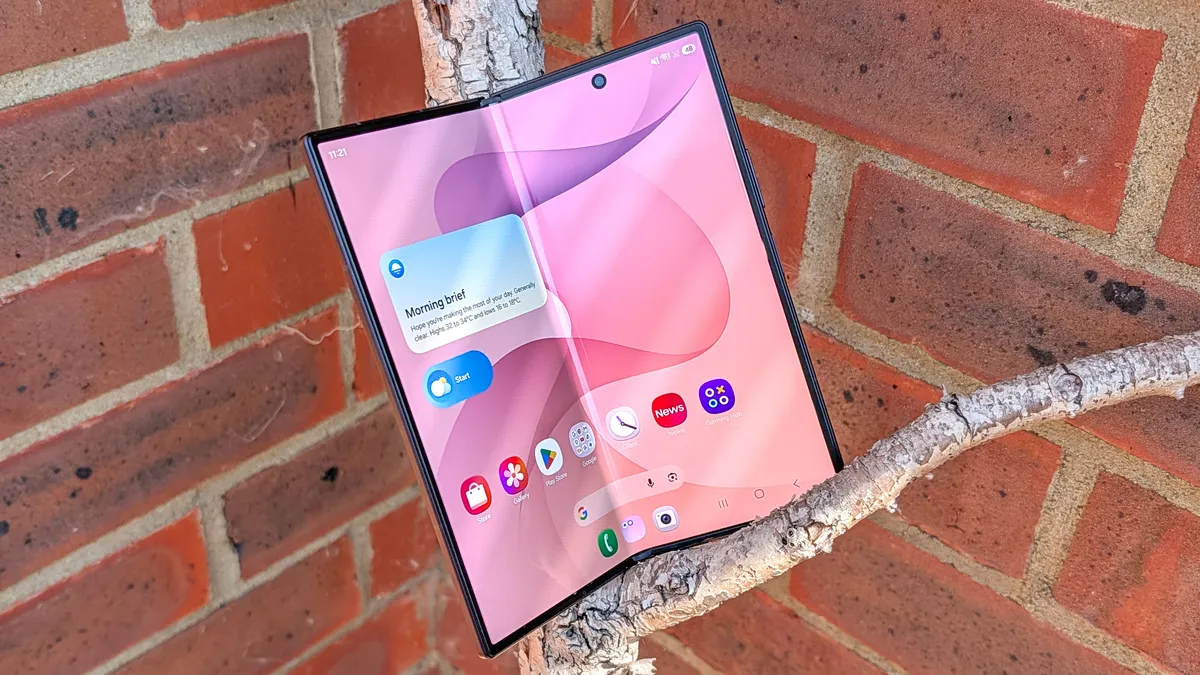
The Galaxy Z Fold 8 Ultra is, currently, the most expensive phone you can buy from Samsung. Apart from the ill-fated Trifold. What do you get for $2,099 purchase? The best folding phone that you can buy right now, as you might expect. Samsung has stepped up its game with this model, after other manufacturers started to catch up and land higher places in best lists.
The screen on the inside is the most noticeable improvement. For one, it’s incredibly bright and clear. This is one of the brightest AMOLED screens that Samsung has packed into a foldable yet, and it looks phenomenal. Movies are immersive, and games look epic. The crease is almost gone now too — you can still feel it with your finger, but it’s all but entirely invisible this time around.
Going back to games quickly, the Z Fold 8 Ultra is a powerhouse. We threw some very graphically intensive games at the Fold 8 Ultra, and they all ran incredibly smoothly. Gamers will love it. Productivity heads will get a kick out of it too, as they pan around and multitask without any kind of slowdown at all. This is a very powerful handset.
We only wish that the cameras were better, especially considering how much the phone costs. The main camera is fine, and the selfie camera takes a decent image, but the telephoto camera is straight up bad. It might as well not be there at all — everything looks blurry and awful. If you want the best camera around, you’re better off with the non-folding Galaxy S26 Ultra.
Battery life is good, with 14 and a half hours of staying power. That’s excellent, although not quite as good as the Motorola Razr Fold.
And we need to talk about that price. On a phone contract, it might not be something you think about initially, but it will add up month by month. $2,099 is a lot of money for a phone, whether its excellent or not.
- Read our full Samsung Galaxy Z Fold 8 Ultra
Best pocketable folding Samsung phone

“Big screen” and “easily pocketable” aren’t usually things that you’d assume could be a part of the same conversation. And yet, thanks to a very clever folding screen and square shape, the Samsung Galaxy Z Fold 8 is just that. A pocketable phone with a massive screen inside. It’s about the same size and shape as a passport when it's folded, and then around the size of a passport.
There’s not much missing here, beyond perhaps a telephoto lens. But given how not good the telephoto lens on the more expensive Fold 8 Ultra is, it's perhaps no great loss. We’d also like it if more apps were suited to the larger screen inside, but that’s not really the fault of the phone itself. Just app developers. Still, worth thinking about if you’re going to buy one.
Everything else is great. The large display inside is super bright and clear, and the crease in the middle has been handled with some very cool new screen tech to make it almost invisible. The outer screen is similarly bright and clear, and easy to use with one hand thanks to that squarer shape. The whole thing is mind-blowingly thin when unfolded, as well. We really shouldn’t be wowed by stuff like this anymore, but it's hard not to be impressed by a knife-like phone in the hand.
It all runs extremely smoothly as well, the Elite chip inside handling multitasking and heavy games with ease. Gamers will love that extra screen real estate too. Productivity fold will find a lot to like too, as they hop quickly from app to app on the same screen. Very cool.
Cameras are fine, although by no means class-leading. If you’re looking for a camera to take loads of snaps, you’ll want one of the non-folding models. If you just want to take the occasional picture, you’ll be fine, mind you. Battery life is good too, with an extra few minutes of battery over the Fold 7. It’s likely that most users will be charging by the time they go to bed every evening.
The Fold 8 is a great phone, and this wider form factor is a master stroke that sets it apart from the larger and more expensive Fold 8 Ultra. It’s still expensive, but it hasn’t broken the $2000 mark yet. That honor is for the flagship.
- Read our full Samsung Galaxy Z fold 8 review
Best flip Samsung phone

The Samsung Galaxy Z Flip 8 is a very similar phone to the 7th generation that came before it. In essence, not a necessary upgrade if you’ve got the old one. But. If you’re looking for a good flip phone to buy right now, and you’re upgrading a 3-year-old phone that’s coming up to the end of its device plan, then there’s little better right now than the Z Flip 8.
The screens this time around are brighter than ever, making sure that you can see them no matter the outside lighting conditions. Bright sun? No problem for either display in the Flip 8. There’s also some fancy new tech in the folding display that makes the crease inside far less noticeable. Like, it’s there, but it’s far less noticeable than before.
Battery life is fine, although nothing to write home about. During our lab testing, we found that the phone lasted for 12 hours and 50 minutes — that’s pretty good for a folding phone, but not that much more than the previous model. Expect to be plugging in every night, regardless.
Its smooth and slick to use thanks to a very powerful chip inside. We threw a range of different games at the phone during testing, and that larger interior display looked great the whole time. The phone had little problem running everything at high frame rates. Just don’t expect to use the outer screen. You can even use the Flip 8 as a computer with DEX, if you want. You should probably stick to your laptop.
This is an expensive phone, mind you. It comes in at around $1099, which is more than other phones that have a similarly sized screen when it's open. For those with small pockets who want a larger screen sometimes, though, you’ll love the Flip 8.
- Read our full Samsung Galaxy Z Flip 8 review
Best value Samsung phone

The Samsung Galaxy A57 stands out as Samsung’s best value phone this year, delivering an expansive 6.7-inch display at a midrange price that’s especially compelling for buyers who want big-screen utility without overspending. The screen size brings benefits for streaming and multitasking, and the price means you don’t have to compromise on core features.
Battery life is a clear highlight, with the A57 using a battery as large as the S26 Ultra. Long-term value is another strength. Samsung guarantees six years of security updates and four years of major Android upgrades, so buyers can expect their investment to stay secure and current well past the average upgrade cycle. It's not as good as the seven-year offer you get with a flagship Samsung, but still plenty of time.
Compared to Samsung’s upmarket S26 Ultra and S26, the A57 lacks some luxuries. It doesn’t come with the S26 Ultra’s brighter display, ultra-fast performance, or advanced AI camera features. For hundreds less, you still get a roomy screen and reliable everyday camera performance — essentials most users genuinely need.
The Galaxy A57 is our pick for buyers who want a long-lasting phone with a big screen and great battery life but don’t need the latest in AI tricks or flagship camera prowess. If you want a future-proof everyday workhorse at a sensible price, this is the Samsung to get. Those chasing cutting-edge AI or the brightest, fastest display may want to look at the S26 Ultra or the S25 FE instead.
- Read our full Samsung Galaxy A57 review
Galaxy AI for less

If Samsung’s Galaxy AI is your main point of interest as you upgrade, start by looking at the Galaxy S25 FE. It’s got all the same features as the regular Galaxy S25 models and the Galaxy Z Fold 7 and Z Flip 7, but its $649 entry price means it’s the cheapest of the lot.
But with a lack of hardware upgrades, and stiff competition from Apple and Google, the Galaxy S25 FE isn’t quite as much of a bargain as its predecessors were. We still love its software, which is guaranteed seven years of updates, its speedy charging and its decent camera performance. It’s just the battery life and lack of hardware improvements over the previous S24 FE, especially in terms of the chipset, that makes it harder to recommend.
If you like your phones on the larger side, but don’t want to pay through the nose for it, and want to try out Galaxy AI features like cross-app actions or Now Brief, then perhaps the Galaxy S25 FE is worth your while. We’d still recommend spending a little extra to get a better-rounded device overall though, from Samsung or someone else.
- Read our full Samsung Galaxy S25 FE review
Also tested
If these options don't suit your needs, then fortunately we have other recommendations that aren't necessarily the top choice for a given niche, but could still be excellent for particular users.
You can still probably find the Galaxy S24 models around, and given their lengthy software support (seven years like the S25 models), Galaxy AI features and similarities to the S25 hardware, these would still be very good phones. Some of the new Galaxy AI features introduced with the Galaxy S25 could find their way to older models, but there's no official word yet from Samsung.
If you do look for an S24, make sure you're getting it for less than what the current Galaxy S25 models cost. As a reminder, the Galaxy S25 starts at $799, the S25 Plus goes for $999, and you'll pay at least $1,299 for a Galaxy S25 Ultra. Look for discounts of at least $100 if you opt for the S24 versions.
If you're on a really tight budget — when even the Galaxy A36 and A56 seem pricey — Samsung offers the Galaxy A16, a $199 phone with a 6.7-inch display, Exynos 1330 chipset and three rear cameras. (A macro lens joins the main and ultrawide shooters.)
How to choose the best Samsung phones

Picking which Samsung phone to buy is primarily driven by budget considerations. You won't want to look at the latest Galaxy S Ultra or Z Fold if you're not prepared to pay for it. But other factors need to be taken into consideration as well.
Focusing on battery life will mean ruling out Samsung's foldables. Most other phones on this list have strong longevity on a single charge but unfortunately you'll probably have to pay more to get the best available battery life.
For photography, the best will normally be the latest Galaxy S Ultra model. That goes for productivity too due to Samsung bundling the S Pen in with its Ultra models, unless you'd prefer the extra screen space and multitasking options that a Galaxy Z Fold can provide. And if you're a gamer, any Galaxy S phone will offer the best possible performance - it's just up to you to device how much you want to pay for other features on top of that.
How we test the best Samsung phones

For a smartphone to make our best phone list, it needs to excel on several tests that we run on every handset. We perform some of these tests in our labs and some in the real world. See our detailed explanation on how Tom's Guide tests and reviews smartphones for more information.
When it comes to performance, we rely on such synthetic benchmarks as Geekbench 6 and 3DMark to measure graphics performance. These tests allow us to compare performance across iPhones and Android devices.
We also run a real-world video transcoding test on each phone using the Adobe Premiere Rush app and time the result. (We unfortunately have to skip this test on some phones due to app compatibility issues, but we attempt this benchmark with each device we get in to review.)
| Row 0 - Cell 0 | Geekbench 6 (single-core / multicore) |
Galaxy S26 Ultra |
3,785 / 11,563 |
Galaxy S26 |
3,531 / 10,778 |
Galaxy Z Flip 8 |
3,627 / 11,215 |
Galaxy Z Fold 8 |
3,659/11,020 |
Galaxy Z Fold 8 Ultra |
3,733/11,457 |
Galaxy A57 |
1,375 / 4,417 |
Galaxy S25 FE |
2,142 / 7,066 |
To measure the quality of a phone's display, we perform lab tests to determine the brightness of the panel (in nits), as well as how colorful each screen is (DCI-P3 color gamut). In these cases, higher numbers are better. We also measure color accuracy of each panel with a Delta-E rating, where lower numbers are better and score of 0 is perfect. (We're waiting for the U.S. release of the Galaxy A56 to test that phone's display in our lab, which is why it's not listed below.)
| Row 0 - Cell 0 | Peak brightness (nits) |
DCI-P3 (%) |
Delta-E |
Galaxy S26 Ultra |
1,806 |
106 (Vivid) / 90 (Natural) |
0.29 (Vivid) / 0.22 (Natural) |
Galaxy S26 |
1,950 |
104 (Vivid) / 91 (Natural) |
0.24 (Vivid) /0.23 (Natural) |
Galaxy Z Flip 8 |
2,150 nits |
83.4 / 97 (Natural / Vivid) |
0.24 / 0.29 (Natural / Vivid) |
Galaxy Z Fold 8 |
2,060 outer, 2,245 inner |
105.2 (Vivid) / 96 (Natural) |
0.28 (Vivid) / 0.22 (Natural) |
Galaxy A57 |
Not tested |
Not tested |
Not tested |
Galaxy Z Fold Ultra |
1,997 |
107.2 (Vivid) / 93.2 (Natural) |
0.30 (Vivid) / 0.25 (Natural) |
Galaxy S25 FE |
1,133 |
84.8% (Natural) / 91.5% (Vivid) |
0.21 (Natural) / 0.21 (Vivid) |
One of the most important tests we run is the Tom's Guide battery test. We run a web surfing test over 5G (or 4G if the phone doesn't have 5G support) at 150 nits of screen brightness until the battery gives out. In general, a phone that lasts 10 hours or more is good, and anything above 11 hours makes our list of the best phone battery life.
| Row 0 - Cell 0 | Battery life (Hrs:Mins) |
Galaxy S26 Ultra |
16:10 |
Galaxy S26 |
11:28 |
Galaxy Z Flip 8 |
12:50 |
Galaxy Z Fold 8 |
12:19 |
Galaxy Z Fold 8 Ultra |
14:33 |
Galaxy A57 |
11:13 |
Galaxy S25 FE |
10:22 |
Last but not least, we take the best phones out in the field to take photos outdoors, indoors and at night in low light to see how they perform versus their closest competitors. Below, you can see a gallery of shots we've taken with various Samsung phones featured in this guide.


We take shots of landscapes, food, portraits and more, and also allow you to be the judge with side-by-side comparisons in our reviews.

