People love to let the sunshine in so much that, once upon a time, someone went and wrote a song about it. But while you and I might love to bask in the rays of a bright, bright sunshiny day, the same might not be true for your TV — at least, I think that’s the case.
A friend of mine recently piqued my interest with a question I admittedly didn’t have an answer for: Is direct morning sunlight doing long-term damage to their TV screen?
Determined to get to the bottom of it, I did a deep dive into this question and walked away with a not-so-firm answer: It's complicated. However, if you’ll stick with me, I think I can shed some light on this one.
Can direct sunlight damage an LCD/LED TV?

The short answer to this question is, yes, direct sunlight can damage an LCD/LED TV, whether it's an ultra-affordable QLED or a high-end Mini-LED TV. However, the long answer paints a much less clear picture of the risks.
Look, the list of electronics I would feel comfortable letting bake in the sun is short, and while an LED TV is on that list, the circumstances would need to be pretty extreme for me to start shifting around furniture and rearranging the room. If your LED TV spends most of the day out of direct sunlight, I'd wager that your TV probably isn't in any immediate danger of long-term damage.
Unlike OLED TVs (which I'll delve into shortly), LED TVs aren't as susceptible to overheating. As long as they're not facing a window getting blasted with sunlight every day, they ought to be fine.
If you don't want to take my word for it, take Samsung's. According to this Samsung customer service page, "LCD TVs are not affected by sunlight. Placing an LCD TV in direct sunlight will not affect the operation or durability of the TV."
That said, if you want to be cautious, you can do what I've seen a handful of A/V enthusiasts do over the years and throw a blanket or curtain over your TV when it's not in use during the day.
OLED TV-owners, on the other hand, might want to be a bit more careful. Direct sunlight might be doing some damage.
Can direct sunlight damage an OLED TV?

Many new Samsung OLEDs — like the incredible S95F OLED — are outfitted with a matte-style finish that cuts down on glare considerably by scattering the light. For a lot of folks, this design element is a huge part of the S95F's appeal.
And while the glare-free finish is remarkably impressive at how it deflects both artificial and natural light, you might want to make sure it's not getting too much natural light, if you can help it. The reason has to do with the nature of OLED itself.
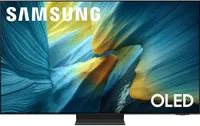
Unlike LCD/LED TVs (which rely on LED backlighting either behind the display or along its edges), every single pixel in an OLED TV is self-illuminating. It's all possible because of the organic materials used by an OLED display. (In fact, the "O" in OLED stands for "Organic.")
It's a marvelous feat, but one that requires a certain level of care and consideration due to delicate nature of the organic materials. For example, when it comes to average picture brightness (that is, the brightness of the entire screen), OLED TVs don't get nearly as bright as Mini-LED TVs.
Not only that, but most OLED TVs arrive with an automatic, brightness-throttling internal feature fittingly called the Automatic Brightness Limiter (ABL). On nearly every OLED TV you can buy, the picture is periodically dimmed to prevent the panel from heating up too much, or too prevent OLED burn-in.
OLED TVs require a certain level of care and consideration due to delicate nature of the organic materials.
Now, OLED TVs have come a long way in the last decade and are more resistant to heat and uniformity issues than they once were. That said, I'd be more worried about an OLED TV receiving prolonged, repeated exposure to direct sunlight than I would a garden-variety LCD/LED TV.
It's always worth considering the placement of a TV relative to the room's windows, if only to prevent unseemly glare. However, if you own an OLED TV, I recommend taking the issue of direct sunlight seriously, particularly if your OLED is sitting in the sun for several hours a day.
If this all seems too fussy for your liking, consider yourself lucky. Years ago, plasma TVs — in many ways the precursors to OLED TVs — were even more susceptible to heat damage due to the phosphors used in their displays.
We've come a long way since then. And, if you want your OLED TV to go a long way, it might be worth going the extra mile and repositioning it out of the sunlight.

Follow Tom's Guide on Google News and add us as a preferred source to get our up-to-date news, analysis, and reviews in your feeds.
More from Tom's Guide