Step aside Military Sleep Method, there’s a new mediation technique I rely on to fall asleep fast and sleep through the night: forest bathing. An ancient Japanese mindfulness practice, forest bathing involves unwinding by immersing yourself in nature.
If it sounds difficult, it really isn’t. In fact, I fell into forest bathing entirely by accident. One minute I was walking home through the woods after dropping my kids to school, the next I was following the sound of a woodpecker as it made its way through the green forest canopy.
I began to notice that on the days when I had these slow ambles through the woods, rooting myself in the surrounding nature, my stress levels dropped and my sleep that night was deep and undisturbed.
Below, experts help explain what forest bathing is and how it can benefit sleep as it is mine.
What is forest bathing?
Forest bathing, also called Shinrin-yoku, is a practice that started in Japan in the early 1980s. Despite its name, it doesn't involve stripping down and physically bathing in the muddy forest floor.
Instead, the 'bathing' aspect of its name refers the act of immersing yourself in nature.

"Forest bathing is slowing down and connecting to nature with all your senses," explains Dr Mark Ellison, a certified forest therapy guide. "It’s being in a natural setting and being present."
Forest bathing is simple; you can't mess it up
Dr Mark Ellison, certified forest therapy guide
While you can partake in guide-lead forest bathing sessions, like the ones that Dr Eliison runs in North Carolina, there aren't any hard and fast rules here.
The act of forest bathing simply involves 'being' in nature, focusing on the senses your surroundings activate — like the vivid green moss growing on a tree, the rush of running water, the rough feel of tree bark or the smell of crushed leaves underfoot.
"Studies have found that forest bathing and spending time in nature lowers heart rate and blood pressure; increases energy levels; improves quality of sleep; improves the ability to focus; boosts the immune system; and improves mood and overall feelings of well-being," says Dr Ellison.
How forest bathing can lower cortisol and prevent 3 a.m. wake-ups
As someone prone to waking up at 3 a.m., I've noticed noticed a link between forest bathing and my ability to fall asleep quickly and stay asleep throughout the night.
There's several reasons for this, the first being that spending time within nature can lower elevated cortisol levels. That's the 'stress' hormone responsible for your fight or flight response.
A 2019 study showed that spending spending between twenty and thirty minutes outside among nature three times per week can significantly lower cortisol levels, regardless of the time of day.
Having previously discussed with doctors how an elevated base level of cortisol is likely behind my 3 a.m. wake-ups, anything I can do to lower feelings of stress will have a positive effect on my sleep.

Other ways that forest bathing can benefit sleep
The second way that forest bathing benefits sleep is due to the time of day that I do it — in the morning. Studies show that natural sunlight exposure in the morning helps regulate has our circadian rhythm, which is our body's internal clock.
"Natural morning light signals to our brain that it's morning, i.e. time to get active, by suppressing any melatonin that's still lingering," shares Dr. Catherine Darley, a Naturopathic Sleep Expert and founder of Skilled Sleeper.
By suppressing melatonin levels, which is the hormone we release naturally at night to prepare our bodies for sleep, natural sunlight exposure in the morning helps stave off sleep inertia. This is the temporary feeling of grogginess you sometimes feel in the morning.
Natural sunlight in the morning is one of the most powerful tools to shift your sleep-wake cycle earlier
Dr. Mike Gradisar, a clinical psychologist specialising in sleep
But what does feeling alert in the morning have to do with sleep? When exposed to natural sunlight, our bodies suppress melatonin and instead begin to produce serotonin. That's the feel-good hormone that can improve our mood and focus.
However, after the sun goes down and our bedtime looms, any lingering serotonin is then metabolized into melatonin, which makes it much easier to fall asleep and stay asleep.
"That morning light also increases our nocturnal melatonin surge, and shifts it earlier, which improves our sleep", says Dr Darley, who adds that it's best to get 20-30 minutes of outside light in the first hour of waking.
Dr. Mike Gradisar, Head of Sleep Science at Sleep Cycle, agrees. "Natural sunlight in the morning is one of the most powerful tools to shift your sleep-wake cycle earlier," he explains.
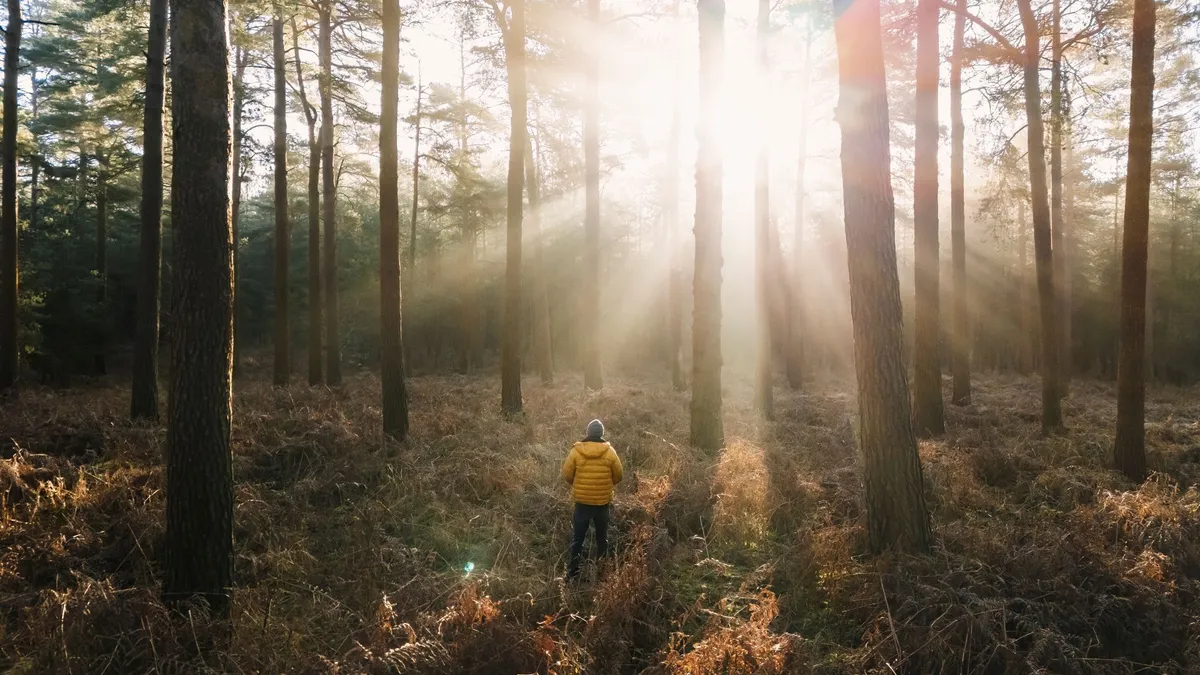
However, that's not to say that the morning is the only beneficial time for sleep to forest bathe — exposure to natural sunlight at any time of the day will help cement a regulated circadian rhythm, says Dr Gradisar.
"Daytime light may boost the ‘height’ or amplitude of your circadian rhythm, so get daytime doses of natural light during the day.”
As well as stress reduction and a regulated circadian rhythm, spending time outdoors can benefit your sleep in another, less direct way. A small UK study from 2025 found that spending time in nature can help reduce lower back pain.
From a study group of ten people with chronic pain, participants noted that they felt less focused on their pain after immersing themselves in nature.
As someone with recurrent lower back pain I know how it can be a barrier to quality sleep, so I welcome anything that can relieve it (like the best mattresses for back pain.)
How to practice forest bathing for better sleep
I spend between 20-30 minutes immersing myself in nature in the woods close to where I live twice a week. That falls slightly short of a 2019 study that outlines that spending time in nature for twenty-thirty minutes, three times a week is optimum for lowered cortisol levels.
However, any period of time spent outdoors can improve your mood and regulate the five key hormones needed for better sleep. If you're keen to get started, here's how:
Set aside a minimum of 15 minutes
Studies indicate that spending a minimum of twenty minutes is needed in order to gain the most stress relieving benefits. However, that doesn't mean you have to limit your forest bathing session to any length of time — spending more or less time than twenty minutes is fine.
"You can get health benefits from being in nature in very short amounts of time, as little as 15 minutes," says Dr Ellison. "My walks are usually 2-2.5 hours which seems to be a good length of time for most people."

Put your phone on silent
Slowing down and spending time in nature might seem like an excellent opportunity to take a few picture of all the lovely scenery you're encountering — don't. You phone or camera will distract you from what you're there to do, which is to slow down and engage with nature.
"If you can, try turning your phone off for a few minutes while you do this, resisting the urge to take photos or be on social media," says Dr Ellison.
When I tried sleeping like the Amish, putting down phones and moving into nature was a key part of it. As a result, I was less stressed and slept better.
Engage all your senses
Like my entry into forest bathing, Dr Ellison advises that you start off by engaging all your sense. Stop and take a deep breath. What can you see, hear and feel?
"My walks start with a focus on sensory awareness," says Dr Ellison,. "Then we go on a really slow walk noticing all that is around us. I always like to have a time to find a place to sit, perhaps by a tree or stream, enjoying connecting with all that is around me."