As you may have seen, the question of whether you can actually buy an Nvidia RTX 50-series GPU has been quite the topic of conversation.
From uncertainty spread by Asus to Nvidia correcting the record and leakers disputing said corrections, it’s been an interesting few days that’s been capped off with Gigabyte’s CEO sharing more about Team Green’s possible plans to focus on increasing “revenue per gigabyte” on each GPU sold.
In short, Nvidia may focus its video memory capacity on the higher-end GPUs. And after talking to Scan UK CEO Elan Raja, I think this decision may be validated after hearing the “sweet spot” is not the RTX 5060 Ti with 16GB of VRAM, as I assumed, it’s actually the RTX 5070.
What is Scan UK?
To my fellow Brits, chances are you won’t need me explaining what Scan UK is. But for context (and to all my U.S. readers), think of Scan as the British equivalent of a Micro Center, or as Elan says, “Argos on Steroids.”
And being honest? It’s one of the coolest places I’ve been to in the U.K. While their bread and butter is gaming PCs — building custom computers to the specs you want (even letting you tune into a live stream of them building it if you want to watch and learn) — the business itself touches much more than that.
These include prosumer-level systems and hardware, setting up cloud compute, AI systems (including Nvidia’s mini supercomputer, the DGX Spark), and even robotics. During my time there, I got to see everything, and I felt like I was in Willy Wonka’s computing factory — building a computer, testing robots and getting to talk to Elan.

Expect much more coverage from my time with Scan. A lot of fascinating discoveries, including how sim games could train the robotics of the future, how the RAM crisis may be more cyclical than you think, and how (in Raja’s eyes) it will never kill PC building.
“Doesn’t break the bank”
So in my sit-down interview with Elan, we covered many topics — all of which I will be covering in a few more articles coming up. But let’s start with this question: of course retailers like Scan focus on the higher-end, but what is the sweet spot most folks are buying?
“Our customers specifically are focused at the very high end,” Raja commented. “But there's always technology for every budget.” Of course, not everybody needs the bleeding edge (and the astronomical cost that comes with it).
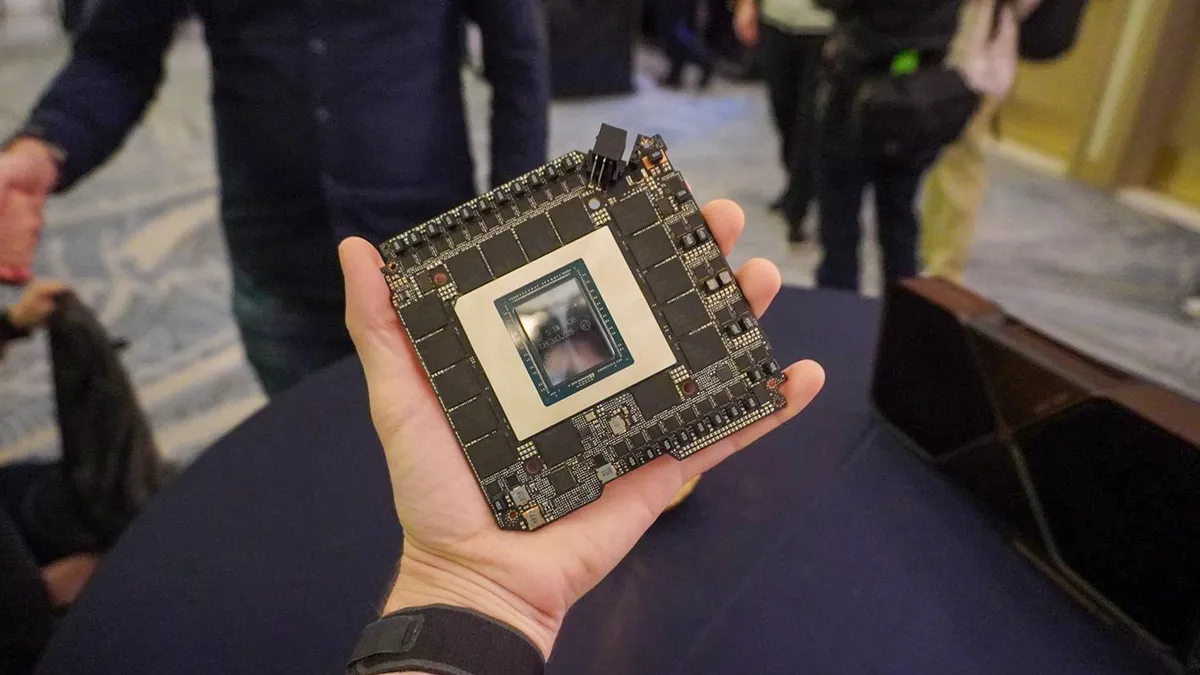
“Entry level now is considered an RTX 5060, all the way up to the extreme 32GB RTX 5090,” Raja added. “Anywhere in between, depending on what you use, is a sweet spot.” That’s a big range from $300 all the way up to $2,000 (and that’s only MSRP), so I pushed him a little to narrow it down.
“If we were talking about the general market, I'd probably say a 5070 is a decent sweet spot,” Raja confirmed. “You know that it offers great performance per buck, but at the same time, it doesn't break the bank. It's your definition of a sweet spot.”

In leaks surrounding the RTX 50-series supply issues (and the decisions Nvidia is reportedly making), a call allegedly hasn't been made on the RTX 5070 and its 12GB of VRAM.
This comment was made before all of this came out last week (I interviewed Elan last month), but with new context, it's interesting to see how this declaration of a sweet spot could tie to what the GPU market could look like this year.
I wasn’t a fan of RTX 5070, but does DLSS 4.5 change that?

It’s an interesting take, because when I reviewed the RTX 5070, I called it the “awkward middle child” of the bunch.
Granted, things have gotten a little better now, as you can grab the GPU for just a touch above MSRP ($50 more than the $549 asking price), rather than when it had ballooned to around $750 at the time of reviewing it. But it’s in between a rock of the RTX 5060 Ti 16GB and a hard place of the RTX 5070 Ti.
That being said, though, DLSS 4.5 could be the difference-maker here. As Nvidia CEO Jensen Huang said himself in a behind-closed-doors Q&A to Tom’s Guide, the vision of DLSS tech is to overcome the “physical limits” of chip technology. “Moore’s Law ended, and we make these chips as large as we possibly can,” Huang added.
And what I’ve noticed while testing DLSS 4.5 is that while you’ll take a frame rate penalty if you use it wrong and turn on Quality or Balanced mode, using the models for Performance and Ultra Performance mode does show some significant improvements. Namely, much improved clarity around moving objects, a much more stable image, and less jagged edges.
I’ll have to find out for myself whether this combination can overcome my initial impressions. Standby for a re-review…

Follow Tom's Guide on Google News and add us as a preferred source to get our up-to-date news, analysis, and reviews in your feeds.
More from Tom's Guide
- I’ve got an Intel Core Ultra X9 388H laptop in front of me, and I’m taking your requests LIVE on what to test
- Xreal is suing Viture for ‘freeriding on technological breakthroughs’ — how does this huge patent infringement lawsuit impact you and the AR glasses you should buy?
- Intel says laptop makers are sitting on 'about 9 to 12 months' of stock, and it might be the key to surviving the RAM crunch