So I’ll be honest. I’ve been a path tracing doubter for a while now. The idea of slightly more realistic-looking textures, shinier lights and better reflections just felt a little bit unnecessary in the games I had tested so far on Nvidia’s RTX 50-series GPUs.
But then I got my hands on Resident Evil Requiem, and I’ve been converted. The difference is night and day with path tracing; a new level of fear and tension is added in the subtleties of light and dark, and the immersion is taken to new heights I’ve never seen before.
What is path tracing?
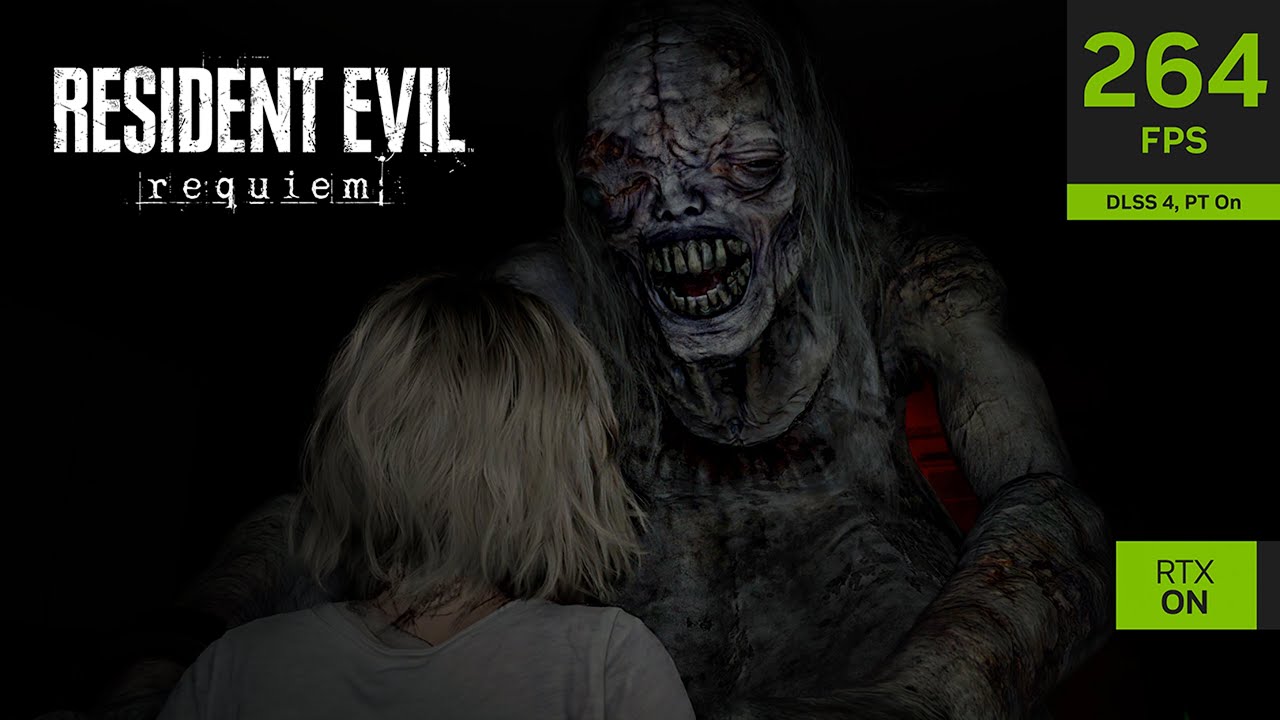
This is like the gold standard of computer graphics — a generational leap over ray tracing that is able to calculate how all direct and indirect light in a scene bounces off surfaces.
In the past, this effect was done through rasterization, which is to paint these lighting effects onto the scene itself. Then, ray tracing was the next step to calculate how direct light sources interact with one another (like a reflection in a window).
Now, path tracing is able to handle both direct light and indirect illumination, while calculating where that light will bounce multiple times in a scene. This is, of course, incredibly demanding on a GPU, and in Resident Evil Requiem, DLSS is required to turn it on.
And on top of that, Nvidia’s Ray Reconstruction tech helps things along by using an AI model to recognize those traced rays of light in real-time and enhance the image quality.
By the numbers

With that in mind, let’s get straight into the testing. I ran Resident Evil 9 on three different machines:
- The first I built myself at Scan computers, which packs an AMD Ryzen 7 9800X3D, RTX 5080 and 32GB of DDR5 RAM. You can watch the whole build here.
- The second is an RDY Element 9 Pro R07 with AMD Ryzen 7 7800X3D, RTX 5060 Ti (16GB) and 32GB of DDR5 RAM. Typically, this prebuilt comes with an AMD Radeon RX 9070 XT, but I switched the GPU for this test.
- The third is a Quoted Tech Frontier, a prebuilt sporting an AMD Ryzen 7 9700X, RTX 5070 and 32GB of RAM. It’s a PC that can muster up solid 4K performance when pushed to its limits.
To make this a stress test but fair to each card, I targeted each one’s preferred resolution — RTX 5080 at 4K and RTX 5060 Ti at 1440p. While an RTX 5070 is generally better suited to 1440p, I decided to turn this up to 4K to see how far I could push it. All have their graphics settings turned up to the max with path tracing turned on.
Latency checker
Now, I take frametime from each baseline test without frame generation because this is important to measure any potential latency. It’s a technical explanation, and there is low-latency tech Nvidia uses to tackle this. Put simply, your computer is “blind” to your mouse movements between frames, so the longer that is, the more prominent the latency can feel.
Throw frame generation on top of that, and while you’ll have a game that looks smooth, it may not feel smooth. But, that rule doesn’t apply with the same level of importance across the board, and Resident Evil Requiem is the peak example of this.
I normally follow a golden rule: start with a base rate of 60 FPS and build from there. That way you get much better responsiveness in your games. However, given the slow, methodical gameplay in Resident Evil, I didn’t feel that latency impacted gameplay — even at the higher end of 26.1 milliseconds.
If gameplay were fast and furious (like a multiplayer shooter that required twitch-like responses), this would be a different story. But as I’m about to show you, the pace of Resi 9 means you can turn up that fidelity and not break your immersion. This is a real masterpiece.
Turning down the difficulty

Yes, that’s not just a cool subheading. That literally happened. I’ve always been a bit of a coward when it comes to horror games, but with path tracing, I noped out at my first monstrous jump scare after a pitch-perfect build of tension and turned down the difficulty. It’s seriously a huge noticeable uplift.


Whether it’s light dancing on floor tiles covered in blood, your terrified face staring back at you in the glass of a fire extinguisher case or the shadows being so accurately cast on a bunch of zombies shuffling towards you, this is the first time I looked at path tracing and thought “I get it now.”
And when it comes down to the differing levels of DLSS 4 to 4.5 — moving from a balanced AI upscaling to one leaning towards performance and ultra performance — there are some telltale signs like a little bit more fuzziness, especially in the rain-soaked intro.


However, it is quite the achievement to have the game looking this good from such a small picture. For context, DLSS 4.5 ultra performance takes an image rendered by the GPU at a third of the size. That means a 720p picture blown up to 4K, and a measly 480p image up to 1440p.
Yet another example of how Team Green runs this town when it comes to AI trickery to extract better bang for your buck from your GPU.
A new level of fear

I will never doubt path tracing again. While it is the case that in some titles that sport it, the difference is small, when used intentionally, like what we see here, it makes for a huge upgrade.
Not only is Resident Evil Requiem a visual tour de force through-and-through (thanks to Nvidia’s tech) with frame smoothness and no noticeable impact to latency, it’s a great game, too — even for scaredy cats like me, I had a great time.
If you’ve been looking for titles to both show off what your gaming tower is capable of, while also actually getting an all-immersive single-player experience out of the deal, this is the one to get.

Follow Tom's Guide on Google News and add us as a preferred source to get our up-to-date news, analysis, and reviews in your feeds.
More from Tom's Guide