If you were to look at what Nvidia announced at CES 2026, I wouldn’t blame you for thinking Team Green may not be a PC gaming company anymore. A huge portion of its $5 trillion valuation is driven by the AI gold rush, and on-stage, CEO Jensen Huang talked entirely about new data center tech and robotics.

We've picked our best of CES 2026 awards after going hands-on with the biggest gadget announcements. For more, be sure to follow Tom's Guide on TikTok for the coolest videos from the show.
But behind closed doors at a Q&A with Huang, we were really able to get into gaming with him and talk about the future of GPU tech, how AI will continue to push the gaming envelope than what we see now with the likes of DLSS 4.5 and how it’s the key to exceeding physical limitations of traditional chip technology. AI could also be used as a workaround to the RAM pricing crisis that is starting to hit the best GPUs.
Oh, and of course, we got answers to the most important meme question in the computing community — what is it with all the leather jackets?
AI is the key to generational leaps
So let’s start at the beginning. After a whole lot of questions about the new Vera Rubin data center tech, we were finally able to get a question about gaming, which made Jensen’s eyes light up.
"GeForce brought CUDA to the world, which brought AI to the world, and then after that, we used AI to bring RTX to gamers and DLSS to gamers,” Huang commented. “And so you know, without GeForce, there would be no AI today. Without AI, there would be no DLSS today. It's harmonious."

Now, I know some of you reading this are looking at the use of AI here and rolling your eyes. Fake frames is something I’m commonly asked about in reader emails, and in my time testing DLSS 4.5, all I can say is that steps are being taken to generate frames only when you need them. It’s a positive shift from hitting it with a 4x blunt instrument!
But is AI being used to overcome physical chip limitations? Huang says yes, and we may have seen the biggest possible GPU for raw graphics rendering come with the RTX 5090.
“Moore's Law ended, and we make these chips as large as we possibly can. If you look at a 5090, holy cow, it's giant. You're really at the physical limits, and that's the reason why we invented DLSS in the first place.”

And much like the Blackwell GPU architecture made the move from data center cards to the RTX 40 and 50 series, it seems obvious that you will see the Rubin architecture jump over for the RTX 60 series. So pay attention to what these cards can do.
Neural rendering is the future

But by steering this PC gaming car into the skid of AI, there’s much more that can be done — you’re seeing the signs of this happening already with some of the RTX neural systems, Nvidia ACE AI NPCs and more. But as Jensen himself says, the future is “neural rendering.”
DLSS is already kind of an example of this in some sort of way: taking some pixels rendered by the GPU and predicting the rest based on a trained model, and DLSS 4.5 in my eyes-on is quite the breakthrough in extracting more performance you wouldn’t normally see. The next step will be leaning more on the AI side of things.

“In the future, it is very likely that we'll do more and more computation on fewer and fewer pixels. By doing so, the pixels that we compute are insanely beautiful, and then we use AI to infer what must be around it.” Huang said.
And in Team Green’s labs, Huang says the company is working on things that are just “utterly shocking and incredible.” To put a more specific point on it, he talked about extreme photo realism: “basically a photograph interacting with you at 500 frames per second.”
These will lead to a growing “fusion between rendering and generative AI” in Jensen's eyes — taking the tradition generative models we know now and having them run at the pace of a video game to create infinite worlds.
AI will touch every part of a game’s DNA

Now, Nvidia has been showing its AI gaming tech isn’t just limited to making titles look prettier and run smoother. We’ve tested Nvidia’s AI NPCs (named ACE) in the past, and while it’s definitely a fun demo feature at the moment, Huang predicts that AI will move beyond just graphics to control the characters and physics within the game world itself.
“You should also expect that future video games are essentially AI characters within them. Every character will have their own AI, and will be animated robotically using AI,” Jensen predicted.

And you can see this coming hand-in-hand with some of the AI work Nvidia’s doing in the enterprise world — such as Cosmos driving robotics and full self-driving to breed interoperated human behavior.
Relying on AI processing isn’t just the shortcut to better performance over raw rasterization of graphics, it could be the key to unlocking the next generation of entire titles.
"All the characters as I mentioned earlier will be AI-based, all the animation will be AI-based and, and all of the fluid dynamics won't be computational based, but AI-emulated physics,” Huang said. “Everything is just going to look so incredibly real, and so immersive."
Looking back to survive RAMageddon
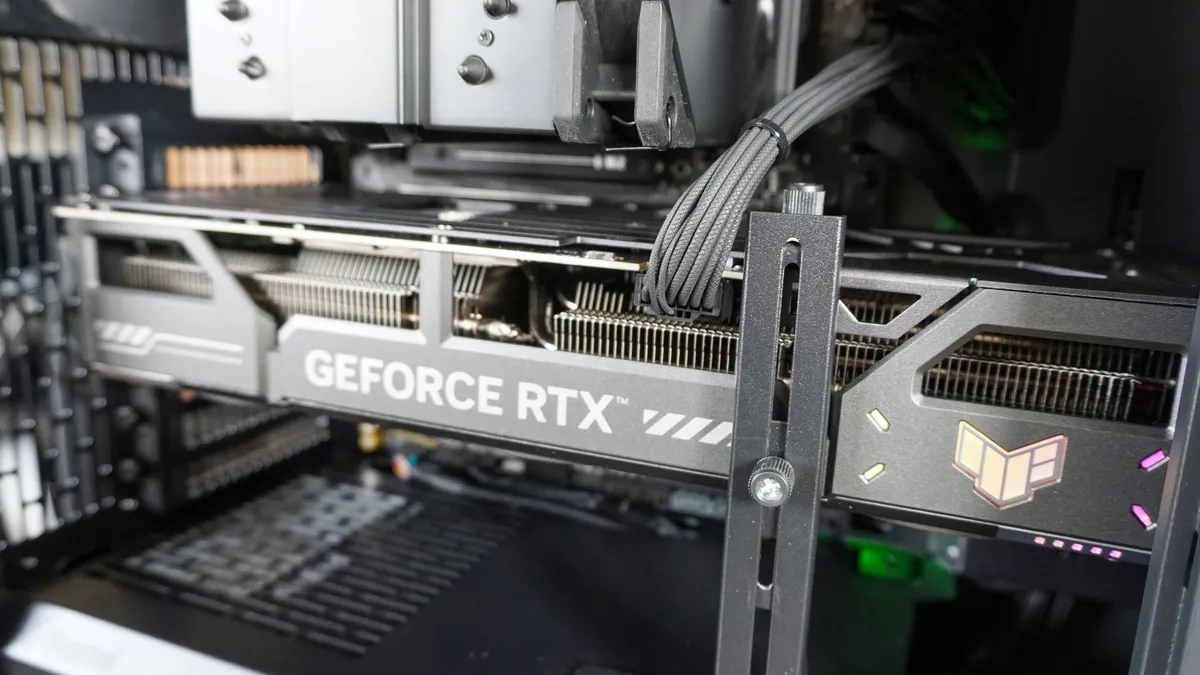
If there’s one topic of conversation that dominated the halls of CES this year, it’s the RAM price explosion. So who better to ask about the great AI gobble-up of DRAM chips than the guy at the center of using them. When asked about rising costs and potential shortages for gamers, Huang went into Nvidia’s role as a major memory purchaser.
“We also purchase GDDR for our graphics cards, and we’ve been a very significant consumer for a very long time, and so we’ve been planning that out with all of our suppliers for quite some time.”
To push further, my friend Paul Alcorn from Tom’s Hardware managed to get a question in, and connected it to the rumor that Nvidia may be bringing the RTX 3060 back from the dead amidst the memory shortage.

Jensen had an interesting answer to this, saying it’s a “good idea,” while also expanding on what could be done. “We could bring the latest generation AI technology to the previous generation GPUs,” Huang commented. “That’ll require a fair amount of engineering, but it’s also within the realm of possibility. I’ll go back and take a look at this.”
This would be an interesting concept and a huge bet on the capabilities of Nvidia’s AI gaming tech. Rendering on older CUDA cores, while doing the guesswork on the latest Tensor cores could produce some interesting results — both in affordability and performance.
Deciphering the leather jacket lore

And of course, the most critical question — the main reason why you’re here. What gives with all the leather jackets? All of us who report on Nvidia’s work have our own theories on the jackets picked and worn for each specific event.
Mine is a simple one: the shinier the jacket, the bigger the announcement. So I was so happy that someone brought up Jensen Huang’s signature attire, and asked if he has a road map for his style in the future.
“Somebody else’s road map, I just wear it,” Huang joked. Of course there’s going to be a stylist behind the scenes, and I have so many questions for them — hopefully to validate my theory on the leather jacket lore.

Follow Tom's Guide on Google News and add us as a preferred source to get our up-to-date news, analysis, and reviews in your feeds.
More from Tom's Guide
- I just went eyes-on with Nvidia G-SYNC Pulsar, and now my own gaming monitor feels obsolete
- I just tested an 8K VR headset that weighs less than my phone, and it could change VR gaming
- I tried HyperX’s brain-reading headset, and it mindfully made me a better gamer by overclocking my mind