So you've just got a new Fuji for Christmas? Or maybe you've treated yourself to one (I don't blame you). Congratulations, they're some of the best mirrorless cameras around. Now comes the tricky part, though: deciding what lenses to buy.
Your camera might come with a kit zoom lens, and these aren't bad to get you started. Kit zooms are generally quite limited though, with narrow and often variable maximum apertures. That makes them less flexible in low light, or if you want to get out of focus backgrounds. To make your photography look professional, you'll need a better zoom lens or a prime lens.
A prime lens doesn't zoom, but the trade off is that they're smaller, sometimes more cinematic looking, and often have wider (A.K.A "faster") maximum apertures for better-looking bokeh. Zooms, on the other hand, are more flexible, which is important if you want to span multiple genres or photography different without changing lenses (although part of the fun with prime lenses is moving yourself to frame properly).
There are lots of Fuji lenses out there, both from Fuji itself and third parties. The choice can be daunting, but don't worry — I'm here to help. I got my first Fujifilm 10 years ago and have owned six in total. And as the senior editor in charge of our cameras section here at Tom's Guide, I test almost all Fujis that are released, from the entry level Fujifilm X-T30 III through to street legends like the Fujifilm X-E5 and Fujifilm X100VI, to powerful medium format cameras like the Fujifilm GFX100 II.
I've used many Fuji lenses throughout that time. Here are my recommendations. I've broken things down into a few different genres to help you find the right lens for you.
Note: I'm only covering APS-C X-Mount fit lenses here. I'm assuming that new Fuji users likely won't have dropped $8,000 into a brand new GFX100 II, so I'm leaving Fuji's GF medium format lenses out. Note 2: Fujinon is the brand name for lenses made by Fujifilm itself.

I've been shooting Fuji since 2015 and have either owned or tested almost every recent Fujifilm camera, from the humble X-T30 through to medium format GFX monsters. Follow me on Instagram to see my photography.
Best all-rounder: Fujinon XF35mm F2
This, in my opinion, should be every Fujifilm user's first lens. It's a fantastic, compact versatile lens with a field of view equivalent to 52.5mm on a full frame camera. That's known as a "standard" field of view and is good for a variety of genres, including street, documentary, architecture and even portraiture. It has a fast F2 maximum aperture for some reasonably attractive out of focus backgrounds, too!
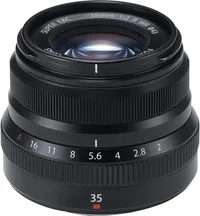
This is the only Fujifilm lens I've owned and never sold. It's my ride-or-die Fuji lens. You can see it fitted to my X-E4 above! Buy it once and it'll last you forever.


If you can't stretch to the XF lens, you can try the Fujinon XC 35mm F2, which costs $239 at Amazon, which uses the same optics.
XC lenses are Fuji's cheaper range, with plastic bodies instead of metal and no aperture control ring — this is vitally important! Some Fuji cameras have very limited controls, so having an aperture control ring frees up priceless on-camera dials for other important controls, such as ISO. In my opinion, cheaper XC lenses are not worth the saving in the long run.
Best for street: Fujinon XF23mm F2.8
This is a fun little lens. It was launched as the kit lens for the Fujifilm X-E5, which I reviewed. So I spent a few weeks shooting with this thing. It's also been released standalone, to (kinda) replace the older Fujinon XF27mm F2.8 that shipped with the X-E4.
The 23mm is a pancake lens, so it's very flat, compact and unobtrusive, making it great for street, documentary and travel. It has a wide 23mm focal length, which gives a field of view equivalent to a 34.5mm lens on a full frame camera. 35mm is the classic focal length for street! The XF23mm has a fairly wide maximum aperture of F2.8, which is good for getting some out of focus backgrounds and isolating your subject.
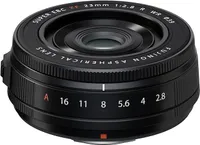
Below you can see a photo of the lens on the X-E5, as well as some photos I took using the 23mm lens during testing.


If you'd like to save a bit of cash and want a similar focal length, check out the Viltrox AF 23mm F1.4, which is just $239 at Amazon. This lens is super sharp and highly regarded in the photography world. It has a super bright maximum aperture of F1.4, although it's a lot bigger and heavier than the XF23mm pancake.
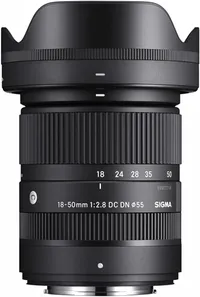
Best for video: Sigma 18-50mm F2.8 DC DN | C
This is a lens I haven't tested personally, but this one is actually on my bucket list, as I need a standard zoom for my product photography and personal work. I have, however, used Sigma standard zooms before when I shot with Sony, and they're excellent optics.
The Sigma 18-50mm has proved itself an extremely sharp little lens, having already been released for Sony E-mount APS-C cameras before the Fuji variant was released. This is a great little lens for video, as it demonstrates no noticeable focus breathing (where the lens zooms in and out slightly while focusing). Its an AF lens, too, with fast focusing capabilities, and also has a fairly bright F2.8 constant maximum aperture, which means you can maintain F2.8 throughout the zoom range.
An alternative to the Sigma F2.8 would be the Fujinon XF16-55mm F2.8, currently $1,399 at Amazon. This is a lens I've shot with extensively during testing, and it's a beautiful general-purpose zoom lens. It also has an F2.8 constant maximum aperture, as well as adjustable aperture ring feel (clicky or smooth), allowing you to perform smooth focus pulls in video. The downsides? It's big, and it's very expensive, so my vote would still be for the Sigma.
Best for architecture: Fujinon XF14mm F2.8
I've been using the Fujinon XF14mm F2.8 for a few years now for my personal architecture photography. I actually sold this lens once a few years ago, only to regret my decision and buy it back. This lens is truly excellent for architecture because it's almost unbelievably straight. Usually, at wide focal lengths like 14mm, wide-angle barrel distortion warps the image — think of the fish bowl effect on a fisheye lens.
The XF14mm is astoundingly straight, showing no barrel distortion while maintaining excellent sharpness in image corners. Hence, it's my go-to for snapping buildings!
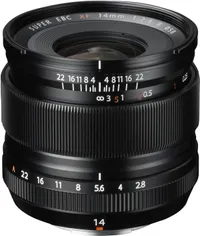
Now, I'll be the first to admit this lens' imperfections, because there are a few. Firstly, it's old. This was one of the first XF lenses released for Fuji mirrorless cameras back in the 2010s, and that shows — it's a slow lens to focus, and noisy too, so it's not ideal for video work or fast-paced photography.
It also has a curiously loose aperture ring (from the factory — this has been an issue on both my versions), so you might find yourself knocking your aperture out in use. Neither as huge issues for architecture photography, though, which is a slower-paced and more considered genre.
If you'd like something a little newer and snappier, not to mention cheaper, there's the Viltrox AF 13mm, which costs $486 at Amazon, has a slightly wider field of view and a brighter F1.4 maximum aperture. And yeah, this is also a great lens that I'm happy to recommend. But I just love the character and utter sharpness of the Fuji optic!
Best for portraits: Viltrox 56mm F1.2
Another great Viltrox lens is the 56mm F1.2. All of Viltrox's AF lens range have fantastic reputations, so despite not having used this one, I'm happy to recommend it. Again, this is a lens I have on my own bucket list, potentially for purchasing in the new year sales.
56mm on an APS-C camera gives a field of view equivalent to an 84mm lens on a full frame camera. That's the ideal focal length for portraiture, providing lots of distance compression to separate your subject from their background. Add to that the super shallow F1.2 maximum aperture, and you can get razor thin depth of field, extremely tight background blur and gorgeous bokeh. What more could you ask for from a portrait lens?
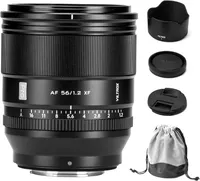
You're actually spoiled for choice when it comes to 56mm portrait lenses on the X-mount. Fuji makes its own version, the Fujinon XF56mm F1.2, which costs $1,199 at Amazon. I've used this lens, and it's gorgeous, but it's hella pricey. There's also the Sigma 56mm F1.4, which costs $459 at Amazon, so could be a good budget alternative. However, the Sigma has no aperture control ring, which is a difficult thing for many Fuji users to stomach.
Best for wildlife: Fujinon XF70-300mm F4-5.6
The XF70-300mm is a fantastic lens for wildlife shooters thanks to its super telephoto 300mm maximum focal length. That gives you a field of view equivalent to a 450mm lens on a full frame camera, and essentially gives you bags and bags of reach to bring far away critters into frame.
I tested with this lens recently for my Fujifilm X-T30 III review, where I took it for some wildlife photography. It performed very well, focusing quickly and producing images with lovely distance separation thanks to the long focal length. It also features optical image stabilization, which is extremely useful when shooting at longer focal lengths (where handheld camera shake is exacerbated) on a non-IBIS camera.
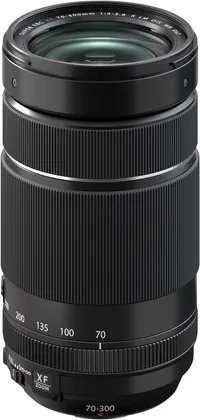
There isn't a whole lot of competition for this lens. Tamron makes a 70-300mm APS-C camera, but hasn't yet ported its version to the Fuji X-mount, so you'd need a mount adapter for the Sony or Nikon variant.


There's also the Fujinon XF50-140mm F2.8, which costs $1,899 at Amazon. This is a fantastic lens for wildlife, and you can see some examples of images I shot with it in the gallery above. It also has a bright constant F2.8 maximum aperture, meaning no need to stop down throughout the zoom range. However, it's much more expensive and doesn't have the same extra-long reach as the 70-300mm.

Follow Tom's Guide on Google News and add us as a preferred source to get our up-to-date news, analysis, and reviews in your feeds.
More from Tom's Guide
- I'm a cameras editor — here are my top mirrorless cameras from a year of testing
- I reviewed every drone that came out in 2025: these are the best photos and videos I’ve taken
- I just bought this 5-year-old Fujifilm camera and it proves newer isn’t always better