Tom's Guide Verdict
The Leica Q3 Monochrom is an outstanding camera, featuring a 60.3MP sensor and Leica’s Maestro IV processor, and it captures lovely black-and-white images packed full of detail. It boasts incredible high ISO and dynamic range performance, offering +14 stops for extensive adjustments in post-production. It can record 8K video too, and is Leica’s only Monochrom camera (at the time of writing) to do so. Tactile to handle and use, the Q3 Monochrom is a powerful and compact street and architecture camera — as long as you don’t mind short battery life and lack of in-body image stabilization.
Reasons to buy
- +
60.3MP sensor captures heaps of detail
- +
Takes stunning black-and-white images
- +
Beautifully designed and built
- +
Clean high ISO and dynamic range performance
- +
C8K/30fps video capabilities
Reasons to avoid
- -
Expensive (like every other Leica)
- -
No focus joystick
- -
Underwhelming battery life
- -
Optical stabilization only
Why you can trust Tom's Guide Our writers and editors spend hours analyzing and reviewing products, services, and apps to help find what's best for you. Find out more about how we test, analyze, and rate.
What happens when you strip away all color and shoot exclusively in black-and-white? That was the challenge at hand when I started testing the Leica Q3 Monochrom, a camera carrying the same shooting specs as the standard Q3 but packing a mono sensor. This 60.3MP beast captures highly detailed images, chock-full of detail, and even with no color in sight, the images are characterful and nothing short of stunning.
Aiding the Q3 Monochrom’s position as one of the best mirrorless cameras is clean high ISO performance, all packaged into a body that handles well, is easy to use, and is beautifully designed. Autofocus is fast and reliable, and the camera can even shoot 8K/30fps video (in black-and-white only).
But similar to nearly every other Leica I’ve used, CIPA-rated battery life remains a sticking point, and optical stabilization limits handheld shooting capabilities. For the complete breakdown, read my full Leica Q3 Monochrom review.
Leica Q3 Monochrom review: Specs
Specs |
Leica Q3 Monochrom |
|---|---|
Price |
|
Sensor |
60.3MP CMOS |
Processor |
Leica Maestro IV |
Stabilization |
Optical Image Stabilization only |
AF system |
Contrast-detection, 315 points |
Focus modes |
Intelligent AF, Single AF, Continuous AF, Manual Focus |
Viewfinder |
OLED EVF, approx. 5.76 million dots |
Display |
3-inch TFT LCD touchscreen, approx. 1.84 million dots |
ISO range |
100-200,000 |
Max video resolution |
C8K/30fps | C4K/60fps | FHD/120fps |
Ports |
USB-C, micro HDMI output, 1x SD/SDHC/SDXC UHS-II/V90 |
Wireless/bluetooth |
Wi-Fi, Bluetooth |
Max shooting speed |
15fps (electronic) | 7fps (mechanical) |
Max shutter speed |
60m to 1/2000s (stills, electronic) | 60s to 1/16,000s (stills, mechanical) |
Battery life (Stills, CIPA) |
302 shots | 1535 shots (Adapted Shooting) |
Size |
5.11 x 3.64 x 3.16 inches |
Weight |
1.64lbs (with battery and SD card) |
Leica Q3 Monochrom review: Cheat sheet
- What is it? A 60.3MP camera that shoots exclusively in black-and-white
- Who is it for? Photojournalists, street photographers, and anyone who prefers shooting in monochromatic tones
- How much does it cost? Leicas rarely come cheap, and the Leica Q3 Monochrom retails for $7,790 / £5,800
- What do we like? The detailed and sharp images, clean high ISO and dynamic range performance, beautiful design, and tactile handling
- What don’t we like? The underwhelming battery life and optical stabilization
Leica Q3 Monochrom review: Price & availability

The Q3 Monochrom, at the time of writing, is the latest Leica to get the black-and-white treatment, joining the rangefinder M11 Monochrom ($10,160). It succeeds the Leica Q2 Monochrom which can be bought second-hand for approximately $5,000. The Q3 Monochrom’s imaging tech is identical to the base model, the Leica Q3 which shoots in color. The difference? The Q3 Monochrom features a mono sensor that shoots black-and-white photos and videos only.
As is the nature of Leica cameras, the Q3 Monochrom costs a pretty penny, retailing for $7,790 at Adorama / £5,800 at Wex. It’s a little more expensive than the full frame 60MP Sony RX1R III ($5,099), and far more expensive than other 60MP cameras, such as the Sony A7R V ($3,900). Of course, these cameras shoot in color with black-and-white color profiles available, and the Q3 Monochrom’s monochromatic color profile is closest to Fujifilm’s Acros, found on cameras like the 102MP medium format Fujifilm GFX100RF ($4,899).
One of the advantages of getting the Q3 Monochrom is that it features a fixed Summilux 28mm f/1.7 ASPH. lens, so at least you won’t need to spend money on glass (and Leica glass is ridiculously expensive). It’s also Leica’s only Monochrom camera capable of shooting 8K video, making it a more versatile snapper.
Leica Q3 Monochrom review: Design

The Leica Q3 Monochrom is nothing short of beautiful. Similar to the base Q3 model, the Q3 Monochrom is fitted with a fixed Summilux 28mm f/1.7 ASPH. lens. If you want a lens whose field of view resembles human vision and what your eye sees, I’d recommend the Leica Q3 43 ($7,380) with its 43mm lens. The Q3 Monochrom and its 28mm lens are perfect for street, travel, and landscape photography. It comes fitted with a square lens hood which is revealed when the cap is twisted off.
This looks like a very minimalist camera, and if you didn’t know it was a Leica, you wouldn’t really guess that it’s one. That’s because the German giant has chosen to forego the red dot you find on most of its other cameras. The base Q3’s yellow and red accents have been eliminated too, and the lens and shutter dial markings are now gray and white to reaffirm the fact that this is a black-and-white camera. As Leicas go, this is the stealthiest-looking one out there.

Size and weight remain fairly identical to the standard Q3 as the Q3 Monochrom measures 5.11 x 3.64 x 3.16 inches and weighs 1.64lbs (with battery and SD card). I’ve had no problems or discomfort carrying it in my backpack or wearing the camera around my neck, thanks to the great weight distribution.
Handling is good too, but there is some room for improvement. I wish the camera had a protruding or sculpted grip on the right-hand side, like the Fujifilm GFX100RF does. But the Q3 Monochrom is still very grippy, thanks to the textured faux-leather surface, so I didn’t have any problems holding the camera with one or both hands.
Viewfinder

The Q3 Monochrom features the same viewfinder found on the Q3 43: an OLED EVF with a resolution of approximately 5.76 million dots. It’s also the same resolution found on medium format beasts, such as the Fujifilm GFX100RF, Hasselblad X2D 100C ($8,199) and Hasselblad X2D II 100C ($7,399), and is much higher-res than the Sony RX1R III’s (2.36 million dots).
This viewfinder is exceptional as it’s very bright and highly detailed, displaying adequate shooting information. Via the settings menu, you can opt for either a 60fps or a 120fps refresh rate, both of which relay smooth motion — the latter doing so at the expense of battery life. In my testing, I was able to keep track of my subjects even while panning, and was able to get an accurate picture of what the result would look like when viewing my subject through the EVF.
Monitor

Around the Q3 Monochrom’s back, you’ll find the 3-inch TFT LCD touchscreen. The screen is bright with a resolution of approximately 1.84 million dots. Although it’s a little lower than the Sony RX1R III’s 2.36M-dot and the Leica M EV1’s ($8,995) 2.33M-dot screens, it’s nice and bright, so I was still able to read it clearly even in direct sunlight.

The monitor can also tilt up and down, enabling you to shoot inconspicuously at waist level, which is great for street photography when you want to capture candid moments. The Q3 Monochrom takes the cake here as the Sony RX1R III’s features a fixed monitor. While some people might find it restrictive, compared to a three-way tilt-type monitor, I had no issues using it, as this is also how the monitor on my personal Fujifilm X-T50 ($1,399) works.
Alongside the monitor being easy to read, Leica’s quick settings and detailed menu system is as straightforward as always. Everything is easily accessible and understandable, thanks to the stripped-back menu.
Ports

Similar to many other Leica cameras, such as the Q3 43 and the M11-D ($9,799), the Q3 Monochrom doesn’t feature many ports. A hatch on the left-hand edge of the camera houses the micro HDMI port as well as the USB-C port for charging and data transfer.
It’s important to note that even though the Q3 Monochrom can shoot 8K video, it doesn’t feature any headphone or mic ports, which limits its video capabilities. If you fancy a Leica with video-first specs, I’d recommend the SL3-S ($5,665) instead. But given Leica’s partnership with Rode, the Q3 Monochrom supports Rode mics via the USB-C port.

On the bottom plate, a silver release lever, when pushed, releases the battery pack and also reveals the memory card slot. The Q3 Monochrom is compatible with a single SD/SDHC/SDXC UHS-II/V90. There is no support for CFExpress cards, though, which might be a problem for those constantly shooting 8K video.
Weather-sealing
The Q3 Monochrom carries an IP52 durability rating. This means that the camera is protected from dust entering and ruining the tech inside, and it is also safe against water drips at a tilt. This, basically, means that you should be able to use the Q3 Monochrom even if it starts drizzling — as I did, in good ol’ rainy Bath, U.K.
Leica Q3 Monochrom review: Controls

Now that I’ve tested a few, one thing I always appreciate about Leica cameras is that they are extremely easy to use, and this is also true in the case of the Leica Q3 Monochrom. As a special iteration of the base Q3 and the Q3 43, its control scheme is exactly the same as the two cameras. I’ve had no issues getting to grips with the camera, and every button and dial gives good tactile feedback when pressed or turned.
The top plate houses the shutter speed dial as well as the shutter/power button, and alongside this is the exposure compensation dial (±3 EV in 1/3 EV increments). Your standard navigation and playback buttons are located next to the monitor. The only important thing missing is a focus joystick, and to change focus points, you must rely on the D-pad. It’s annoying and something we disliked about the Sony RX1R III as well, but it isn’t as bad as the Hasselblad X2D 100C where you must rely entirely on the touchscreen for shifting focus points.

Also making a comeback are the two buttons located above the monitor, one for digital cropping for additional effective focal lengths, and another for swapping between stills and video. The former lets you crop in-camera at an effective 28mm (default, zoomed out), 1.25x (35mm), 1.7x (50mm), 2.7x (75mm), and 3.2x (90mm). Like the Leica M EV1 and the Leica Q3 43, the Q3 Monochrom crops into images to give effective focal lengths at the cost of some resolution, but with 60.3MP at your disposal, there’s plenty of room for extreme cropping.
I found myself making use of the digital crops quite often in my testing. They helped me frame my images better as I could see, in real-time, what they would look like if I chose to crop into them during post-production. I’ll discuss the image quality of these crops in the following sections.
Leica Q3 Monochrom review: Autofocus

Unlike the Leica Q3 and the Leica Q3 43 which utilize phase-detection autofocus, the Leica Q3 Monochrom utilizes a contrast-detection-only AF system. Phase-detection is usually quicker and best for moving subjects, but on a mono sensor, phase-detect AF points can produce visible artefacts. So instead, it relies on contrast-detection, which makes sense as this isn’t a fast-paced camera for wildlife or sports, so it isn’t as big of a deal as in a professional workhorse, like the Sony A7R V.
Similar to other Leica cameras, you can choose between Single AF, Continuous AF, Manual focus and Intelligent AF which automatically swaps between the first two.


You can choose between human eye/face/body and animal detection, and in my testing, the camera locked onto animals and people within milliseconds, as you can see in the gallery above. The first two shots of my partner were taken with face/body detection enabled, and the camera did a good job of focusing on her. The photo of the swan has turned out lovely as well, and this was taken with animal body detection enabled.
Leica Q3 Monochrom review: Stabilization

A pitfall of most Leica cameras is the lack of any in-body image stabilization (IBIS). The base Q3 and the Q3 43 both utilize optical image stabilization, which isn’t as effective as the IBIS found on the SL3 ($7,485). Relying on optical image stabilization means you can’t shoot at the kind of slow shutter speeds you could with IBIS, so I’d still recommend using a tripod for shooting in low-light environments and long exposures (naturally).


The first photo in the gallery above was shot at 1/4s and as you can see, the image is clear and in focus, and that’s the slowest shutter speed I could shoot at. Any slower than that, such as at 0.5s in the second slide, and the image was negatively impacted by camera shake. It still isn’t terrible, though, and the image is still usable.
Leica Q3 Monochrom review: Image quality

The Leica Q3 Monochrom is a well-endowed camera, featuring a 60.3MP CMOS sensor, just like its stablemates, the Leica M EV1 and the Leica Q3 43, and it’s the highest resolution of any Leica Monochrom camera yet. It works in conjunction with the Leica Maestro IV processor to capture images packed with heaps of detail. The images captured by the Q3 Monochrom come out extremely detailed and crisp, perhaps even sharper than ones captured by its color siblings.
But why is that? Most digital cameras that capture images in color utilize what’s known as the Bayer color filter array (CFA), located over the sensor. In simple terms, it’s a set of red, green, and blue filters that allows the sensor to detect the wavelength (color) of light, as the light sensitive photosites on a camera’s naked sensor can only measure light intensity (brightness) on their own. Decoding this information can result in a loss of luminance data. So, when a camera is without a CFA, its monochromatic sensor captures all the luminance detected by its photosites, resulting in a sharper image — and better high ISO performance (more on that soon).
This is all to say that the Q3 Monochrom captures ridiculously stunning images, and as someone who shoots primarily in color, even I was impressed by them. The Q3 Monochrom utilizes either a 15fps electronic or a 7fps mechanical shutter so it’s best suited to street, landscape, travel and portrait photography. The 15fps drive is enough for casual wildlife too, and I’ll get to that in a second.


First, let’s talk about the general image quality, and you can see some photos I’ve captured in the gallery above. The image quality is, in one word, gorgeous. The different textures in all the images have a crispness to them that look etched and defined, such as the details in the shots of the Bath Abbey, storefronts, and the water. In the photos I’ve taken, the Q3 Monochrom has captured inky blacks that appear deep, and the subjects never appear flat.


The Q3 Monochrom is an excellent camera for street photography and capturing candid moments. I loved taking the camera around Bath, U.K. and capturing people going about their day. On any other normal day without the camera in my hands, I wouldn’t have thought twice about how strangers behave and act, but with the Q3 Monochrom, I couldn’t stop taking photos of them. The black-and-white images make otherwise mundane scenes look like they’re part of a movie.
Also, in my opinion, there is good subject separation — humans or animals standing in front of a building or vehicle never look like they’re bleeding into the background. The Q3 Monochrom creates a sense of 3D pop, which gives images lots of character and gives you a sense of movement, even in a still.


Because you have a whopping 60.3MP at your disposal, there’s plenty of room for making extreme crops. You can crop right into an image while retaining lots of detail, and images captured with a 60.3MP sensor are suited to large-format printing too.
In the gallery above, the first image is an extreme crop of the second, and the third is an extreme crop of the fourth. As you can see in the first shot, even though I’ve cropped right into the swan’s face, you can still see its individual feathers and water droplets on its beak. And if you saw the fourth image, you wouldn’t actually think there’s a robin in the shot, and the third image reveals the little bird perched on the branch.


The Q3 Monochrom’s lens has a handy macro mode too, which can be enabled by turning the macro ring, revealing a different set of lens markings and reducing the minimum focus distance from 70cm to 17cm. I love how detailed the photos of the flowers are in the gallery above. You can see the various lines and patterns on the petals and though the photos are devoid of color, they’re still characterful.
In-camera crops


In-camera cropping on the Q3 Monochrom can be helpful when you don’t want to bother with making detailed crops and edits in post-production. It can help you frame images better too, giving you a real-time view of what they will look like if you crop into them later. As I mentioned up top, I found myself using these a fair amount. If you’re shooting in both JPEG and DNG, the Q3 Monochrom will also save an uncropped DNG if you aren’t happy with the crop.
The images of the robin ornament in the gallery above were shot at the following crop settings: 1x (28mm), 1.25x (35mm), 1.7x (50mm), 2.7x (75mm), and 3.2x (90mm). Even at 90mm in the last slide, the robin is packed full of detail, with the wooden carving shapes sharp and distinguishable.
High-speed drive
Though the Q3 Monochrom is more of a street and landscape camera, it can shoot burst photos with its 15fps electronic or 7fps mechanical shutter. I personally can’t imagine using the Q3 Monochrom for, say, casual wildlife photography, as you’ll want a dedicated wildlife camera for that, like the OM System OM-1 Mark II ($2,399).


But even so, I had to put it to the test, and the Q3 Monochrom performed respectably. I went out to photograph some birds and swans, and you can see samples in the gallery above. I found the autofocus quick to lock on, and the 15fps burst felt just enough to capture birds in flight.
ISO performance
The Q3 Monochrom has a high ISO range, ranging from 100 to 200,000. Alongside JPEGs, the camera captures DNGs which are generally 15-20% smaller than RAW but with negligible differences. As for the camera’s high ISO performance, it’s perhaps some of the best and cleanest I’ve seen on any camera I’ve tested so far. That’s because due to the absence of a Bayer color filter, the sensor has more light information for each photosite/pixel, resulting in cleaner images with less noise.


Images taken at ISO6400 come out as you’d expect so I’ll discuss shooting at higher ISO sensitivities here. Shot at ISO12,500, the first image in the gallery above is a JPEG export of the DNG file, and the second is the straight-out-of-camera (SOOC) JPEG. As you can see in the second slide, the camera has done well to reduce the noise and grain, and there’s plenty of sharpness to be found in Knuckles’ knuckles and face.


I didn’t notice much difference between ISO12,500 and ISO25,000, so I pushed the camera to ISO50,000. The first image in the gallery above, the JPEG export of the DNG file, features plenty of noise, especially in the background and around Knuckles’ head. The SOOC JPEG, however, is sharp, as you can make out the patterns in the branch on the book in the background, and Knuckles’ features still appear sharp. Though there is visible noise, I don’t think it necessarily ruins the image or makes it unusable — it just makes it look like a film photo with the right amount of noise that doesn’t hurt the eyes.
Given my ISO testing, I believe that you shouldn’t be afraid to push the ISO when you’re using the Q3 Monochrom, because noise in high ISO shots isn’t particularly ruinous. If you want even better high ISO performance, I’d recommend a medium format camera like the Fujifilm GFX100RF where I noticed ruinous noise only at ISO102,400. The Sony RX1R III does well when you’re shooting at ISO25,600 too, as shown in our tests.
Dynamic range
Just like many of its siblings, the Q3 Monochrom can capture a wide dynamic range, offering up to 14+ stops, so you can make extensive adjustments in post-production without significantly impacting image quality. This comes in clutch especially in challenging lighting conditions.


To test the Q3 Monochrom’s dynamic range performance, I conducted an extreme indoors test where I photographed scales in front of a bright studio light at base ISO100, as seen in the gallery above. The first slide is the original unedited image and the second is the same shot where I’ve reduced the highlights and lifted the shadows in Adobe Photoshop Lightroom.
As you can see in the second slide, lifting the shadows has revealed the scales’ legends, all of which are clearly readable and are very sharp. I was also able to save some highlights in the fake ice cubes placed on the background netting, and you can even see their edges.


But how does the camera’s dynamic range fair in real-world scenarios? Very well! The first slide in the gallery above is the original unedited image, and the second is the same shot but with highlights reduced and shadows boosted in Lightroom. Shadows, again, remain noise-free with plenty of detail captured in the dark areas. You can see the markings and various patterns on the tree’s bark and branches, and lifting the shadows has also revealed several new branches which you can’t necessarily see in the first slide.
Leica Q3 Monochrom review: Video

The Leica Q3 Monochrom isn’t your regular hybrid camera. Just how it can only shoot JPEG/DNG files in black-and-white, it can only shoot MP4/RAW videos in black-and-white too. It’s excellent for casual video or cinematic work, as it can shoot C8K/30fps in a 17:9 aspect ratio, and is Leica’s only Monochrom camera that can do so (at the time of writing). You can also record C4K/60fps and slow motion FHD/120fps.
C8K is recorded in 4:2:0 10-bit to deliver true monochrome footage as well as smooth tonal transitions. 8K also gives you plenty of room for extreme cropping while maintaining a high resolution and retaining details. The Q3 Monochrom also supports Apple ProRes compression at FHD, for high-quality video editing in professional post-production workflows.
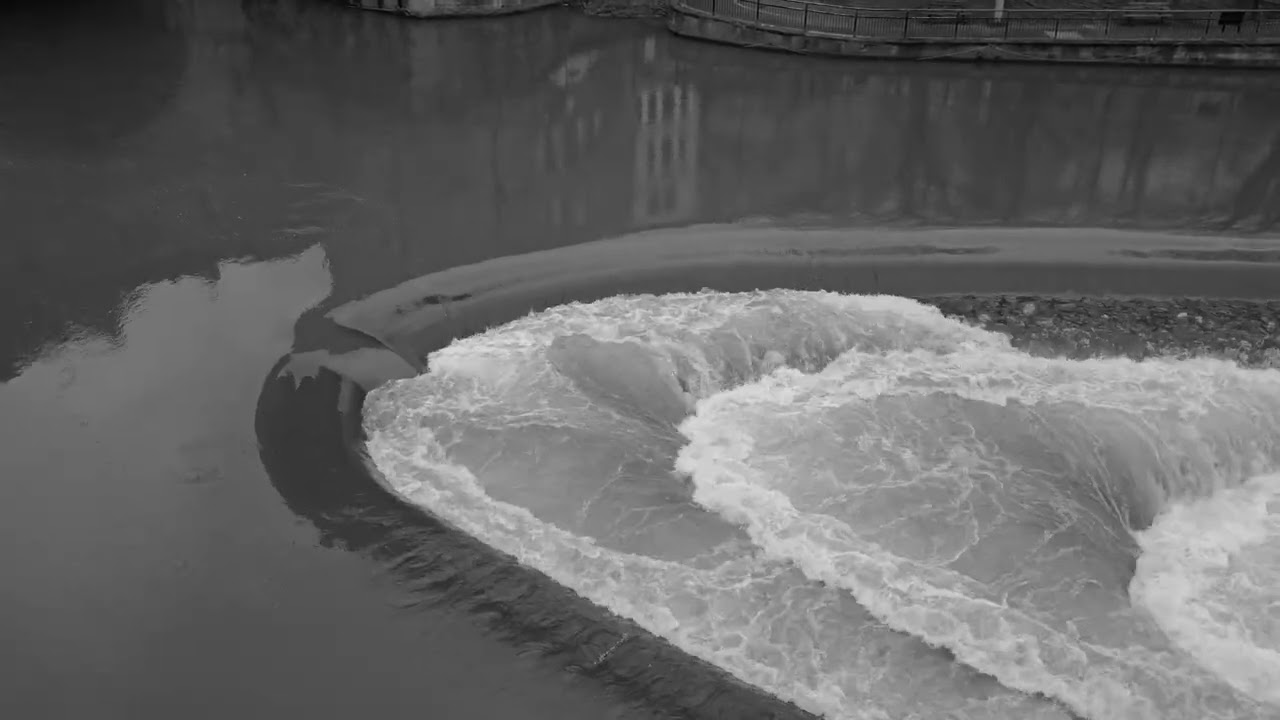
4K footage looks stunning, as you can see in the compilation of clips above. Movement of the water is fluid and flawless at 60fps, and the weir looks almost mesmerizing. I also think the camera has captured the moodiness of the overcast weather well. If you want to capture a wider dynamic range and for more flexibility in post, you have the option to shoot in L-Log as well.
Leica Q3 Monochrom review: Battery life
Leica continues to miss the mark when it comes to its cameras’ battery life. Packing a 2,200mAh Lithium-ion rechargeable battery, the Leica Q3 Monochrom is CIPA-rated for a measly 302 shots. Although poor, it’s worth noting that this is still better than the Sony RX1R III, CIPA-rated for 270 shots only.

CIPA tests are usually conducted under strict conditions, and Leica specifies another rating for the Q3 Monochrom, and says that the camera can last for up to 1,535 shots with the Adaptive Shooting Cycle. According to the official product page, this test is done in two stages, which are repeated alternately until the battery is empty:
“Cycle 1: Switch on, 1st shutter release after 5s, one shot every 3s, the camera switches off after 10 shots (Auto Power Off) and switched back on after a waiting time of 5 min.
“Cycle 2: Switch on, 1st shutter release after 5s, one shot every 3s, the camera switches off after 50 shots (Auto Power Off) and switched back on after a waiting time of 5 min.”
While this is not exactly how I tested the camera, I consistently checked the media playback, adjusted settings, and used a combination of the EVF and the monitor for framing. I took over 600 photos between charges. Though this is nearly double of the CIPA rating stated by Leica, I’d recommend taking that value as the reference point, as the results will vary depending on whether you’re shooting in burst, etc.
Leica Q3 Monochrom review: Verdict

If you’re a fan of black-and-white photography and need a premium, good-looking camera that takes beautiful images, it’s hard not to recommend the Leica Q3 Monochrom. Its 60.3MP sensor captures an astounding level of detail, perfect for large-format printing and extreme cropping. The camera boasts clean high ISO and dynamic range performance, giving you plenty of freedom in post-production.
The camera itself is tactile to use and handle, with a straightforward control scheme and stripped back menu system. It looks and feels like a Leica but omits the classic red dot to make it an inconspicuous street shooter.
Though it costs a lot of doubloons and its CIPA-rated battery life of 302 shots is underwhelming, few cameras are better at pure black-and-white photography than the Q3 Monochrom.