



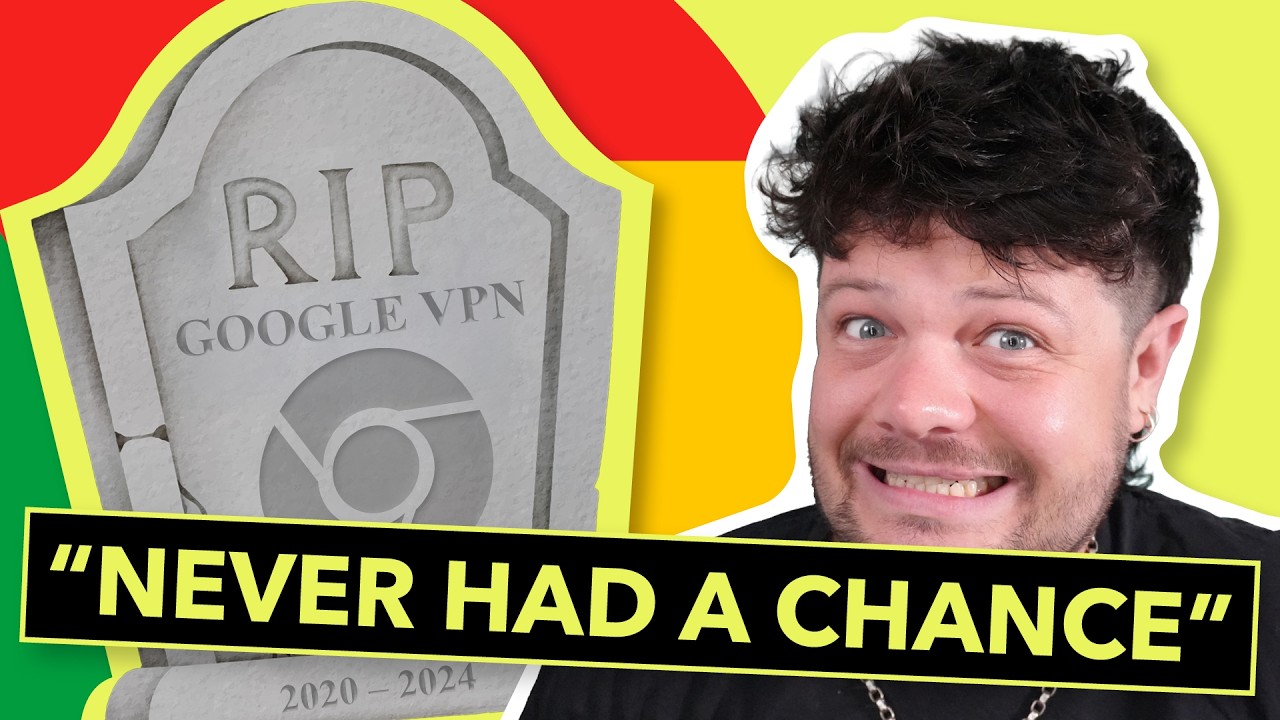
You can watch this article as a video on The Privacy Lab's YouTube channel.
In October 2020, Google launched a virtual private network. Of course, this seemed out of character – one of the most data-hungry companies in the world whipping up a product to help people protect that exact commodity. But, on paper, Google VPN looked pretty good. It had a huge server network and because it came bundled with premium Google Drive plans, for many it was effectively "free." There were murmurings that it could even dethrone the big names that populate our guide to the best VPNs overall.
However, in April 2024, it was announced that the VPN was destined for the Google graveyard. By June, it was dead and buried.
As ZDNet reported, Google stated: "We're refocusing our efforts to support more in-demand features with Google One. To keep our subscription service fresh, we're discontinuing the VPN feature." In short, Google's reasoning was that people simply weren't using it.
But that was just a cover story.
A clash of philosophies

To understand Google VPN's issues, you have to look at the business model first. Effectively, Google is a data and advertising company. It makes money by tracking your searches, mapping your locations, and ultimately building a very specific profile around you to sell targeted ads.
However, VPNs are designed to stop exactly that. By encrypting your data, VPNs allow you to hide what you're doing from your internet provider, government, and any hackers on dodgy networks. By changing your IP address, they make it harder to build a profile from your activity. Naturally, people were skeptical of Google developing such a product.
To build trust, Google published white papers, open-sourced the apps, and even commissioned independent audits. For example, in its official technical white paper, Google laid out how hard it worked to protect your data, writing:
"By employing a cryptographic blind signing step between user authentication and connecting to the VPN, we give users a stronger guarantee that their network activity can't be tied back to their identity."
Cybersecurity firm NCC Group agreed, writing in its public report that it found the system to have "a robust implementation and a strong technical security posture."
The truth is that Google's VPN was very secure. But even with these stamps of approval, most of us struggled to look past the irony of asking an advertising giant to secure your web traffic. The audience looking for privacy didn't trust Google, and the audience that trusted Google didn't care about privacy.
A VPN limited by design

Perhaps more people trusted Google than I'm giving them credit for. But those that did use Google VPN found it was no match for established names like NordVPN, Proton VPN, or Mullvad. It couldn't compete because it only did half the job.
Most people want their VPN to change their virtual location. That might be to access regional sites like BBC iPlayer and watch more shows on Netflix, or maybe to avoid content restrictions in countries like Russia and China. Either way, it's a core feature of any good VPN.
However, even on its paid plan, Google VPN did not let you choose a country to connect to. Instead, when it was first launched, it only allocated you an IP address in your "broad" location. In reality, that often meant connecting to a server several states away. This ended up messing with things like weather reports and proved very annoying – especially for people who didn't really understand how VPNs work.
In 2023, Google addressed this by allowing you to use a "local" IP address nearer your real location, but there was still no true location choice. This decision was an absolute dealbreaker for millions of potential customers.
What's more, the app was seriously underpowered. It lacked things like protocol switching, dedicated IPs, port forwarding, obfuscation, or split tunneling. Plus, if you didn't have a Pixel phone, Google VPN didn’t even have a kill switch to block internet traffic if it crashed.
In short, it was half-baked. Anyone actively looking to buy a VPN realised pretty quickly that there were so many better options out there.
The fragmented ecosystem

You might have noticed that there are more than a few similarities between Google's VPN and another well-known privacy tool from a Big Tech company: Apple Private Relay. Really, they are – or were – exactly the same thing: a limited VPN bundled with cloud storage.
But there are a few key reasons why Google VPN failed spectacularly, and why Private Relay is still going strong. Buckle up – Google made all of this quite confusing.
There were in fact three different versions of Google VPN: Google One VPN (RIP), Google Fi Wireless VPN, and VPN by Google. The latter two still exist, both now called VPN by Google, but in reality they're two different bits of software. Notably, though, the now-dead Google One VPN was the only one available for anyone to buy. The others require Google hardware to use them.
Coverage at the time shows the disconnect. Initially, Google stated that it was shuttering the VPN because "people weren't using it." However, it was also announced that the VPN would live on in the form of the Pixel VPN. And that's not to mention Google Fi.
Confusing, right? Well, it doesn't stop there. If we consider each product separately, they all appear to have different purposes and different goals – and none seem properly integrated. Let's quickly have a look at these:
- Google One VPN: This is the one that died, the one I covered the most here at Tom's Guide, and probably the most-used version at the time. It was used as an incentive to convince users to buy more cloud storage, and the only version available without the purchase of a Google hardware product.
- Google Fi Wireless VPN: This VPN's purpose was to convince customers to switch their phone lines over to Google's cellular network, and was available with a Google Fi subscription.
- Pixel VPN: The Pixel VPN's goal was to increase physical phone sales. Essentially, Google wanted to offer perks to compete with the iPhone. This version was only available with the purchase of a Pixel 7 or newer phone.
Although there's no definitive proof, it appears that each team responsible for these three products was totally separate from the other. The three VPNs may even have run on completely different infrastructures.
Here's a clue that points that way: Google claims it shut down Google One VPN due to low usage – but this was arguably the most-used version of the three. If all three VPNs shared the same servers, why kill the most popular one for being underused, while Fi and Pixel carried on unaffected? It suggests, at the very least, that Google One VPN was built and run with little coordination with Google's other VPN ventures.
Even if we avoid conjecture entirely, the fact remains that in early 2024 you could own a Pixel phone, run it on Google Fi, and pay for a Google One cloud storage – meaning you'd have three different Google-branded VPNs competing for control over the exact same traffic.
Suffice to say, it seems Google wasn't quite as organised as you might expect one of the richest companies in the world to be.
The pivot to AI

Running a VPN is expensive. Thousands of servers in dozens of countries, tip-top security, and routing huge amounts of data takes a lot of cash.
For a company like NordVPN or ExpressVPN, these costs are justified because it's their entire business. For Google, it was a expense that wasn’t generating any revenue. No one was subscribing to Google One just for the VPN – it was just a "perk" that came with their cloud storage, which they probably didn't use.
Then, in early 2024, Google changed tack. AI was here. Google's CEO, Sundar Pichai, celebrated a massive milestone on X, but his words betrayed the future of Google:
We just crossed 100M Google One subscribers! Looking forward to building on that momentum with our new AI Premium Plan (launched yesterday) offering AI features like Gemini Advanced, plus Gemini in Gmail, Docs + more coming soon. https://t.co/m7zAVop7P6 pic.twitter.com/sMdwJeq0iUFebruary 9, 2024
The writing was on the wall. The future of Google's subscription business didn't include tools like a VPN. It was going to be driven by artificial intelligence – and there was no reason to maintain an unpopular product that didn't line the coffers.
Bottom line
Ultimately, the collapse of Google VPN proves that privacy can't be treated as an afterthought. A successful VPN needs more than solid engineering – it demands an overall philosophy that isn’t compromised by a business model based around advertising and data collection. Google didn't fail because it lacked the technology. It failed because it lacked the trust.
Then, when the AI boom hit, the VPN was first on the chopping block. Google could no longer justify maintaining an expensive and underused infrastructure that actively protected your data – the commodity most valued by the tech giant. By killing the VPN, it cleared the path for Gemini and showed us exactly where Big Tech’s priorities lie.
But, for us, this was a win. Consumers sent a message that they refused to compromise on trust just for the convenience of a cheap bundle. You voted with your wallets, and Google had to listen.
We have contacted Google for comment. We await their reply.
We test and review VPN services in the context of legal recreational uses. For example: 1. Accessing a service from another country (subject to the terms and conditions of that service). 2. Protecting your online security and strengthening your online privacy when abroad. We do not support or condone the illegal or malicious use of VPN services. Consuming pirated content that is paid-for is neither endorsed nor approved by Future Publishing.

