Tom's Guide Verdict
The iPhone 18 Pro and iPhone 18 Pro Max raise the bar for performance in a phone with the new A20 Pro chip. You also get a versatile new variable aperture camera that takes brighter images and gives you more creative control. The battery life from both devices is awesome, too, and you get the fastest charging yet from an iPhone. You have to pay $100 more for both Pro phones, and they’re heavier than their predecessors, but overall these are easily the best phones money can buy.
Pros
- +
Fastest chip in a phone
- +
Variable aperture camera
- +
New Pro controls
- +
Super long battery life
- +
Smarter Siri AI
- +
Faster charging
Cons
- -
$100 price hike
- -
Heavier designs
Why you can trust Tom's Guide Our writers and editors spend hours analyzing and reviewing products, services, and apps to help find what's best for you. Find out more about how we test, analyze, and rate.
The iPhone 18 Pro and iPhone 18 Pro Max don’t have a ‘wow’ feature to flex to your friends like the iPhone Duo. Yet beneath the familiar design is a pretty big leap forward for two areas people really care about: cameras and performance.
With a new variable aperture main camera, the iPhone 18 Pro lets in more light and gives you more creative freedom than ever before with new Pro controls. And the A20 Pro chip — the first 2nm chip in a phone — delivers record-breaking speed that surpasses all Android flagships. Based on our testing, the iPhone 18 Pro and Pro Max battery life is stellar, too. And with the new Siri AI on board these Pro phones are much more capable personal assistants.
The bad news? The iPhone 18 Pro and iPhone 18 Pro Max are noticeably heavier than their predecessors, and the prices are $100 higher for both models. But if you’ve been putting off that upgrade for a while, you'll find that both of these Pros are the best phones you can buy.
iPhone 18 Pro and Pro Max: Specs
| Row 0 - Cell 0 | iPhone 18 Pro |
iPhone 18 Pro Max |
Price |
From $1,199 |
From $1,299 |
Main Display |
6.3-inch Super Retina XDR display (2,622 x 1,206) |
6.9-inch Super Retina XDR display (2,868 x 1,320) |
Processor |
A20 Pro |
A20 Pro |
Storage |
256GB, 512GB, 1TB, 2TB |
256GB, 512GB, 1TB, 2TB |
RAM |
12GB |
12GB |
Front Camera |
18MP Center Stage camera (f/1.9) |
18MP Center Stage camera (f/1.9) |
Rear Cameras |
48MP main with variable aperture (f/1.48, f/1.8, f/2.8, f/4), 48MP ultrawide (f/2.2), 48MP telephoto w/4x optical zoom (f/2.8) |
48MP main with variable aperture (f/1.48, f/1.8, f/2.8, f/4), 48MP ultrawide (f/2.2), 48MP telephoto w/4x optical zoom (f/2.8) |
Battery Life Video Playback |
Up to 36 hours |
Up to 45 hours |
Charging |
60W, 35W wireless |
60W, 35W wireless |
Size |
5.91 x 2.83 x 0.34 inches (150.0 x 71.9 x 8.75 mm) |
6.43 x 3.07 x 0.34 inches (163.4 x 78.0 x 8.75 mm) |
Weight |
7.44 ounces (211 grams) |
8.78 ounces (249 grams) |
IP Rating |
IP68 |
IP68 |
Colors |
Black, Silver, Glacier, Burgundy |
Black, Silver, Glacier, Burgundy |
iPhone 18 Pro and Pro Max Performance: Fastest phones ever

The A20 Pro chip isn’t just the world’s first 2nm chip inside a smartphone; it’s the fastest one we’ve ever tested, blowing away the Android competition.
You get a new CPU with two super cores that are up to 20% faster and four efficiency cores, a 7-core GPU that’s up to 40 percent faster (up from 6 cores) and a new dual 16-core Neural Engine for better AI performance. Plus, there’s a wider memory interface that provides up to 50% more internal bandwidth.
It’s all wrapped up in a new package design that seats the memory next to the SoC instead of on top, which results in better heat dissipation. In fact, the vapor chamber itself has 3x the surface area to deliver better sustained performance (aka, less overheating). So how about the results? They’re pretty staggering.
| Row 0 - Cell 0 | Geekbench 6 (single/multi-core) |
Geekbench 7 |
3DMark Solar Bay Unlimited |
Geekbench AI 1.7 |
iPhone 18 Pro |
4,735 / 12,800 |
4,022 / 11,543 |
61.93 fps / 16,288 |
69245 (Quantitized Core ML/Neural Engine) |
iPhone 18 Pro Max |
4,741 / 12,789 |
4,025 / 11,525 |
67.9 fps/17,850 |
71974 |
Galaxy S26 Ultra |
3,785 / 11,563 |
3,149 / 10,612 |
49.37 fps / 12,984 |
83047 (TensorFlow Lite QNN) |
iPhone 17 Pro |
3,834/ 9,988 |
3,138 / 8,692 |
46.4 fps / 12,208 |
49,050 |
iPhone 17 Pro Max |
3,871 / 9,968 |
3,285 / 8,999 |
46.6 fps / 12,260 |
48549 |
On Geekbench 6, which measures overall performance, the iPhone 18 Pro and iPhone 18 Pro Max scored in the 4,700 range in the single core portion. That’s about 25% higher than the iPhone 17 Pro series and also 25% faster than the Galaxy S26 Ultra’s Snapdragon 8 Elite Gen 5 for Galaxy chip.
In terms of multi-core performance, the A20 Pro once again excelled, offering a 28% boost versus the iPhone 17 Pros. And we’re talking about a 10% advantage over the Galaxy S26 Ultra here.
We also ran the newer Geekbench 7, which has a multi-core benchmark that’s designed to be more real-world and uses more challenging data sets. The iPhone 18 Pro delivered similar performance gains.
The graphics leap is even more impressive from the A20 Pro. On the 3DMark Solar Bay Unlimited test, the iPhone 18 Pro turned in a frame rate of 62 fps, which is 33% faster than the 17 Pro. And the iPhone 18 Pro Max scored an even higher 67.9 fps, which is 45% faster than the 17 Pro Max.
The Galaxy S26 Ultra just couldn’t keep up, as the regular iPhone 18 Pro was 25% faster and the iPhone 18 Pro Max was 37% higher.

When playing the game Ungodly, the gameplay remained fluid even while I was slicing through three enemies at once with my sword. And the animations looked just as crisp as console gameplay when I switched characters and rained down fire attacks on my enemies.
So how about Apple’s sustained performance claims? Thanks to the larger vapor chamber and design of the A20 Pro chip, Apple promises up to a 40% improvement. The iPhone 18 Pro and Pro Max did indeed impress when we ran the 3DMark Wild Life Extreme Stress Test, which loops through a graphics test 20 times in a row.
| Row 0 - Cell 0 | 3DMark Wild Life Extreme Stress Test Stability Score |
iPhone 18 Pro |
62.8% |
iPhone 18 Pro Max |
79.4% |
Galaxy S26 Ultra |
53.9% |
iPhone 17 Pro |
61.1% |
iPhone 17 Pro Max |
65.2% |
The iPhone 18 Pro Max turned in a stability score of 79.4%, which is 25% better than the iPhone 17 Pro Max. That’s also over 47% better than the Galaxy S26 Ultra. However, we saw only a minor 1.7% gain between the iPhone 17 Pro and 18 Pro.
Last but not least we tested AI performance using the Geekbench AI test. The iPhone 18 Pro turned in a Neural Engine score of 69,245 and the iPhone 18 Pro Max a much higher 71,974. That’s a boost of 41 to 48%, which means on-device AI tasks should run faster.
iPhone 18 Pro and Pro Max: Battery life and charging

Thanks to the efficiency of the A20 Pro chip and bigger batteries, the iPhone 18 Pro Max is rated to have the longest battery life ever of any iPhone. And the iPhone 18 Pro is rated for the endurance of last year’s iPhone 17 Pro Max, which made our best phone battery life list last year.
The good news is that both the iPhone 18 Pro Max and iPhone 18 Pro last longer than their 17 Pro counterparts. But we didn’t see a huge leap in endurance.
| Row 0 - Cell 0 | Hrs:Mins |
iPhone 18 Pro Max |
18:27 |
iPhone 18 Pro |
16:17 |
iPhone 17 Pro Max |
17:54 |
iPhone 17 Pro |
15:21 |
Galaxy S26 Ultra |
16:40 |
OnePlus 15 |
25:13 |
On the Tom’s Guide battery test, which involves continuous web surfing over 5G on 150 nits of screen brightness, the iPhone 18 Pro Max lasted 18 hours and 41 minutes on its longest run and averaged 18:27. The iPhone 17 Pro Max lasted 17:54.
The iPhone 18 Pro lasted an average of 16:17 on our test, which is nearly an hour longer than the iPhone 17 Pro (15:21).
By comparison, the Galaxy S26 Ultra averaged 16:40 with the display mode set to standard and 16:10 in adaptive mode. So the iPhone 18 Pro Max lasts about 2 hours longer on a charge.
The OnePlus 15 is still the champ with its silicon carbon battery at 25 hours and 13 minutes. It will be interesting to see what happens when (or if) Apple embraces this technology for itself.
The iPhone 18 Pro and Pro Max both support 60W charging for the first time, and Apple promises a 30% charge in just 15 minutes. The iPhone 18 Pro hit 53% in 15 minutes and 80% in 30 minutes, but the iPhone 18 Pro Max was a bit behind with 44% and 77%, respectively.
iPhone 18 Pro and Pro Max Cameras: What variable aperture can do

The iPhone 18 Pro and Pro Max have a first for iPhones, even though the Samsung Galaxy S9 tried it years ago. I’m talking about a variable aperture main camera. There’s six tiny blades inside the wide lens that can expand or contract depending on the conditions.
For example, if you’re taking a portrait, the aperture might open up to f/1.48 to let in more light. And if you want more detail throughout the shot, the iPhone 18 Pro Max might stop down to f/4.0. This gives you more depth of field.
The iPhone 18 Pro’s camera can do this all automatically, but there’s new Pro controls on board that lets you set the exact aperture with four options.


In the above portrait, you can see that the menu in the background is blurred out at f/1.48, but it's clear when I set it to f/4.

When I captured a photo of begonias in Bryant Park, I selected f/1.48 to blur the background and f/4.0 to bring detail to the stage across the park and buildings.
The wider aperture of the iPhone 18 Pro and Pro Max also enables the phones to let in significantly more light overall, which means better low-light images.


Take this American flag photo captured in near darkness. You can make out more detail in the flag pole and the brick in the iPhone 18 Pro image. The Galaxy S26 Ultra shot is downright blurry.


Indoors I’d give a slight edge to the iPhone 18 Pro with this shot of Halloween decorations. The dots of light reflecting off the transparent orb look sharper through the iPhone. But the Galaxy S26 Ultra’s photo has more saturated colors inside the ball and in the fabric.


As you can see in the gallery above, the iPhone 18 Pro takes a better looking shot of produce (the red peppers don’t look right through the Samsung).
When it comes to zoom power, the iPhone 18 Pro and Pro Max hold their own with a 4x telephoto lens and 8x optical quality zoom. The iPhone is neck and neck with Samsung with this 10x zoom shot of a pumpkin.
However, at 40x the iPhone really struggles versus the S26 Ultra. Check out the sign above. I'm sure the Galaxy is doing some AI processing, but the test is definitely sharper in its photo.
iPhone 18 Pro and Pro Max: Video
My favorite video feature when testing the iPhone 18 Pro and Pro Max is the ability to add Cinematic mode to your clips after the fact. You no longer have to select the mode before you start shooting.


I had someone capture a video of me walking down a park trail. Afterwards, I toggled the Cinematic mode feature in editing right at the top of the screen. Sure enough, the iPhone 18 Pro added an artful blur to the footage.
Other new features include 4K Timelapse in Dolby Vision HDR, higher-quality low-light video in 1080p resolution and Pro controls for video, such as shutter speed.

To test out the iPhone 18 Pro’s video capabilities I shot this koi pond with a fountain using the new iPhone and Galaxy S26 Ultra at 4K at 30 fps with HDR turned on. I prefer the way the iPhone 18 Pro renders the details in the rocks and its smoother zooming motion; the S26 Ultra takes a second to regain focus. However, the S26 Ultra’s superior zoom shines when I get really close on the fountain wall.

iPhone 18 Pro and Pro Max: Siri AI and Apple Intelligence

I’m not going to say that Siri AI is smarter than Gemini or ChatGPT yet, but it’s come a long way with iOS 27, and is now a lot more helpful. That’s because Siri now better understands your personal context, and it can let you do multiple things with a single voice prompt.
For example, I asked Siri to look up reviews for a hotel I was thinking of staying at with my brother for a road trip and send them via text in the same prompt. The results seemed okay but didn’t have as much detail as I’d like. So I tried again, asking for best dishes.
I can also control three different apps with the same prompt, such as setting a reminder, starting a timer and looking up photos and adding them to a Note. The new Siri AI is smarter and more powerful, but sometimes it started doing the first thing I asked before I got to the second request, interrupting the flow.
Visual Intelligence also gets an upgrade with iOS 27 and the iPhone 18 Pros. For example, I pointed the iPhone 18 Pro Max at a flyer with a bunch of dates on it, and it automatically recognized the dates and asked if I wanted to add them to my calendar. I especially like that there’s a dedicated Siri mode in the camera app so you don’t have to go to a separate app.
However, Siri AI is not quite as robust as Gemini or ChatGPT Voice. You can’t have a live back-and-forth conversation about what’s live in your camera view. This comes in quite handy for troubleshooting.
Other helpful Apple Intelligence features include contextually relevant cards that pop up when you’re texting. For example, you might get a prompt to add something to your calendar or reminders with a little icon.
Some of the coolest Apple Intelligence upgrades live in the camera app. For example, with Reframe you can change the angle of your photo after the fact. I did this with a photo of my daughter and the iPhone 18 Pro Max basically guessed what the background was of the pier and filled it in.
In addition, you can extend the background of your photos via Apple Intelligence. I tried this with a group shot of me, TechRadar’s Lance Ulanoff and Apple’s CEO John Ternus and Joz. It added a plant that wasn’t there and extended Lance’s arm. It’s a bit cool but also kinda creepy. Clean Up also gets a performance boost, making it faster to remove unwanted objects or people from your photos.
iPhone 18 Pro and Pro Max: Design and colors

Most people would find it challenging to tell the difference between the iPhone 18 Pro series and iPhone 17 Pro phones. But there’s a couple of telltale signs.
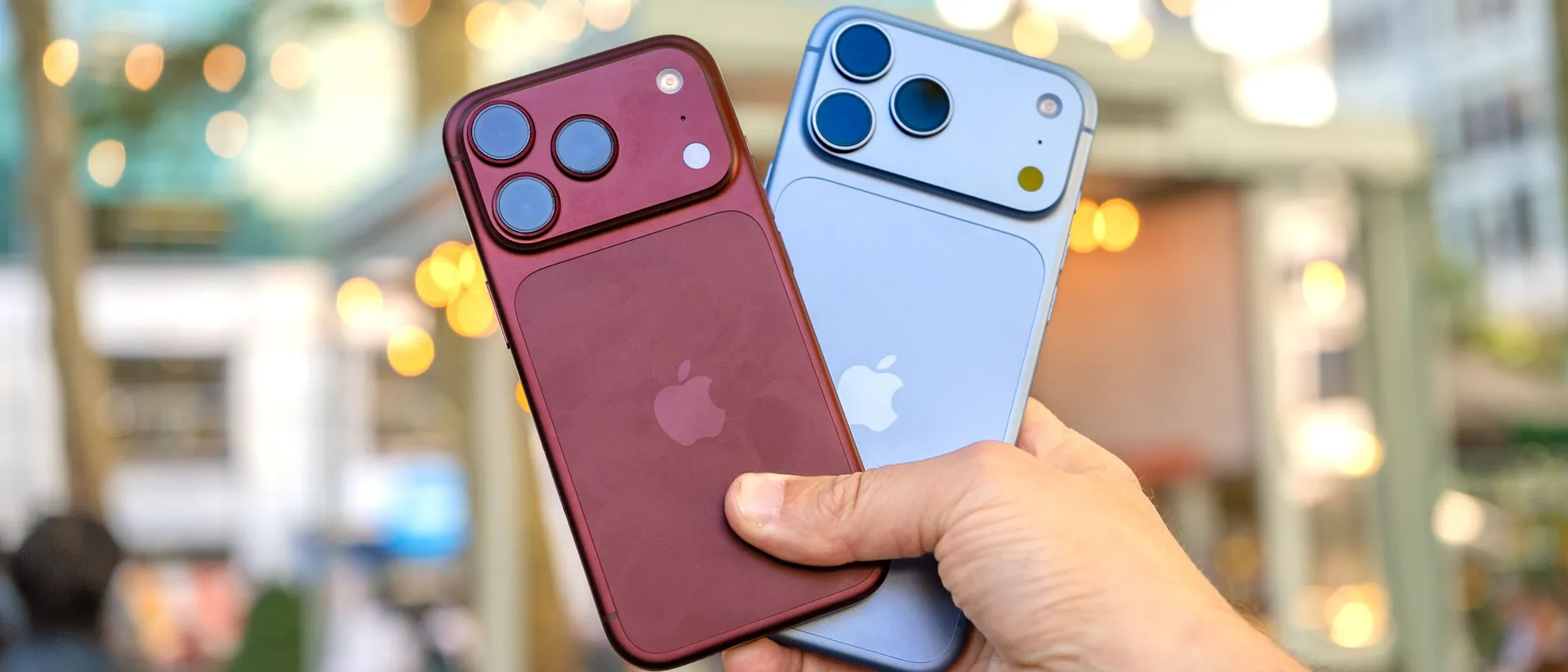
First, the iPhone 18 Pro and Pro Max have new colors, and Apple has done a better job of color matching the plateau and back glass of these phones. It’s no longer a two-tone look. I tested the Glacier (blue) version of the iPhone 18 Pro Max and the Burgundy iPhone 18 Pro. I prefer the Glacier, but Burgundy has a sophistication to it. You can also take your pick from Black or Silver.

The other key visual change is a smaller Dynamic Island. Apple moved the infrared sensor for Face ID under the display, allowing for a tinier cutout at the top of the display. Plus, you can now have up to three Live activities running at once inside the Dynamic Island area, such as a timer, Spotify and Uber status.
| Row 0 - Cell 0 | Weight |
iPhone 18 Pro |
7.44 oz (211 g) |
iPhone 18 Pro Max |
8.78 oz (249 g) |
iPhone 17 Pro |
7.27 oz (206 g) |
iPhone 17 Pro Max |
8.22 oz (233 g) |
Perhaps owing to the bigger batteries, variable aperture lens camera and larger vapor chambers, the iPhone 18 Pro and Pro Max are heftier than their predecessors despite having the same dimensions as before. At least they fit in the same cases as the 17 Pro series if you're upgrading.
iPhone 18 Pro and Pro Max: Displays

The iPhone 18 Pro and Pro Max once again offer 6.3-inch and 6.9-inch displays with 120Hz refresh rates and rated 3,000 nits of maximum brightness. These panels are identical versus the iPhone 17 Pro series, but if you’re coming from an iPhone 16 Pro or Pro Max you’ll appreciate the anti-reflective coating.
In our lab tests, the iPhone 18 Pro and Pro Max delivered strong results. Using our Klein K10-A probe combined with the Patterns Mobile iOS app, we measured a maximum brightness of 2,326 nits in a 25% window and 1,762 nits in a 10% window. The iPhone 18 Pro hit a similar 2,314 and 1,627.

The iPhone 17 Pro Max scored 2,324 in a 25% window and 1,882 at 10%, so comparable performance. We have not yet tested the iPhone 17 Pro for comparison.
The Galaxy S26 Ultra doesn’t support the Patterns Mobile app, but we measured HDR brightness in a 10% window with the same equipment. It reached 1,478 nits.
iPhone 18 Pro Max vs. iPhone Duo

If you’re on the fence between the $1,299 iPhone 18 Pro Max and $1,999 iPhone Duo, here’s a quick cheat sheet. The iPhone 18 Pro Max is the phone to get if you want a telephoto camera for better zooming and the longest possible battery life. Plus, only the iPhone 18 Pro Max offers Face ID; the Duo uses Touch ID.
The iPhone Duo is the phone for you if you want the ability to have a small phone and tablet in the same device. You get a larger 7.6-inch main display, versus 6.9 inches on the iPhone 18 Pro Max, plus the ability to run two apps side by side. It’s the better choice for watching videos and multitasking.
Verdict

My take on the iPhone 18 Pro and iPhone 18 Pro Max is that they are obscenely powerful phones inside a quiet redesign. You get the fastest chip ever in a phone with the A20 Pro, a variable aperture camera I find easy to use and overdue Pro controls that give you more creative freedom when shooting photos and videos.
I personally really like the ability to transform your pics and clips after the fact, whether it’s reframing your shots or adding a Cinematic effect to your footage. And while Siri AI is no Gemini killer, Apple has made great strides with its assistant to the point where it’s a lot more helpful in the moment. I can guarantee you’ll wind up using other chatbots less.
Between the iPhone 18 Pro and iPhone 18 Pro Max, I’d opt for the Pro Max because of the bigger screen and longer battery life, but the regular 18 Pro is no slouch and an hour better than the 17 Pro based on our testing.
I think the Galaxy S26 Ultra is still the phone to beat when it comes to zooming power and AI features, but it’s not nearly as fast as the iPhone 18 Pros and lasts two hours less on a charge versus the Max.
Sure, Apple is expected to completely reinvent the iPhone with the iPhone XX/iPhone 20 next year with a rumored all-screen design. But if you want the most powerful iPhone ever in a familiar body, the iPhone 18 Pro and iPhone 18 Pro Max are easily the best non-folding phones money can buy.