For years, my mom has been my equivalent of an ongoing sleep study, always asking if I had a good night's rest. Recently, however, I've started using the Withings Sleep tracker, $199.95 at Withings in stead, which not only enquires after my sleep but is helping me actively improve it. Sorry, mom, you've been upgraded.
Tested against clinical polysomnography, the gold standard of sleep studies, the Withings Sleep observes data such as movement, breathing and even heart rate to form an overall picture of your sleep.
It then breaks your night into key metrics — and here's where the magic happens. Following these metrics is helping me understand my sleep and actually improve it. Here's how I'm sleeping deeper and longer with the help of one of the best sleep trackers we've tested.
The sleep tracker I'm using
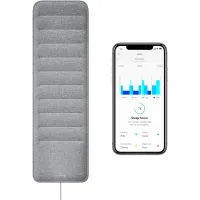
Withings Sleep is an under-the-bed sleep tracker mat that slips beneath your mattress (it measures 25" x 7.5" and is only 0.2" thick) and uses pneumatic and sound sensors to monitors data like movement and breathing.
In the morning, the results await in the accompanying Withings app. Here you can access your overall sleep score alongside metrics including sleep time and depth, HRV and breathing, as well as your sleep diary.
Like all sleep trackers, the Withings has its limitations (it sometimes confuses light sleep with time awake, for example.)
But Withings notes the tracker has been developed alongside sleep physicians from Hôpital Béclère in Paris, France, and tested against data from polysomnography (PSG) tests, the 'gold standard of sleep diagnostics'.
It's not quite as advanced or insightful as true PSG, which requires being directly connected to a variety of sensors and occasional video monitoring.
But there's two major drawbacks preventing me from undergoing polysomnography. First, it's expensive. Second, I know once those sensors are attached to my head, I won't be sleeping a wink.
My Withings tracker is an excellent, accessible alternative and after months of consistent use, I've noticed some clear benefits.
3 ways my Withings Sleep tracker has improved my sleep
First of all, you get what you put in when it comes to a sleep tracker — my Withings isn't improving my sleep by sending magical beams through my mattress (if only.)
But it is helping me recognize the problems in my sleep, so I can boost my duration and depth.
1. It helped me identify the right bedtime
I have an early start on Monday and Tuesday so to prepare for a 6 a.m. alarm, I used to go to bed around 9.30 p.m. Sensible, right? I was maximizing my time in bed to ensure I had ample opportunity for sleep.
But my tracker notes both when I go to bed and when I fall asleep and exposed one big problem: my early nights didn't correlate to more rest. Instead it would take me over an hour to drop off (keeping in mind that typical sleep latency is 10-20 minutes.)

This is because my circadian rhythm is trained to a later bedtime. While my brain knowns I want to sleep, my body thinks it's still the 'wind-down' phase.
I recommend (and my tracker results agree) sticking to the 60 minute bedtime rule: pick an anchor bedtime (say, 10.30 p.m.) and aim to go to sleep within a 30 minute time frame either side of this anchor (so 10 p.m. to 11 p.m.) This teaches your body clock regularity, and with that comes faster sleep onset.
2. It showed the fix to one of the biggest problems with my sleep
When I wake up in the middle of the night, I panic. I can practically feel tomorrow's energy slipping away with every second I spend awake, leaving me desperately trying to sleep — and completely unable to do so.
Some nights I find it so frustrating the only thing I can do is get out of bed and try to achieve some zen in another room.

Curiously, looking at my Withings app revealed that getting out of bed typically resulted in less time spent awake and deeper sleep overall for the rest of the night. My frustrated response was actually a healthy habit.
This is known as the '15 minute sleep rule' and it encourages you to get up during disrupted nights, breaking the connection between 'bed' and 'annoyed' so you can reclaim your sleep. It's now my go-to response to waking up at 3 a.m.
3. I've found long-term, sustainable sleep solutions
I cover a lot of sleep hacks for Tom's Guide — from mouth taping to finger breathing — and while I enjoy a quick trick, my sleep tracker is helping me understand the best response is focusing on sleep hygiene.
After months of using the Withings I've noticed my Sleep Depth, Interruptions and Time To Sleep are the three variables most likely to fall into the amber or red zone.

On its own, this info might not mean much, but combined with the Withings Sleep Diary feature, I can identify the habits that are impacting my sleep.
And what do you know, the days I eat late, drink alcohol in the evening, or go to bed frustrated and stressed correlate to my key metrics falling into the red zone.
By starkly laying out my sleep-sabotaging habits, I know that even the flashiest TikTok hacks won't have an impact if I don't follow good routines.