Could the secret to falling back asleep when you wake up at night really be as weird and wonderful as disrupting your brain's 'wakefulness' waves?
That's what I asked myself when I tried out the Elemind sleep headband, priced from $399 at Elemind, a wearable neurotechnology device that provides acoustic stimulation tailored to your brainwaves to help you fall asleep.
As a light sleeper who often finds herself wide awake at 3 a.m., I'm the perfect candidate for the Elemind.
I tried it for a little over a week and, yes, it works. However, I also discovered two major drawbacks which stop me from wearing it night after night, and I'm sharing them here...
Key takeaways: At a glance
- The Elemind sleep headband uses EEG sensors to monitor brainwaves and bone-conduction 'acoustic stimulation' to suppress wakeful Alpha waves.
- It's designed to quieten your brain so that you fall asleep faster – and sleep through the night – when anxiety, stress and overthinking try to keep you awake.
- While it works, my partner could hear the bone-conduction sound when I lay in bed next to him. I also find the rigid design uncomfortable for side sleeping.
- The Elemind costs $399, which includes the headband and a membership giving you access to analysis of your sleep.
- I recommend the Elemind as part of a pre-sleep routine for people who can't sleep because of anxiety, stress and overwhelm, but there is a no-tech, free alternative that I love more: cognitive shuffling.
- Cognitive shuffling involves visualizing random letters, words and objects to quieten the wakeful part of your brain so you can fall asleep fast again. This is my go-to whenever I wake at 3 a.m.
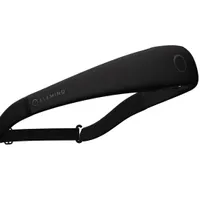
What is the Elemind sleep headband?
The Elemind is a sleep headband that speeds up the process of falling asleep by influencing wakeful brainwaves.
This is done by detecting and monitoring brain electrical activity and then producing acoustic stimulation through bone conduction that encourages brain activity associated with sleep.

Through EEG sensors, the headband is looking for alpha wave activity that's associated with wakefulness (if you're lying awake and overthinking, there's likely plenty of alpha activity).
It then provides sound tailored to your specific brain waves to instead discourage alpha activity and encourage delta and theta activity, which the brain produces naturally when in deep sleep.
The sound, which can best be described as fuzzy, distant weather or pink noise, tapers off when you eventually fall asleep.
You keep the headband on, which then tracks your sleep and provides detailed analytics via the app.
But does it work? My experience of using it

Nighttime anxiety is a big problem for me, which can make it harder to fall asleep and often causes me to wake up at 3 a.m.
I was skeptical that a headband could help with that, but I was wrong. Within minutes of putting the headband on, I was fast asleep.
It's like turning down the volume on overthinking and turning the volume up on sleep
Placing the headband on for the first time involves opening up the app, which tells you in real time if the band is fitted correctly.
Too tight and it's uncomfortable, too loose means that the EEG sensors won't be able to detect brain activity. Finding the right tension takes a little bit of getting used to.
Once it's on and you're ready to go to sleep, you hit 'start session' on the app. From there and through EEG detection, the headband is picking up electrical signals emitted by the brain and then producing sound tailored to your brain activity. This is done via bone conduction.

It's as though, through the power of this specific sound, it's turning the volume down on sleep-disrupting alpha waves and turning the volume up on sleep-inducing delta and theta waves.
The best way I can describe what this feels like is, it's as though you're trying to hold a thought but feeling it slip away.
While that initially feels a bit unsettling, I found the trick is to relax into that sensation and allow sleep to wash over you.
The two flaws that I can't overlook
After trying it, I can say that the Elemind headband worked for me. I fell asleep faster and, when I inevitably woke up in the middle of the night, it helped me fall back asleep then, too.
However, during testing, I also uncovered two major drawbacks...
1. It's disruptive for anyone you share a bed with
Sound from the Elemind headband is emitted through bone conduction (this works by vibrating the skull), which should only be audible for the person wearing the band.
But if the 'leakage' is loud enough, it’s often because the transducers aren't making perfect skin contact or the volume is fighting ambient silence.
However, we soon found that my husband could also hear it. So much so that, when I re-hit the 'start session' button on the app at 3 a.m., the sound of it woke him up.

You can adjust the volume via the app — Elemind recommend that it's audible enough but not so loud that it's disruptive.
I turned the volume down as low as I could without rendering it useless, but it was still loud enough to apparently be annoying.
2. It's uncomfortable for side sleeping
The Elemind headband is relatively low profile and has been designed to suit all sleep positions.
However, as a side sleeper, I didn't find it comfortable when sleeping on my side. Instead, I slept on my back. But even then, I was still very aware of it. (A bit like trying to sleep with rollers in).
What I found I started to do was to pull the headband off in my sleep so I could sleep comfortably on my side.
But that meant that if I wanted to use it to go back to sleep when I woke at 3 a.m, I needed to refit it, which meant opening up the app and waking myself up even further.
The no-tech method I recommend instead

Yes, the Elemind headband works. It's a very clever piece of kit that helps 'hack' the process of falling asleep.
But unless you're a solo back sleeper, I'm not sure I could say that the $399 price tag is warranted.
That's not because it doesn't work, but because it's uncomfortable for side sleeping and disruptive for anyone you share a bed with. In this instance, I recommend the cognitive shuffling method instead.
As someone who swears by cognitive shuffling to fall asleep, I think it shares a few similarities with the Elemind — hear me out.
While one is a high tech wearable and the other is a relaxation technique, both methods are working towards the goal of quietening racing thoughts.
While the Elemind disrupts wakefulness brain waves through sound, cognitive shuffling also helps break the cycle of rumination. But instead of influencing brain activity, it's done by visualizing seemingly random objects and thoughts.

The sleep technique, developed by Canadian scientist, Dr. Luc P. Beaudoin, involves 'shuffling' your stream of consciousness to effectively switch off racing thoughts.
While you won't get the same detailed sleep report with cognitive shuffling as you would the Elemind, you can do it while lying on your side — and it won't wake your husband in the process.
How to use cognitive shuffling
This is one of the best science-backed methods for falling asleep fast. To do it, simply pick a random letter and then think of as many words as you can that begin with that letter.
So, if we use the letter 'E' as an example, words you might think of include:
- Elephant
- Eggs
- Eggplant
- Easter
- Electricity
Once you've have thought of as many words as you can that begin with 'E', pick another letter and repeat the process.
Cognitive shuffling has become such a powerful tool for falling back asleep fast for me that even when I do wake up at 3 .a.m. I can drop off again in a minute or two.
I really notice the impact on my energy lvels the next morning, and I'm not so afraid of anxiety ruining my sleep at night any longer because I know how to deal with it to get back to sleep.