As Samsung's top-performing 4K Mini-LED TV, the QN90F delivers a bright, colorful picture hold ups up better in brightly lit rooms than the S90F. It's stuffed with nearly every streaming- and gaming-related feature you could ask for outside of Dolby Vision.
Pros
- Incredible bright room performance
- Great color accuracy
- Tons of gaming features
Cons
- Middling audio
- No Dolby Vision
- Minor Tizen OS issues
- No ATSC 3.0
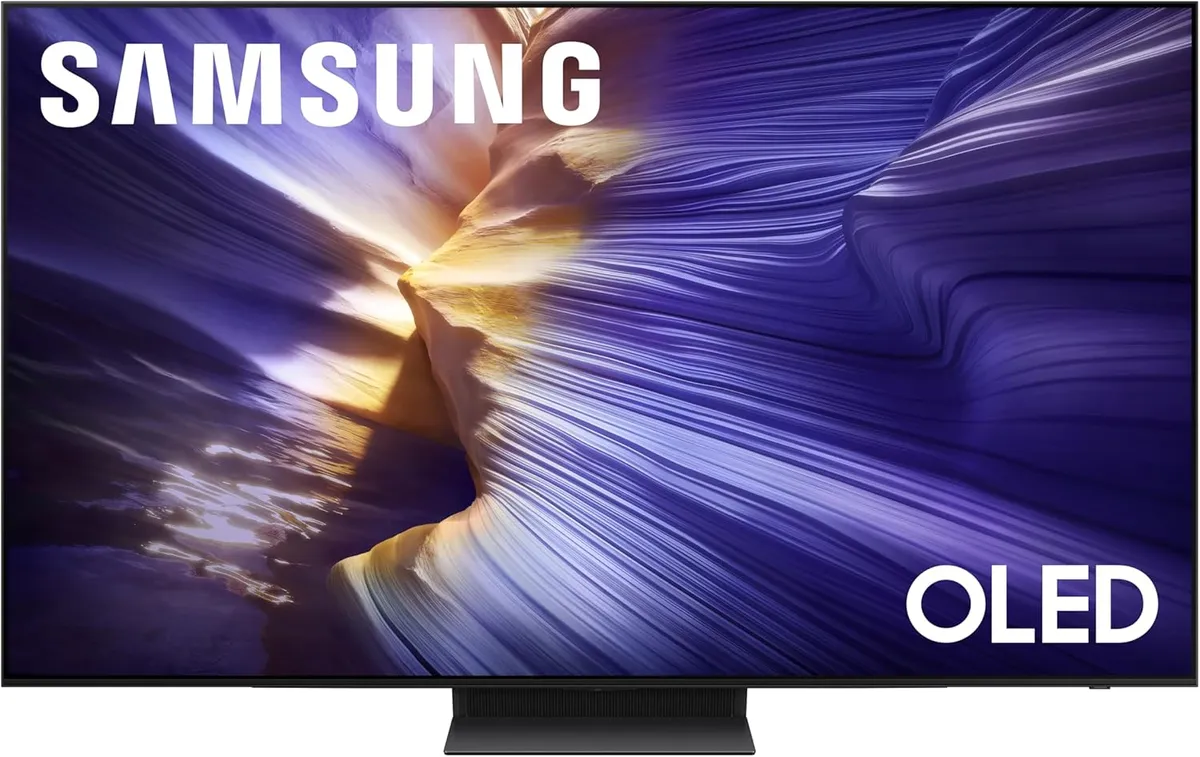
The S90F doesn't get as bright as the QN90F, but its OLED-driven picture is slightly better on account of its pixel-level contrast control. It offers almost all of the same features as the QN90F, but it's similarly missing Dolby Vision support.
Pros
- Incredible color accuracy and color volume
- Tons of gaming features
- Exceptionally thin design
Cons
- Middling audio
- No Dolby Vision
- No ATSC 3.0
- Minor Tizen OS issues
If you’re shopping for a high-performance TV and your priority is a Samsung-branded model, you’ve got several quality options. Among those are the Samsung QN90F — the brand’s top-performing, 4K Mini-LED TV — and the Samsung S90F, a mid-range OLED TV with a similar set of features.
These TVs are close in price but quite different in performance. Both offer sensational picture quality, but how they achieve it is completely different. Here’s everything you need to know about how Samsung’s top Neo QLED TV compares to its mid-range OLED.
Samsung QN90F vs Samsung S95F: specs compared
| Header Cell - Column 0 | Samsung QN90F |
Samsung S90F |
|---|---|---|
Sizes |
43", 50", 55", 65", 75", 85", 98", 115" |
42", 48", 55", 65", 77", 83" |
Ports |
4x HDMI 2.1 |
4x HDMI 2.1 |
Resolution |
3,840 x 2,160p |
3,840 x 2,160p |
Refresh rate |
165Hz |
144Hz |
HDR |
HDR10, HDR10+, HLG |
HDR10, HDR10+, HLG |
Smart TV software |
Tizen OS |
Tizen OS |
ATSC 3.0 support? |
No |
No |
Processor |
NQ4 AI Gen3 |
NQ4 AI Gen3 |
This pair of Samsung TVs has a number of specs in common. Neither set supports ATSC 3.0, so 4K over-the-air broadcasts via an indoor antenna are out of the question.
Like all Samsung TVs available today, neither of these TVs supports Dolby Vision, a proprietary version of enhanced HDR. Instead, Samsung offers HDR10+ across all of its HDR-enabled TVs. HDR10+ is a royalty-free version of the format that, like Dolby Vision, leverages metadata to adjust the picture on a frame-by-frame basis.
You'll still be able to watch Dolby Vision-mastered streaming titles and Blu-rays on both sets, but the picture will fall back to standard HDR10. In other words, these TVs won't be taking full advantage of Dolby Vision's efforts to replicate the creator's intent.
(To learn more about Dolby Vision, check out our guide to whether or not you need Dolby Vision at all.)
When it comes to specs, the QN90F has two key advantages, but they're relatively modest advantages. First, the QN90F supports 4K content up to 165Hz, while the S90F OLED tops out at 144Hz. This will only really affect people who intend to hook one of these TVs up to a PC, however, as current-gen consoles are limited to 4K/120Hz.
In addition, the QN90F is available in two more sizes than the S90F. Crucially, these are 98- and 115-inch models, two niche size points that most people won't be shopping.
The QN90F takes this category because of these technicalities. That said, for most people, these two TVs offer a comparable set of specs.
Winner: Samsung QN90F
Samsung QN90F vs Samsung S95F: design

The back of the Samsung QN90F is pictured above. As you can see, the TV makes use of a pedestal-style stand that connects to a heavy, flat plate. At just a hair over an inch thick, the QN90F's panel is one of the narrowest we've seen for a Mini-LED TV in recent years. All of its internal hardware is spread across the chassis to allow for this uniform profile.
The QN90F's stand lifts the panel several inches above its surface, which is good news for anyone with a dedicated soundbar. There's enough room for most soundbars to sit in front of the QN90F without obstructing one's view.
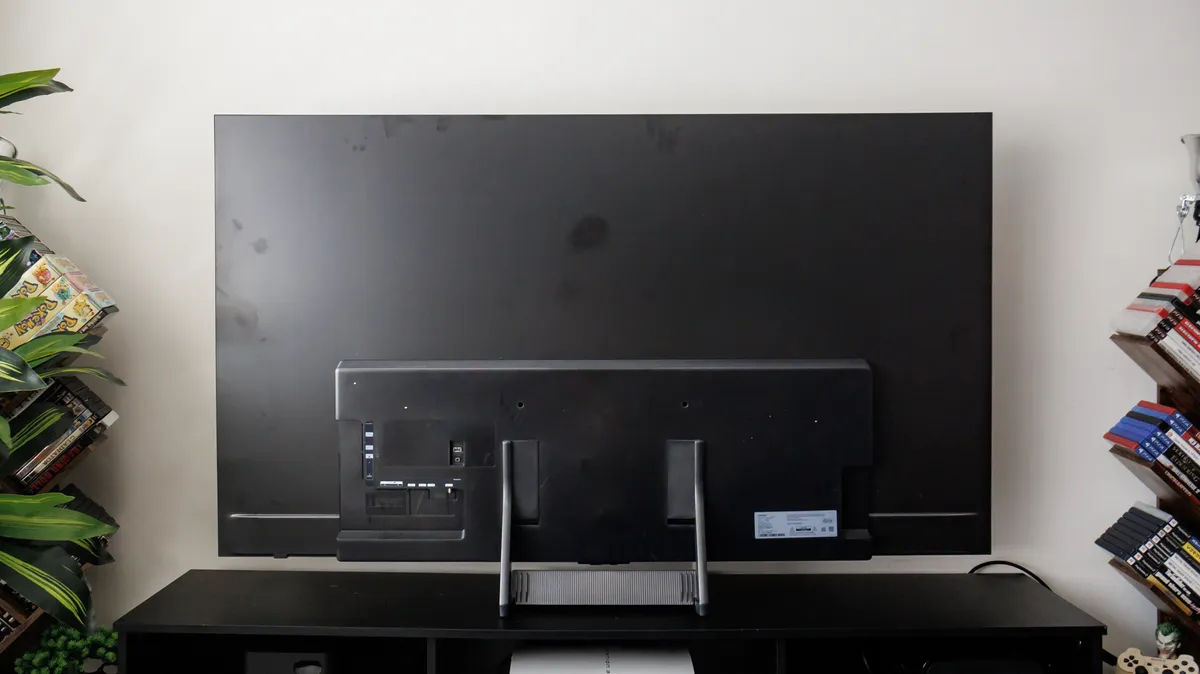
The S90F (pictured above) also uses a pedestal-style stand, but its panel is engineered with a different design approach. Most of the TV's internal hardware is relegated to a rectangular-shaped compartment that bulges outward from the bottom half of the panel's backside. As a result, the S90F's profile isn't uniform.
Nevertheless, the S90F is a posh customer. Like many OLED TVs, the rest of the S90F's panel is wafer-thin and quite impressive-looking when viewed from the side. It might lack the QN90F's edge-to-edge uniformity, but I prefer the signature, ultra-thin look of an OLED TV.
Another key difference between these two TVs lies in their anti-reflective coating. The QN90F features a matte finish, which diffuses glare from direct light sources very effectively. The S90F makes use of a more glossy screen.
As a result, the S90F doesn't handle direct glare as well as the QN90F, but by neglecting the matte finish, it maintains the inky-black presentation that OLEDs are known for.

Both sets arrive with the same remote control: the Samsung Solar Cell remote. It's a sleek little number with a minimal amount of buttons, but its best feature is its rechargeable lithium-ion battery, which taps natural and artificial light for battery life.
I prefer the S90F's design slightly more than the QN90F, but there's no denying the latter's excellent design. It's a close category.
Winner: Samsung S90F
Samsung QN90F vs Samsung S95F: performance

Before we dive into which of these TVs delivers better overall performance, let's take a look at how their test results stack up in a side-by-side comparison. (Both TVs were in Samsung's Filmmaker picture mode when these tests were taken.)
| Header Cell - Column 0 | Samsung QN90F |
Samsung S90F |
|---|---|---|
SDR Brightness (10%, in nits) |
228 |
255 |
Delta-E (lower is better) |
1.8 |
1.1 |
HDR Brightness (10%, in nits) |
2,109 |
1,155 |
UHDA-P3 Gamut Coverage |
93.32% |
100% |
Rec. 2020 Gamut Coverage |
77.44% |
89.03% |
Input latency (milliseconds) |
9.5 |
9.1 |
When comparing these sets, two things ought to jump out at you: brightness and color. As a top-of-the-line, quantum dot-enhanced Mini-LED TV, it's no surprise that the QN90F delivers much better brightness than a mid-range OLED TV. This is one of the ways Samsung Neo QLEDs set themselves apart from OLED TVs.
With that much horsepower under the hood, the QN90F is capable of sizzling specular highlights during HDR content. In other words, small, concentrated bits of brightness practically leap off the screen, giving the picture depth.
However, while the S90F's OLED display tops out at just over half of the QN90F's HDR brightness, its ability to render perfect black levels and to control its brightness on a pixel-by-pixel basis has a tremendously positive impact on picture quality.
Having spent considerable time with both TVs, I find the S90F's picture to be much more cinematic. As good as the QN90F is at showcasing movies and shows with bright, eye-catching highlights, the S90F's overall contrast is much more impressive.

I find the S90F's picture to be much more cinematic.
In addition, the 55-, 65-, and 77-inch versions of the S90F make use of Samsung Display's quantum dot-enhanced OLED panels, which offer brighter, purer color than standard WOLED panels. As you can see from our test results, the S90F's QD-OLED panel also delivers better color volume than the QN90F.
The rest is mostly a wash. Both TVs arrive with incredible out-of-the-box accuracy in Filmmaker mode, and both are super-responsive with input latency measurements that fall below 10ms.
If you're planning on putting your next TV in a sun-soaked room, the QN90F will almost certainly be a more reliable pick. For almost everyone else, the S90F's pixel-level dimming and superior color volume will be the winning choice.
Winner: Samsung S90F
Samsung QN90F vs Samsung S95F: smart platform and features
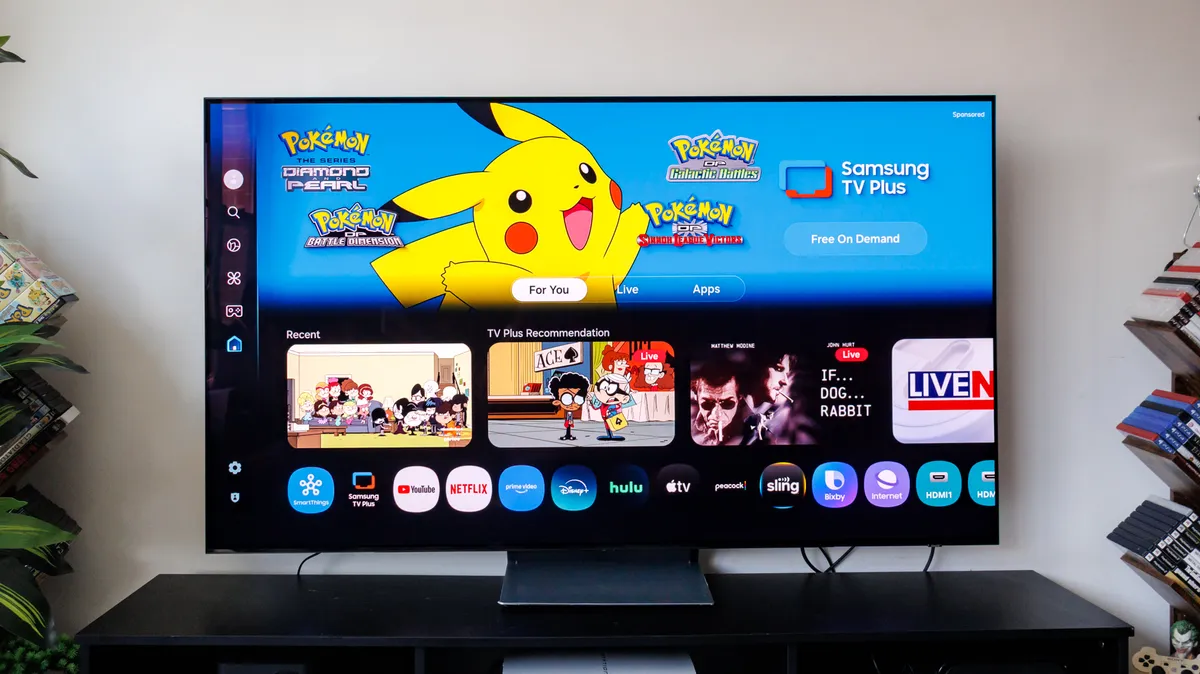
Samsung's latest version of Smart Hub (powered by Tizen) isn't my preferred choice. That said, if you'd rather not splurge on one of the best streaming devices for your living room, Smart Hub will get the job done.
It's the same version of Smart Hub on both TVs, and in my experience, the navigational experience is nearly identical. The software moves along at a mostly zippy clip, but I find its layout to be visually cluttered. It also takes multiple steps to arrive at various menus, when it feels like the route should be shorter.
Fortunately, when it comes to gaming features, the QN90F and the S90F are among the strongest gaming machines you can buy. Each TV offers four HDMI 2.1 inputs, and both support Variable Refresh Rate (VRR), G-Sync compatibility and AMD's FreeSync Premium Pro.
As mentioned, neither of these TVs supports Dolby Vision or ATSC 3.0. This means they're similar in what they offer and similar in what they don't offer.
Winner: Draw
Samsung QN90F vs Samsung S95F: outlook
| Header Cell - Column 0 | Samsung QN90F |
Samsung S90F |
|---|---|---|
Specs (25) |
24 |
23 |
Design (25) |
23 |
24 |
Performance (25) |
23 |
24 |
Features (25) |
23 |
23 |
Total Score (100) |
93 |
94 |
These are two impressive TVs that offer excellent performance and a wide array of features, but the S90F comes with slightly better picture quality due to the many benefits of its quantum dot-enhanced OLED display. That said, the QN90F is among the best Mini-LED TVs money can buy, and for some people, it might be a better pick.
If you're planning on placing your next TV in a room that gets a lot of sun or artificial light, you might find the QN90F's brighter picture to be a safer bet. Not only does it offer brighter specular highlights, but it also offers a brighter picture overall.
Most of the comparable sizes in the QN90F and the S90F series are similarly priced. Currently, the 55-inch QN90F is $1,299 at Best Buy, while the 55-inch S90F is $1,199 at Best Buy. Whichever you land on, you can rest easy knowing that you're getting a fantastic, feature-rich TV.
More from Tom's Guide