Now that I’ve been using Google's latest budget phone for more than a week, I have a better feel for how a Pixel 10a vs. Pixel 9a matchup plays out. These are two of the best cheap phones around, primarily because they both launched at that sweet $499 starting price.
Yet, part of me is disappointed. As I've stated in my Pixel 10a review, it’s one of the laziest upgrades in recent memory. Seriously, it looks identical to its predecessor and packs much of the same hardware — including the Tensor G4 chip, 5,100 mAh battery, and dual-camera system. It’s so similar to the Pixel 9a that it makes me wonder why Google even chose to release it.
That’s why I’ll detail everything in this Pixel 10a vs. Pixel 9a face-off, so you can determine for yourself if it’s actually worth the upgrade.
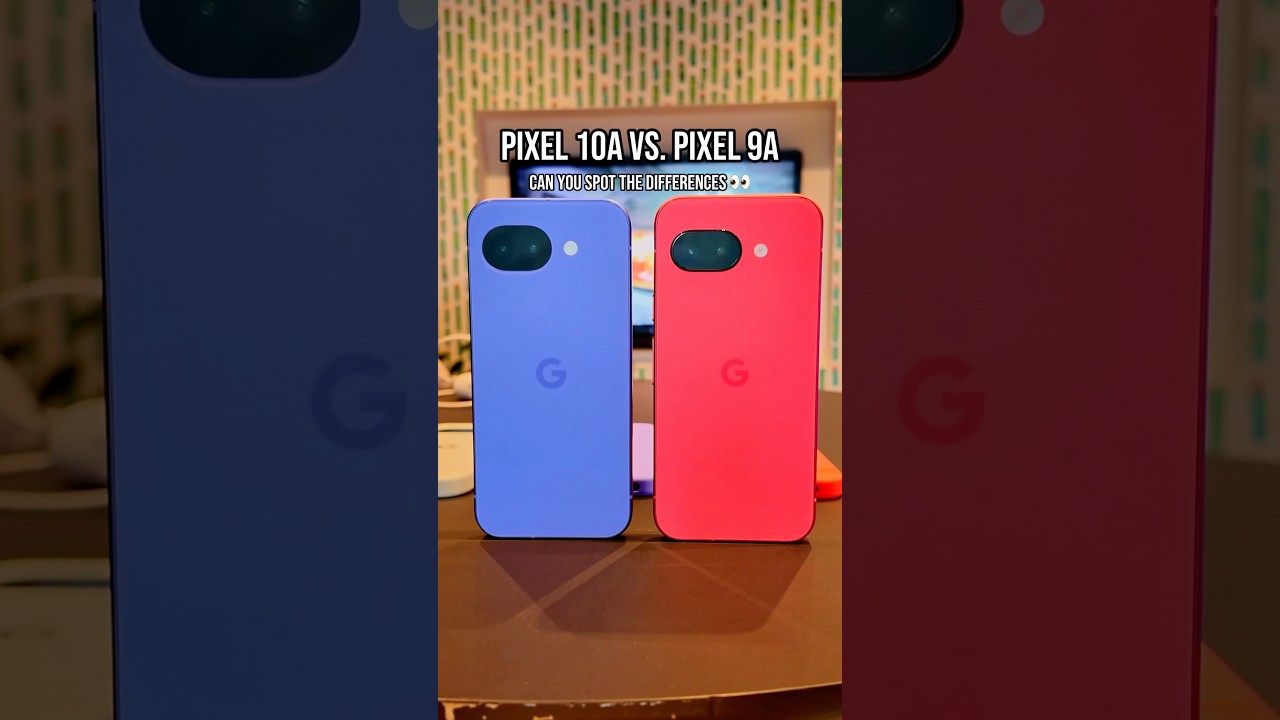
Pixel 10a vs Pixel 9a: Specifications
Pixel 10a |
Pixel 10a |
|
Starting price |
$499 / £499 / AU$849 |
$499 / £499 / AU$849 |
Screen size |
6.3-inch Actua pOLED (2424 x 1080) |
6.3-inch Actua pOLED (2424 x 1080) |
Refresh rate |
60-120Hz |
60-120Hz |
Chipset |
Tensor G4 |
Tensor G4 |
RAM |
8GB |
8GB |
Storage |
128GB, 256GB |
128GB, 256GB |
Rear cameras |
48MP (f/1.7) main, 13MP (f/2.2) ultrawide |
48MP (f/1.7) main, 13MP (f/2.2) ultrawide |
Front camera |
13MP (f/2.2) |
13MP (f/2.2) |
Battery size |
5,100 mAh |
5,100 mAh |
Charging speed |
30W wired; 10W wireless |
23W wired; 7.5W wireless |
Size |
6.1 x 2.9 x 0.4 inches / 153.9 x 73 x 9 mm |
6.1 x 2.9 x 0.4 inches / 154.7 x 73.3 x 8.9mm |
Weight |
6.5 ounces / 183 grams |
6.6 ounces / 185.9 grams |
Colors |
Lavender, Berry, Fog, Obsidian |
Obsidian, Porcelain, Peony, Iris |
Pixel 10a vs Pixel 9a: Price and release

Google launched the Pixel 9a on April 10, 2025, at the same $499 price point as the previous Pixel 8a. Meanwhile, the Pixel 10a launched back on March 5, 2026 — also debuting at $499.
Even though Google still keeps the Pixel 9a on its site, it’s a bit strange that the company is still asking $499 for it. However, I’m already seeing other retailers discounting the phone to $399. That $100 gap puts a much stronger emphasis on the actual value each phone offers.
Pixel 10a vs Pixel 9a: Design


From a cursory glance, the Pixel 10a and Pixel 9a share very similar designs — most notably their flat edges and rounded corners. While the Pixel 9a was famous for bringing back a flush camera look, the Pixel 10a iterates on that by making the lenses truly level with the rest of the back. As a result, the subtle raised border found on the Pixel 9a is now gone.
At the same time, the Pixel 10a benefits from a sturdier construction, featuring an upgrade to Corning Gorilla Glass 7i for better scratch resistance. There are other minor changes you can see in the gallery above, such as the different SIM slot placements. Both are available in four colors, but I really prefer the deeper, richer berry and lavender tones on the Pixel 10a.
Winner: Pixel 10a
Pixel 10a vs Pixel 9a: Display

Both phones feature 6.3-inch Actua displays with identical resolutions and 60–120Hz refresh rates. But while Google claims the Pixel 10a has an 11% brighter screen, our lab testing reveals that isn't the case.
| Row 0 - Cell 0 | Peak brightness (nits) |
DCI-P3 Adaptive/Neutral (%) |
Delta-E color accuracy (lower is better) |
Pixel 10a |
1,896 |
94.2 / 83.8 |
0.24 / 0.20 |
Pixel 9a |
2,076 |
94.2 / 83.8 |
0.24 / 0.20 |
In fact, the Pixel 10a’s OLED panel recorded a peak brightness of 1,873 nits — falling short of the Pixel 9a’s stronger 2,076 nits. While these results prove the Pixel 10a has a dimmer screen, I can still barely tell the difference when playing the exact same video outdoors under direct sunlight.
However, I can’t overlook what the numbers show.
Winner: Pixel 9a
Pixel 10a vs Pixel 9a: Cameras

I’m a camera snob, so I’m always critical of camera changes in year-over-year upgrades. Sadly, there are none to be found with the Pixel 10a, as it recycles the same hardware as the Pixel 9a: a 48MP main shooter and a 13MP ultrawide on the back, paired with a 13MP selfie camera on the front. In fact, everything about them is identical — right down to their fields of view, apertures, and sensor sizes.
Daytime scenes come out practically identical in the comparison above, as both phones produce the same exposure and colors. However, zooming into the sign hanging above the door, I can see a tiny bit more definition from the Pixel 10a.
In the shot of the tree in my backyard above, the ultrawide cameras appear to deliver the same results — including the contrast between the shadowed foreground and the brighter areas on the right.
Likewise, I don’t find one phone to be any better than the other when it comes to selfies. You can see from my pose above how they capture the same scene, including fine details like my facial features and the texture of my hoodie.
There’s nothing to distinguish their zoom performance either, as they both top out at 8x digital zoom. I’ll admit the shots above are usable, but neither phone draws out more detail or definition than its rival.
Under low light, it’s no shocker that I don’t see a boost in how the Pixel 10a handles the challenging conditions of my backyard in the dead of night. While the dedicated Night Sight mode brightens the scene with proper exposure throughout, the details on the tree are smudgy at best — just as they are with the Pixel 9a.


I also shot video with both phones to better illustrate their differences. In the 4K 30fps clips above, there isn't an overwhelming difference in detail or exposure, but the Pixel 10a does a better job of mitigating the shakiness introduced when I begin to run.

Yes, there are some differences that show the Pixel 10a being the better camera phone, but the improvements are minimal at best. The real reason it takes the lead is because of two new additions to the camera experience: Camera Coach and Auto Best Take.
I like how the former guides novice shooters to capture better-looking photos with on-screen instructions, while the latter uses generative AI to ensure I can put picture-perfect smiles on everyone’s faces.
Winner: Pixel 10a
Pixel 10a vs Pixel 9a: Performance

Whether it was a cost-saving measure or not, I’m disappointed that this year’s Pixel 10a retains the same Tensor G4 chip found in the Pixel 9a. Unsurprisingly, our benchmark testing reveals no improvement whatsoever — which is a real shame for a generational update.
Technically speaking, the Pixel 9a actually delivers better Geekbench 6 scores, though the lead is negligible. Similarly, the gap in graphics processing is non-existent, as the Pixel 10a produces practically the same frame rates in 3DMark’s Wild Life Unlimited test.
| Row 0 - Cell 0 | Pixel 10a |
Pixel 9a |
Chipset |
Tensor G4 |
Tensor G4 |
Geekbench 6 (single-core/multi-core) |
1,694 / 4,501 |
1,707 / 4,512 |
3DMark Wild Life Original Unlimited (score/fps) |
9,746 / 58.49 |
9,592 / 57.44 |
Adobe Premiere Rush time to transcode (mins:secs) |
N/A |
1:24 |
Beyond these synthetic tests, I can tell you that neither phone feels faster or snappier than the other in daily use. I do still appreciate the 120Hz refresh rates, which give the UI animations that signature buttery feel.
Winner: tie
Pixel 10a vs Pixel 9a: Battery life and charging

You’d think there wouldn’t be a difference in battery life, seeing as both phones carry the same 5,100 mAh battery and Tensor G4 chip. Yet, the Pixel 10a surprised me by lasting longer in our battery drain test, with an average time of 15 hours and 16 minutes. That’s two hours longer than the Pixel 9a's result, which leads me to believe there are software-based power optimizations allowing the Pixel 10a to get more life from the same cell.
Average Battery life (Hrs:Mins) |
Charging % in 15 minutes |
Charging % in 30 minutes |
|
Pixel 10a |
15:16 |
31% |
64% |
Pixel 9a |
13:08 |
25% |
47% |
One of the few hardware upgrades in the Pixel 10a is its charging speed, which has been bumped up to 30W wired and 10W wireless. Unsurprisingly, the Pixel 10a charges faster via wired charging — reaching 31% capacity in 15 minutes and 64% in 30 minutes.
Winner: Pixel 10a
Pixel 10a vs Pixel 9a: Software

In the short time since the Pixel 10a was released, my Pixel 9a has received software updates that quite frankly narrow the gap between their experiences. They both run vanilla Android 16, complete with the same personalization and AI tools. For example, their Call Screening features are still the best out there, especially how Google Assistant provides contextual responses I can select directly from the screen without ever having to speak to the caller.
Likewise, they have access to practically the same AI tools I’ve come to rely on. Since I already subscribe to Gemini AI Pro for $19.99 per month, I have access to more AI credits for video generation, Gemini Live (which lets the phone tap into the camera to see what I’m seeing), and even Nano Banana Pro for image generation.

Although it wasn’t available at the time of my initial Pixel 10a review, a recent update added the new Pixel desktop mode to my Pixel 9a. This means I can use both phones similarly to a laptop when connected to an external monitor, which further drives home my point about the value these phones offer.

Apart from the inclusion of Auto Best Take and Camera Coach, the only other feature exclusive to the Pixel 10a is support for Satellite SOS, which is distinct from the standard Emergency SOS feature found on both devices.
While both phones are backed by seven years of software support, the Pixel 10a naturally benefits from being the newer release. All told, the software experience is practically identical, save for the two AI camera tools and the Satellite SOS functionality on the Pixel 10a.
Winner: Pixel 10a
Pixel 10a vs Pixel 9a: Verdict

Until Google and more retailers drop the price of the Pixel 9a, there’s no way I’d recommend getting it over the Pixel 10a — despite the fact that it’s essentially the same phone. The changes are minor at best, but its longer battery life, faster charging, and new AI photo tools do make the Pixel 10a the better device.
However, it gets complicated if you can find the Pixel 9a at a discount. Walmart is currently the only major retailer to discount the Pixel 9a to $399, which I think makes it compelling enough to buy.
That $100 difference is significant, in my opinion, given that the 9a shares the same Tensor G4 chip and camera hardware. But until the price is officially lowered across the board, you might as well pick up the Pixel 10a.

Follow Tom's Guide on Google News and add us as a preferred source to get our up-to-date news, analysis, and reviews in your feeds.
More from Tom's Guide