For years, OLED technology has dominated the premium display market, offering a great picture quality with deep, perfect black levels. OLED has become the gold standard for high-end TVs, to the point where most of the best TVs available right now are OLEDs. But there's a new challenger on the horizon: Samsung Micro RGB.
Micro RGB has been making headlines for the past year or so, thanks in part to Samsung's marketing. The TV-maker is one of many developing their own version of Micro RGB. The promise of the tech is that it could address some of OLED's limitations while delivering its own advantages. But will Micro RGB actually prove to be better than the current reigning champ?
What is OLED?

Today's OLED displays are more efficient, brighter and more resistant to burn-in.
OLED (Organic Light-Emitting Diode) is a type of display made with organic materials that emit light when electricity passes through them. Unlike traditional LED displays, OLED doesn't need a backlight — each pixel produces its own light and can turn off completely. This is why OLED TVs can deliver perfect black levels.
OLED technology has matured a lot since its introduction. Today's OLED displays are more efficient, brighter and more resistant to OLED burn-in issues that plagued earlier versions.
The organic nature of these displays also allows for flexibility — making them useful for things like rollable and foldable screens, like in smartphones. Many new OLED TVs essentially use OLED layers as the backlight itself, combined with quantum dot tech for enhanced brightness and more vibrant colors.
What is Micro RGB?

Micro RGB is a less cut and dry. You might assume that Micro RGB is a form of Micro-LED display — but it's not.
Instead, it could be described as a kind of middle-ground between Mini-LED screens that use thousands of backlights and Micro-LED screens that have self-emitting pixels. Micro RGB displays still use a backlight. but instead of white light, the backlight can produce red, blue, and green light with tiny RGB LEDs. These tiny backlight LEDs can turn off, but when they're on, the light they produce still passes through LCD pixels.
The big advantage of having an RGB backlight is that Samsung is able to produce much more vibrant colors than what you'll find on even the best Mini-LED displays.
Samsung says that its Micro RGB TV can deliver 100% of the BT.2020 color gamut, which is very impressive. But, in the absence of true pixel-level control, Micro RGB panels can't get the same deep black levels that OLED TVs can get — or at least, not with the same control.
The technology's biggest hurdle at the moment is manufacturing efficiency. Only one Samsung Micro RGB TV is currently available, and it's 115-inch Micro RGB TV that costs $30,000.
Micro RGB vs OLED: black levels and brightness
OLED's contrast is often described as "infinite" because each pixel can be completely turned off, resulting in perfect blacks with no light emission whatsoever. This creates stunning depth in dark scenes and eliminates the halo or blooming effect you get with many other display technologies.
Micro RGB, while excellent, can't quite match OLED's perfect blacks at the individual pixel level. Instead, it uses many tiny dimming zones to control backlighting across different areas of the screen. This can sometimes result in slight blooming around bright objects on dark backgrounds, though the effect is far less noticeable than on traditional LCD/LED displays (or even on Mini-LED displays).
Micro RGB can reach significantly higher peak and sustained brightness levels.
Where Micro RGB dramatically outperforms OLED, however, is brightness. While OLED struggles to maintain high brightness levels (particularly across the entire screen), Micro RGB can reach significantly higher peak and sustained brightness levels.
This makes Micro RGB ideal for well-lit environments, outdoor viewing and HDR content where brightness impacts the overall experience. OLED, despite improvements in recent models, still faces inherent limitations in very bright rooms where ambient light can wash out the picture.
Micro RGB vs OLED: color

Micro RGB panels create color through RGB backlighting, which in turn passes through color filters. Because these tiny LEDs aren't organic (like on OLED panels), they can be pushed to brighter levels without the same risk of damage or burn-in. This theoretically enables superior color accuracy and purity, with Samsung claiming to achieve 100% of the BT.2020 color space.
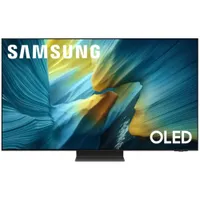
OLED also offers excellent color performance with a wide color gamut. While OLED may not reach the same levels of Micro RGB displays, recent implementations of OLED tech, which use quantum dot layers, do still produce very vibrant and bright images. The Samsung S95F OLED, for example, reached 90.26% coverage of the same color space. (This may sound far less impressive, but it's nevertheless exceptional.)
Micro RGB vs OLED: lifespan
One of the biggest differences between these technologies is long-term reliability and power consumption. Micro RGB, using inorganic LED materials, is immune to burn-in. Unlike organic compounds that degrade with use, the inorganic LEDs in Micro RGB displays can maintain consistent performance over extended periods without developing image retention or permanent burn-in, even when displaying static content.
Despite massive improvements in recent years, OLED remains susceptible to burn-in and image retention due to the organic nature of its light-emitting materials. While modern OLED displays make use of various mitigation techniques like pixel shifting and brightness limiting, the risk of burn-in is still there, particularly for displays showing static objects like channel logos.
Micro RGB vs OLED: who wins?

Both OLED and Micro RGB offer their own advantages, but they excel in different situations. OLED continues to dominate in applications where deep black levels, infinite contrast and a movie-theater-like experience are the top priorities. OLED is also a lot cheaper and a lot more accessible (though that could change over time).
Micro RGB stands out for its high brightness, making it useful in environments with a lot ambient light. Its resistance to burn-in makes it ideal for outdoor displays and situations where you might continuously display static elements on the screen. If it can truly saturate 100% of the BT.2020 color space, that's another advantage over OLED, too.
Of course, they do so at a much higher price. Micro RGB displays are barely available, and cost a whole lot in regions where they are available. That's likely to change over time, but in the meantime, if you're interested in a Micro RGB panel, expect to pay new-car money.

Follow Tom's Guide on Google News and add us as a preferred source to get our up-to-date news, analysis, and reviews in your feeds.
More from Tom's Guide