The best smart ring available right now is the Oura Ring 5. The company kickstarted the whole smart ring market, and it is the most comprehensive, multi-platform option you can buy at the moment. It's a good product, but there's another reason I say "at the moment."
In late 2025, Oura filed patent dispute lawsuits in the U.S. against pretty much every other smart ring manufacturer. Several have been banned from sale, while for others, availability is patchy while the legal process continues. So, realistically, your best bet is the market leader: the Oura Ring 5.
Your other safe choice is the Ringconn Gen 2 Air. Ringconn chose to end the legal dispute and enter a licensing agreement with Oura, so that ring is readily available. It's our favorite entry-level ring, especially because you don't need a subscription to use it, as you do with Oura's rings.
For now, you can also buy the Samsung Galaxy Ring and Amazfit Helio, though I wouldn't recommend it. If these companies lose the legal battle, those rings could be withdrawn and maybe lose support. If tracking your health metrics is important to you, then stick with the Oura Ring 5 and Ringconn Gen 2 Air for now.
We've kept our best smart rings list intact, for now. Hopefully, these legal challenges will come to an end, maybe even in a similar licensing agreement that Ringconn accepted, so we think it's still important to discuss all the rings we've tested, even if buying a few of them could be a gamble for long-term support.
The best smart ring you can buy today
Why you can trust Tom's Guide Our writers and editors spend hours analyzing and reviewing products, services, and apps to help find what's best for you. Find out more about how we test, analyze, and rate.
Best smart ring overall
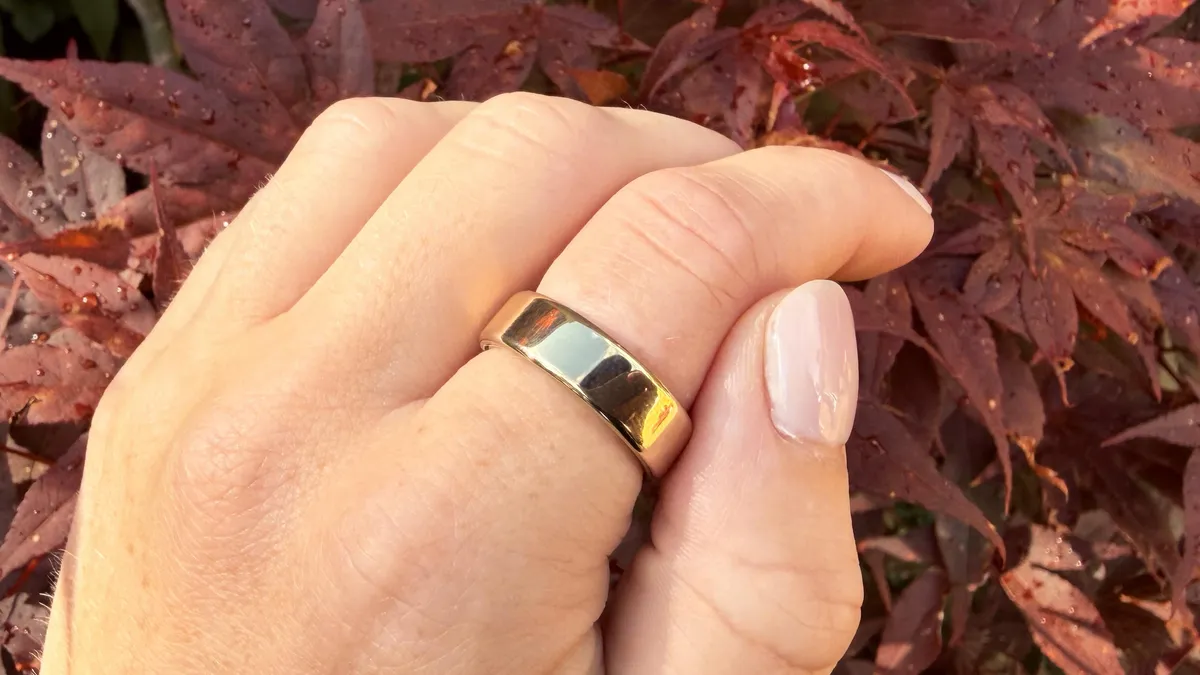

The Oura Ring 5 is by some margin the best smart ring available right now. It's the latest version of the Oura Ring, and even lighter and thinner than the Oura Ring 4.
You may have been put off by the Oura Ring 4's bulkiness or thought it was too thick to be discreet, but the Oura Ring 5 does away with these concerns. It's 40% smaller than the Ring 4, just 2.28mm thick, and weighs as little as 2 grams, depending on ring size.
You should keep in mind, however, that the Oura Ring 5 has slightly fewer sizing options than the Ring 4. It's available in sizes 6-13 versus Ring 4's 4-15. So, if you have smaller hands, you may find the Ring 5 simply doesn't fit.
From a tracking perspective, no other fitness tracker offers this level of insight. Oura helps you not only monitor your recovery and sleep, but also the impact of the day's stress on your body. Its companion smartphone app makes it easy to see daily insights, long-term trends, and an overall picture of your health, as well as more in-depth, impressive analysis if you want to get into the nitty-gritty of your health.
There is one major downside, however: the $399 price tag — $50 more than the Oura Ring 4. Plus, the Oura Ring 5 requires a monthly subscription of $5.99 to use the ring (just as the Ring 4 did).
However, if you want a discreet fitness tracker that offers you a better understanding of your overall health, it's a great option.
- Read our full Oura Ring 5 review
Best smart ring for sleep tracking
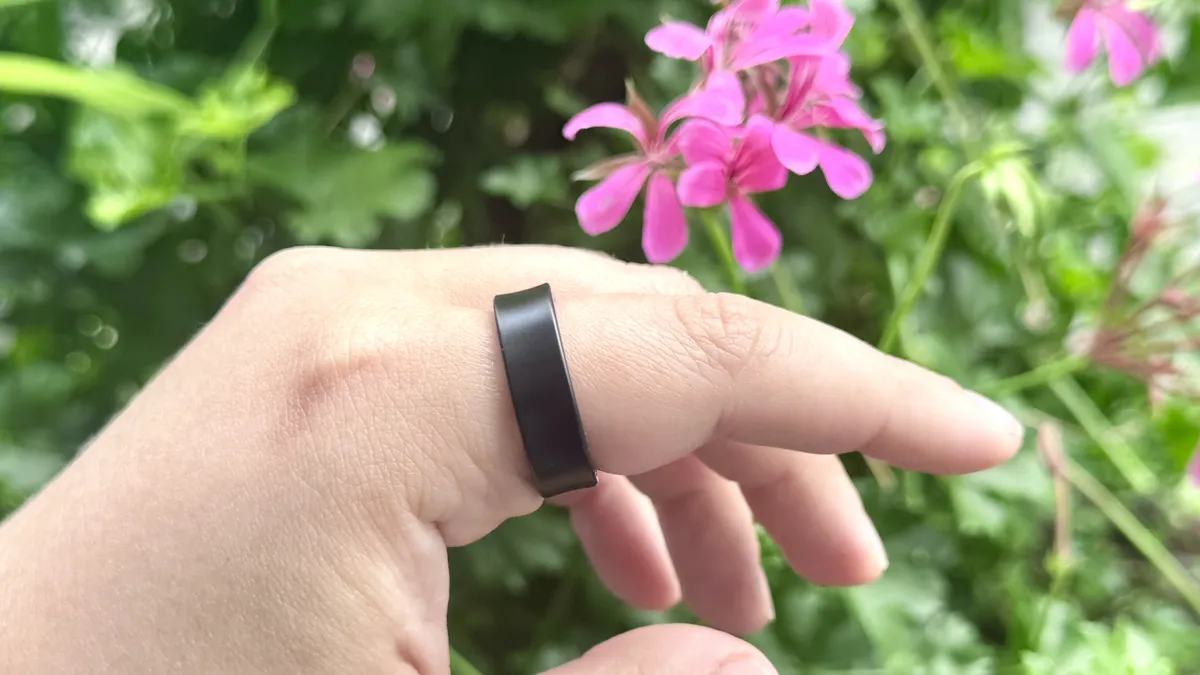
This model is still available in buy in the U.S., but Samsung is currently in a legal dispute with Oura which could lead to the removal of the ring from sale or end of support. Proceed with caution.
The Samsung Galaxy Ring is the best smart ring for sleep tracking and my favorite subscription-free smart ring available today. It has Oura beat when it comes to analysis of your sleep patterns, while providing nearly the same level of holistic tracking and trend insights.
The interior sensors on the ring protrude slightly, making it less comfortable than the Oura Ring 5, but overall, it's pretty easy to wear. Sizes range from five to 15, with three finishes to choose from: Black, Silver, or Gold.
Though the Samsung Galaxy Ring is subscription-free, at $399, it's one of the pricier models in this buying guide. Additionally, to get the most out of its AI-backed insights and trend reports, you'll need to pair it with one of the latest Samsung Galaxy phones.
Battery life is nearly as good as the Oura Ring 5, with the Galaxy Ring cruising for between five and six days per charge in my testing. The ring also ships with a clamshell-style charging case that can recharge the device up to two times while on the go.
Like Oura, Samsung has partnered with Natural Cycles for female health tracking features. And even though the tools aren't quite as advanced as you'll find on the Oura Ring — you don't get access to Natural Cycle's full suite of fertility and contraceptive features — my female colleagues who've tested the Galaxy Ring report good, reliable results from those that are on offer.
Sleep tracking is really where the Galaxy Ring shines, in my opinion, with details on nightly body movements, breathing patterns, body temperature, heart rate, blood oxygen saturation levels, and more. Basically, all the sleep insights and AI-backed recommendations you'd get from the best Samsung Galaxy Watches are available in a much more comfortable, discreet form factor via the Samsung Galaxy Ring.
- Read our full Samsung Galaxy Ring review
Best cheap smart ring


This model is still available in buy in the U.S., but Amazfit is currently in a legal dispute with Oura which could lead to the removal of the ring from sale or end of support. Proceed with caution.
The Amazfit Helio Ring is the best wallet-friendly smart ring you can buy today. Normally priced at $199 (and subscription-free), I've seen it go as low as $109. That said, there are some caveats.
The Helio Ring comes in just one finish, titanium, and three sizes: 8, 10, and 12. While it works with both Android and iOS, battery life is considerably less than the competition, lasting for between three and four days per charge in my testing.
That said, the Helio Ring is pretty comfortable, despite protruding sensors, and fairly durable. I knocked it into plenty of walls and desks while reviewing it, and even dropped it (accidentally) on a hard tiled floor with no damage to report.
Sleep and holistic insights aren't nearly as detailed as what you'll find on the Oura Ring 4 and Samsung Galaxy Ring, but the Helio Ring covers the basics well, with daily metrics for sleep quality, readiness, heart rate variability, workout recovery, and more.
Like the Oura and Samsung, the Helio boasts onboard heart rate, blood oxygen, body temperature, EDA, and ECG sensors, along with an onboard gyroscope and accelerometer for movement detection. Fitness tracking modes are seriously limited, though, with only four to choose from. This is likely because Amazfit hopes you'll pair the ring with one of the brand's smartwatches, like the also cost-effective Amazfit Active 2, one of the best cheap smartwatches.
The Helio Ring additionally supports female health tracking, with period and ovulation predictions. However, these tools don't hold a candle to what the Oura Ring 5 offers in terms of women's health.
- Read our full Amazfit Helio Ring review
Best entry-level smart ring

Similar to the Amazfit Helio Ring, the Ringconn Gen 2 Air starts at $199, is subscription-free, and works with both Android and iOS smartphones. It also comes in a wider range of sizes (6-14) and two finishes, gold or silver.
Compared to the best smart ring, the Gen 2 Air has the Oura Ring 4 beat in terms of battery performance. Advertised as lasting up to ten days per charge, I managed about eight days of usage per charge compared to closer to six days for the latest Oura Ring. The Gen 2 Air also lasts nearly twice as long as the Helio Ring in my testing.
The Ringconn Gen 2 Air is one of the thinnest and lightest smart rings in this guide, but that doesn't mean it's the most comfortable. The interior sensors protrude considerably, leading to an initial period of discomfort that lasted a few weeks before I eventually got used to the ring on my finger. That said, it's just as well-built as any of the options listed here.
The sleep insights from the Gen 2 Air go further than what you'll find from the Helio Ring, but aren't as in-depth as those from the Oura Ring 5 or Samsung Galaxy Ring. As expected, you get a daily sleep score, details on time spent in sleep cycles, and alerts for any abnormalities, like irregular blood oxygen levels or body temps.
Women's health tracking features are pretty limited compared to Oura and even Samsung, and mostly consist of ovulation predictions and not much else. Fitness tracking tools are also few and far between, similar to the Helio Ring.
There are only six workout modes: Outdoor running, Indoor running, Indoor cycling, Outdoor cycling, and Outdoor Walk, but post-workout insights are quite lacking. For example, when tracking a walk, there are no metrics for pace, distance, or climb.
Still, as far as easy-to-use, entry-level models that work as intended and play nicely with most modern smartphones go, the Ringconn Gen 2 Air is my top choice. It's longer-lasting than the Amazfit Helio Ring, with deeper sleep insights, albeit in a slightly less comfortable package.
- Read our full Ringconn Gen 2 Air review
Also consider
Best smart rings: features comparison
Smart rings are one of the newest categories in the world of wearable tech, and though a handful of big brands currently dominate the space, like Oura and Samsung, there are plenty of worthy smaller companies vying for space on your finger, like Amazfit and Ringconn.
The Amazfit Helio Ring and Ringconn Gen 2 Air are the most affordable options at $199 a pop with no subscription costs, while the Samsung Galaxy Ring is the priciest at $399 (also subscription-free).
Oura is the only model with a monthly fee of $5.99 a month for access to the Oura app. However, Oura's wellness insights are the most comprehensive and also our favorite.
While the latest Oura Ring and Galaxy Ring come in lots of sizes and finishes, the Ringconn Gen 2 Air is only available in 2 finishes and nine sizes, while the Helio Ring comes in just one finish and three sizes.
All of the best smart rings are reasonably lightweight and easy-wearing, though some are a tad heavier and thicker than others. Ultimately, though, it's the positioning of the sensors that most dictates long-term comfort. In that regard, only the Oura Ring 5 offers a sensor array that's flush with the interior of the ring.
Battery life ranges from four days per charge for the Helio Ring to up to ten days per charge for the Ringconn Gen 2 Air. The Galaxy Ring and Oura Ring 5 each last for roughly a week. For durability, a water resistance rating of 100 meters is par for the course for all the best smart ring models, so feel free to keep them on while you shower and swim.
| Header Cell - Column 0 | Oura Ring 5 |
Samsung Galaxy Ring |
Amazfit Helio Ring |
Ringconn Gen 2 Air |
|---|---|---|---|---|
Starting price |
$399 |
$399 |
$199 |
$349 |
Subscription |
$5.99 per month |
n/a |
n/a |
n/a |
Sizes |
6 - 13 |
5 - 15 |
8, 10, 12 |
6 - 14 |
Finishes |
Gold, Deep Rose, Brushed Silver, Stealth, Black, Silver |
Titanium Black, Titanium Silver, Titanium Gold |
Titanium |
Gold, Silver |
Thickness |
2.88 mm |
2.6 mm |
2.6 mm |
2 mm |
Weight |
From 2g (depending on ring size) |
2.3 - 3.0 g |
3.8 g |
2.5 - 4 g |
Battery life |
Up to 9 days |
Up to 7 days |
Up to 4 days |
Up to 10 days |
Water resistance |
100 meters (waterproof) |
100 meters |
100 meters |
100 meters |
How we test the best smart rings
Testing the best smart rings involves wearing them for weeks at a time while we sleep, work, eat, exercise, and perform daily chores. During this period, I'm taking diligent notes on overall comfort, durability — does it scratch or scuff easily? — how long the battery lasts, and how quickly/easily data syncs with the device's companion app.
Assessing the accuracy of the best smart rings is another crucial part of my testing. It involves wearing them alongside other fitness trackers that have proven reliable to see how the results compare. For example, I walked 5,000 steps with the Helio Ring and Garmin Forerunner 165 to gauge the accuracy of the former; it proved quite precise.
I also do testing while we sleep to ensure the rest/recovery data is legit. For this assessment, I'm noting how sleep duration, sleep cycles, heart rate and other core metrics compare to other popular sleep trackers worn during the same period.
Finally, I look at how the core features of each smart ring line up with other options out there by evaluating the data presented in each app. Are these metrics easy to parse? Are there insights and tips to help you better understand the big picture? And, are any core data points missing?
How to choose the best smart ring
When shopping for your first smart ring, you'll want to first identify your budget, then narrow your search by phone type (the Galaxy Ring, for example, is Android only). Next, choose which features matter most and how often you're willing to recharge your new smart ring.
You'll also want to take comfort into consideration. The Oura Ring 5 is the comfiest smart ring in this guide, while the Ringconn Gen 2 Air is the least comfortable. Finally, choose your size and finish.
For folks with an Android smartphone, I recommend starting your search with the Samsung Galaxy Ring vs. the Oura Ring.
iPhone users will likely be choosing between the Oura Ring vs. the Helio Ring or the Ringconn Gen 2 Air.
FAQs
Can you still buy smart rings in the US?
In late 2025, Oura filed patent disputes with pretty much every smart ring manufacturer in the U.S. The initial rulings banned the sale of Ultrahuman smart rings and led to a licensing agreement between Oura and Ringconn.
So, right now, our advice is that the Oura Ring 5 and Ringconn Gen 2 Air are your safest choices while these legal disputes rumble on. Oura is currently in contention with Samsung, Amazfit and Reebok.
While you can technically continue to buy rings from those brands, I wouldn't recommend it. If they get removed from sale, the companies may drop support for those rings in the U.S. or potentially remove features.
At the moment, the situation is too fluid to recommend anything other than the safe options (Oura, Ringconn). There is also going to be a new Ultrahuman ring due later in the year that has been redesigned to avoid the patent issue. But it's a bit of an unknown at this point.
Do you need to pay for a smart ring subscription?
Whether or not you need to pay for a smart ring subscription depends on which device you choose. Of the smart rings I recommend, only the Oura Ring 5 requires a subscription fee ($5.99 a month).
What are the pros and cons of a smart ring vs a fitness tracker?
Unlike most wrist-based fitness trackers and smartwatches, smart rings don't have a screen, which means that you primarily interact with them through a companion app. For fitness tracking, smart rings also don't have onboard GPS, unlike some trackers and watches, so you'll need to bring your paired smartphone along for location data.
On the flip side, smart rings tend to offer better battery life than non-finger wearables. Most last somewhere around a week before needing a recharge. I also find smart rings less cumbersome to wear to bed than smartwatches. And for the fashion-conscious, they're all but inconspicuous compared to an Apple Watch or Garmin device.
Will a smart ring fit the same as a regular ring?
Generally, no, smart rings do not use the same sizing as standard US jewellery sizes. This means that if you order a smart ring in your regular size you wear for jewellery, you may find that it does not fit.
Luckily, most smart ring manufacturers (for example, Oura) have ring sizing kits so you can get the perfect fit.
Which smart rings work with iPhone and Android?
If you want a smart ring that will work with both iPhone and Android, you'll need to avoid Android-specific devices like the Samsung Galaxy Ring. As it is an Android product, it will not work with iPhone.
Aside from the Samsung Galaxy Ring, all of the rings recommended on this list will work with iPhone or Android.