





Coffee can feel like an overwhelming pastime. There's so much noise online about coffee — grind size, flow rate, milk texture — that I'm surprised any newbies are brave enough to take the plunge and buy their first espresso machine.
But the most important difference is the type of espresso machine you buy. There are loads of different types of machines for different types of coffee drinkers: superautomatic, semi-automatic, manual, bean-to-cup/all-in-one... the list goes on. Today, let's get to the bottom of it.
What type of espresso machine is best for you, and which should you buy? I'm using Casabrews, Ninja, and De'Longhi espresso machines to exemplify my points today — and they're all on sale for Black Friday.
Automatic vs manual espresso machine: Key differences
There's one key difference between automatic and manual machines: ease of use. (Size and price also come into play!)
Ease of use
Automatic machines are called that for a reason: press a button, and you get hot coffee in seconds.
An automatic coffee machine selection screen generally looks something like this.

Some machines have upwards of 50 recipes. The De'Longhi PrimaDonna Aromatic ($2,499) offers 38 recipes — some of which I, an ex-barista, had never heard of — including hot and cold beverages. At the press of a button, the machine makes your drink for you.
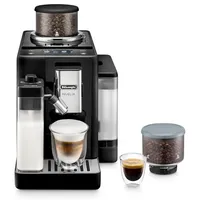
Depending on price, some automatic machines have integrated milk frothing, like the pictured De'Longhi Rivelia ($1,499) or the De'Longhi Magnifica Duo ($999)
You don't have to do anything. No grinding, no tamping, no calculating dosage volume. As long as there are beans in the hopper, water in the tank, and electricity in the machine, it'll take care of everything.
Automatic machines are ideal if you drink a lot of coffee, but either you don't have time to make it yourself, or you don't want to make it yourself. Both are valid.
But what about a manual espresso machine? Manual espresso machines vary in functionality — some have built-in grinders, so closer to automatics, but some are incredibly hands-on. Let's run through a few examples.

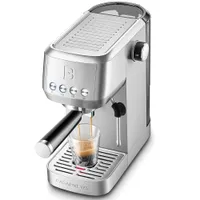
This is the Casabrews 3700 Essential. It's the cheapest espresso machine I've rated highly, and my only recommendation for a sub-$100 espresso machine. If you want the cheapest manual espresso machine on the market, I'd go for this one.
This machine necessitates either a separate grinder or getting your coffee ground for espresso at a local cafe. It comes with dual-walled (pressurized) coffee baskets. While a pressurized basket means it doesn't make "technically" perfect espresso, it's a fantastic machine to learn on, as it's incredibly forgiving.
However, you do need to spend a bit of time learning the ropes. Unlike an automatic machine, you have to do everything yourself. You need to grind the coffee, put the coffee in the portafilter, press "start", and steam your milk.
If you want to get into coffee as a hobby, or you like the routine of making coffee, then I would recommend a manual machine such as this.
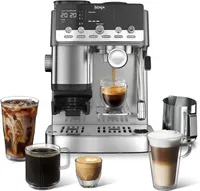
However, if you want to make your life easier and you have a little more money to spend, I'd also recommend looking at manual espresso machines with built-in grinders, like the Ninja Luxe Cafe Mini Plus.

As you can see, this machine has a lot more going on than the Casabrews 3700 Essential. The Ninja Luxe Cafe Mini Plus has a built-in grinder (on the left) and tamping assist (also on the left).
Although you still need to put beans in the hopper and adjust grind size yourself, this machine takes a lot of the hassle out of your morning brew. The Luxe Cafe Mini doesn't have automatic milk frothing, but the Luxe Cafe Mini Plus (pictured) does. The Mini will set you back $449, while the Plus goes for $499. Right now, though, the Mini Plus is $419, and the Mini is $399.
The long and short of it is this: No time to spend making coffee? Just want coffee, stat? Automatic — De'Longhi Rivelia.
Want to learn the art of coffee, and don't mind buying a grinder or getting your beans ground at a cafe? Manual — Casabrews 3700 Essential.
Still want to make the coffee yourself, but you want a built-in grinder? Manual with a built-in grinder — Ninja Luxe Cafe Mini Plus.
Size

Although not as integral as ease of use, size is also something to consider. In general, automatic machines are pretty huge. Here's a size comparison of our three case studies.
| Header Cell - Column 0 | Dimensions |
Weight |
|---|---|---|
De'Longhi Rivelia (automatic) |
16.9 x 9.7 x 14.6 inches |
21.4 pounds |
Ninja Luxe Cafe Mini Plus (manual, grinder) |
10.2 x 12.2 x 13.4 inches |
19 pounds |
Casabrews 3700 Essential (manual, no grinder) |
12.6 x 5.7 x 12.5 inches |
8.1 pounds |
If you're short on space, the answer's kind of obvious — it should probably be a manual with no grinder. However, you need to remember you will either require a separate grinder or have to get your beans ground at a cafe.
Obviously, though, automatic machines are much larger than manuals. I would only recommend automatics if you're sure you have the space for them — they look bigger and bulkier than the numbers might suggest.
For everyone in between, I'd go for the Ninja.
Price

Obviously, the more features a machine has, the higher its price. In general, automatic machines will set you back at least $1,000 — the only models I've tested under this are the $999 De'Longhi Magnifica Duo and the $999 Jura ENA4 — the latter of which can't make milk drinks. Honestly, what's the point? If you like black coffee, just get a drip machine like the Moccamaster KBGV Select ($270 right now on Black Friday deal).
After automatic machines come manual machines with built-in grinders. This price can range from $3,000 (Breville Oracle Dual Boiler) to $229 (Amzchef Espresso Machine with Grinder). As someone who's tested all the cheapest models and all the high-end models, I would be wary of a machine charging less than $400. I'd recommend machines like the Ninja Luxe Cafe Mini (pictured, $499), Breville Barista Express ($699), and De'Longhi Arte Evo ($699) — the latter of which can make cold(ish) brew!
Automatic vs manual espresso machine: Which should you buy?
I want you to answer these three questions.
- Do I want to make my coffee, or do I want the machine to make it for me?
- How much money do I want to spend?
- How much room do I have?
- Do I want to buy a grinder, or get my beans ground at a cafe?
To help you out, I made a quiz!
What did you get? Here are my top recommendations for each type.
Automatic vs manual espresso machine: My favorite machines
Depending on your quiz results, I'd recommend one of these three machines. Let me know which one you go for in the comments — I'd love to hear about it!
Follow Tom's Guide on Google News and add us as a preferred source to get our up-to-date news, analysis, and reviews in your feeds.
More from Tom's Guide
- Amazon Black Friday LIVE latest updates on the lowest prices for iPads, Garmin smartwatches, Bose headphones, everyday essentials and more
- Black Friday streaming deals LIVE best discounts from $0.99 on Disney+, HBO Max, Apple TV, Hulu, Paramount+ and more
- Black Friday TV deals LIVE: Big savings on the best TVs from Roku, Best Buy, LG, Hisense and more

