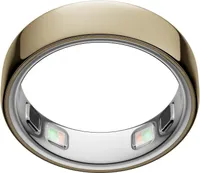
Two months ago, I got my hands on the Oura Ring 5, which you can buy from $399 at Amazon. It's a sleek smart ring that delivers gold standard sleep tracking analysis. But could the Oura Ring actually help me sleep better, or merely hold a mirror up to it?
I was wearing the Oura Ring when a sleep doctor helped take my rest from six to seven hours of sleep in a week. And I can now see why it's considered to be one of the best sleep trackers on the market.
From keeping me moving throughout the day to pinpointing my optimal bedtime, the Oura Ring has helped me reach my seven-hour sleep goal, and even helped me pay back a chunk of my sleep debt. Here's a closer look at the top three things the Oura Ring did to help me increase my total time asleep, plus the three hidden Oura features that can help you boost your rest.
Key takeaways
- The Oura Ring 5 provides helpful feedback to optimize your sleep.
- Its activity reminders encourage healthy habits that improve sleep quality, while bedtime reminders help you to optimize sleep timing.
- Sleep and health metrics also help to pinpoint the reason for any sleep issues, with its 'latency' and 'time asleep' metrics showing when you need to go to bed and wake up to hit your sleep duration target.
- Other Oura Ring features for seep optimization include unguided and guided sleep meditations and sleep stories.
My sleep before using the Oura Ring 5

I've always struggled to get at least seven hours of sleep. As for the apocryphal 8-hour recommendation? Forget it.
My barriers to getting enough sleep can vary from night to night, but the common offenders include revenge bedtime procrastination and the Sunday Scaries.
Getting six hours of sleep is common for me (though racking up 5 hours isn't a rarity either), and my average sleep duration in May, the month before I got my Oura Ring, was 6 hours and 9 minutes. And that is a problem.
In 2025, researchers at the Oregon and Health and Science University reported that sleeping for less than seven hours a night decreases life expectancy more than poor diet and lack of exercise.
Meanwhile, a study by Vitality and The London School of Economics and Political Science (LSE) found that following the 7:1 sleep rule (meaning getting at least seven hours of sleep, falling asleep within the same one-hour window, for at least five nights a week) could add four years to lifespan.
"The recommendation for adults is seven to nine hours, with seven being the minimum," says Sam Sadighi, a certified sleep practitioner at Get Laid Beds "By getting the appropriate amount of sleep, we are giving our brains and bodies the opportunity to rest, recover, and repair."
3 key Oura Ring features that helped me go from 6 to 7 hours of sleep
1. It keeps me moving

The Oura Ring 5 does more than track sleep, of course. It's also a health and fitness tracker, which means it becomes a pedometer, reports on how long I've been active for, how much calories I've burnt, and even sends me gentle reminders to stretch my legs and move around if I've been inactive for too long.
That's all well and good, but you're probably wondering how that ties in with my sleep?
Research has shown that regular physical activity helps improve seep quality, meaning that it regulates sleep cycles and helps you fall asleep faster. It also helps me to move around throughout the day, rather than encouraging a vigorous workout before bed (which has been shown to actually decrease sleep quality).
Plus, the Oura starts tracking my movement as soon as I roll out of bed, which means it motivates me to take morning outdoor walk. And that morning dose of vitamin D, according to studies, actually helps to regulate my circadian rhythm to sleep better at night.
2. It helps me set the right bedtime

There's been many times were I believed that going to bed at 11 p.m. and setting my alarm for 6.05 a.m. guaranteed me at least 7 hours of sleep. Surely adding an extra 5 minutes to my wake-up time would account for the time it takes to fall asleep?
However, I was way off base. Not only does the Oura Ring's sleep tracking tell me that it can take me up to 18 minutes to fall asleep (which is by no means a bad thing; the Oura app tells me that the ideal sleep latency should be around 15-20 minutes), but I also have to factor in nighttime awakenings.

For example, on a night where I managed to rack up 7 hours and 3 minutes of sleep, I went to bed at 11.18 p.m., and set my alarm for 6:45 a.m — and leaving room for 7 hours and 27 minutes in bed (instead of just 7 hours and 0 minutes) paid off.
My 6-minute sleep onset latency that night, added to any nightline awakenings I had, took my total time awake to 27 minutes. Having the Oura Ring, which tells me how long it takes me to fall asleep and how long I wake up for at night, helped me set a bedtime that took into account for any obstacles that could take me away from my seven-hour goal.
In addition, it also sends me bedtime notifications (I don't set these reminders, the app sets a notification time that's in line with my body clock and encourages sleep consistency), which nudge me to start my nighttime routine so I'm ready for bed at the right time.
3. It helps me pinpoint any sleep issues

The Oura Ring doesn't just show me the number of hours I slept and a sleep score, it also breaks down my night, shows me the areas I need to work on, and offers me guidance on how I can improve my sleep.
For example, on nights where nighttime awakenings affected my sleep score, it suggested that stress and tension could be to blame for my restlessness and advised me to reduce stress and tension with proper hydration and dynamic stretching, among other stress-relieving activities.
The Oura Ring's counterlife as a health and fitness tracker also means it can tell you how your health patterns are affecting your sleep. Recently, I got a low amount of REM sleep, and the Oura Ring app (which also functions as a period tracker) informed me that this could be due to the fact that I was in the second half of my menstrual cycle, which increases the need for restorative sleep but also naturally reduces REM sleep.
3 other Oura Ring 5 sleep features to check out
1. Unguided session

Considered to be one of the hidden Oura Ring 5 features (I confess it is very difficult to find in the app), the Unguided Session offers you the chance to try some meditation and mindfulness sessions to improve sleep. To access this feature go to the home (Today) page, scroll down to Timeline, and scroll across the Add a tag section until you find Unguided session.
When you begin a session, the Oura Ring 5's sensors activate on a continuous cycle, and then when the session ends, it provides insights from that session so you can see the health benefits (such as higher HRV) of meditation.
The session can last as long as you like, anywhere from one minute to an hour. You can also choose from a menu of soothing "soundscapes" to help you unwind. This feature is excellent for nighttime routines, as mindfulness meditation has been reported to improve sleep quality and reduce daytime fatigue.
2. Body Clock and Chronotype

The Body Clock and Chronotype features your optimal sleep window, based on your sleep chronotype (when you're at your most active and alert) and pits it against your current sleep patterns. From this information, you can gain understanding of how your biological clock likes to function and how to improve your sleep schedule and habits.
This feature is hidden, as it isn't available from the get-go. Instead, unlocking this feature requires you to consistently wear your Our Ring to bed to gain 30 long sleep periods (in the same time zone) during a 90 day period. As I've recently travelled (and haven't owned the Oura Ring for 90 days), so this feature isn't available to me yet. But stay tuned...
3. Sleep stories and mediations

Bedtime stories for adults are now a popular sleep hack, with popular meditation apps such as Calm and Headspace offering a library of cozy, relaxing tales for you to fall asleep to. Luckily, Oura has its own selection of sleep stories, with calming titles such as "A Walk to the Cottage" and "Rockabye Railway".
There's also a library of guided sleep meditation, if you need more help than the above Unguided session offers. These guided mediations gently coach you through body scans and breathwork for sleep.
More top-rated sleep trackers to improve your rest