





Tom's Guide Verdict
The AYO+ Light Therapy Glasses are an excellent piece of circadian tech. They're simple to use, free of harmful UV rays and infrared rays, and have a light therapy dosage equivalent to a 10,000 lux stationary light box or S.A.D. lamp. The blue light intensity can be varied from 10% to 100%, and there's the option to finish each session with a dose of red light to boost eye health. I saw noticeable changes to my morning energy levels within two weeks, and my afternoon slumps were all but vanquished during the third week of testing. Recommended to people struggling with sleep inertia and daytime fatigue.
Pros
- +
470nm blue-turquoise light effectively reduces sleep inertia.
- +
Optional red light therapy can improve eye health.
- +
Delivers a clinical grade dose of light equivalent to a 10,000 lux light box.
- +
Lightweight and simple to use with or without the companion app.
- +
App allows you to customize each light therapy session, with variable light intensity from 10% to 100%.
Cons
- -
Takes up to three weeks to see significant circadian changes.
- -
Double daily dosing of light therapy drains the battery in under four days.
- -
App is quite basic once you've read all of your recommendations.
Why you can trust Tom's Guide Our writers and editors spend hours analyzing and reviewing products, services, and apps to help find what's best for you. Find out more about how we test, analyze, and rate.
I'm a Certified Sleep Coach but early motherhood means I haven’t had a good night’s sleep in nearly four years. Most mornings I battle with sleep inertia — that dense, groggy feeling when your brain refuses to reboot. I’ve been relying on caffeine for an energy boost, but it’s interfering with my sleep (caffeine has a half-life of up three to seven hours in adults).
To break the cycle, I decided to stop propping up my morning brain with caffeine and start biohacking it instead. That’s how I ended up testing the AYO+ Light Therapy Glasses (from $249/£249 at Ayo)—lightweight phototherapy frames that use blue-enriched light to fine-tune my circadian rhythm.
NASA’s Fatigue Countermeasures Lab team, led by Dr. Erin Flynn-Evans, is doing some interesting research into blue light as a way to reduce sleep inertia, so I was curious to see how effective AYO’s blue light glasses were. Here’s my experience after testing them for three months…
At a glance: Key takeaways
- The AYO+ glasses effectively reduce sleep inertia: The 470nm blue-turquoise light effectively flushes out deep, heavy brain fog after waking.
- They help stave off afternoon slumps: In my case, implementing a 20-minute ‘blue light boost’ session after lunch stopped me from crashing later that afternoon.
- Total freedom of movement: Unlike traditional 10,000-lux light boxes, you can go about your morning routine, get dressed, and pack lunches when wearing the AYO+ glasses.
- AYO+ Light Therapy Glasses are not an overnight miracle: It took around three weeks of consistent daily use for me to feel a noticeable biological shift.
- Some people need to exercise caution: Light therapy glasses aren’t suitable for everyone. People with cataracts, bipolar disorder, or lupus should speak to their doctor first.
What are AYO+ Light Therapy glasses?

- 10,000-lux equivalent: Because they sit in close proximity to your eyes, the AYO+ Light Therapy Glasses produce the same powerful wake-up signals as a clinical grade light therapy box.
- Targeted blue-turquoise light: The AYO+ emit a 470nm wavelength, which studies show as the sweet spot for stimulating your internal body clock and boosting daytime energy.
- Eye-safe: These narrow-band LEDs are free of harmful UV rays and infrared rays, making them safe for daily wear.
- Optimized light strength: They deliver a peak irradiance (light intensity) of 250 µW/cm² – that’s an effective clinical dose of phototherapy without causing glare or eye strain.
Use the glasses within 30-60 minutes of waking. Don't look directly at the light, and don't exceed the recommended 45-60 minutes of light therapy a day. Use the app for personalised circadian rhythm feedback to learn your best times of the day to eat, work, exercise, rest, and sleep.
AYO+ are the next-gen version of the original AYO Light Therapy Glasses, which began life as a Kickstarter in 2019. They’re often pitted against rival phototherapy glasses such as Luminette, and are fall into the circadian tech bracket – a branch of sleep tech designed to regulate, fine-tune and strengthen your circadian health.
The AYO+ glasses emit a blue-turquoise light at around 470nm (nanometer), with a ‘light strength’ (irradiance) of 250 µW/cm² (250 microwatts of light energy per square centimeter).

This targeted 470nm wavelength works by stimulating specialized receptors in our eyes called ipRGCs. Neuroscientists at Harvard discovered these receptors are uniquely tuned to blue-turquoise light for regulating sleep and alertness.
I wear contact lenses and prescription glasses and the AYO+ Light Therapy Glasses work well with both.
On an eye health note, I haven’t experience any side effects since using the glasses, but on its website AYO lists possible side effects while your body adjusts to the glasses. These include headaches, eye strain and dizziness.

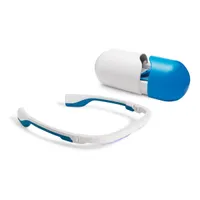
The glasses themselves are incredibly lightweight and can easily be worn over prescription eye glasses, emitting light downwards into your eyes via four light-emitting diodes.
The glasses turn on as soon as you open up the arms, kick-starting a 20-minute light therapy session. In the app you can change the duration of your session from 5 minutes (minimum) up to 90 minutes.
The light intensity can also be customized – choose from low, medium or high (most effective), or a custom intensity from 10% to 100%.

You also have the option of finishing your blue light therapy session with three minutes of red light.
There’s lots to dig into with narrowband red light, but in a nutshell it can stimulate the "powerhouses" of your cells (the mitochondria) to produce more energy. In terms of eye health, narrowband red light can help lower inflammation and give retinal cells a boost.
The root cause of my sleep and energy issues
There are two pain points in my day: feeling like a zombie when I wake-up, and hitting the wall, energy-wise, around 2.30 p.m. most afternoons.
In my defence, my sleep hygiene is excellent. I keep a consistent sleep schedule, follow the same bedtime routine, and go device-free and switch to circadian lighting an hour before bed. I drink water and eat soon after waking to give my body those wakeful cues, and I start moving my body.

None of that is a match for my wakeful three-year-old.
Sleeping has always been hard for him, for various health reasons. So I’m awake multiple times a night with my son, and that’s without my daytime caffeine habit fuelling more overnight chaos.
I can easily get through four or more cups of tea or coffee by 3pm. If I had to guess, I’ve probably been consuming around 400mg of caffeine in an eight-hour period (7am to 3pm) most days.

Caffeine can stay in your system for up to seven hours, which can make falling asleep within a decent time frame (20 minutes is average) quite tricky.
And according to the National Institutes of Health, even if you can fall asleep after a day on the caffeine train, high doses can reduce the amount of deep sleep you get. They can also trigger overnight awakenings.
Trading caffeine for circadian-optimized shots of blue light
I’ve tested many traditional light therapy boxes throughout my career working across Tom’s Guide, T3, TechRadar, and Top Ten Reviews, and while these S.A.D. lamps are highly effective, they require you to sit still.
The AYO+ Light Therapy Glasses are my first long-term experience using wearable phototherapy — and they’ve been a revelation.
Instead of being stuck at my kitchen table for 20 minutes each morning sat near a lightbox, I simply pop the AYO+ glasses soon after waking and get on with my morning routine.
From a productivity perspective alone, being able to move around the house while getting my daily dose of light therapy is convenient. And honestly? I don’t think I’ll ever go back to a stationary light therapy box.

But convenience wasn’t my main motive for testing the AYO+ Light Therapy Glasses. Instead I was desperate to tackle three major, interconnected issues:
- Intense grogginess upon waking – that heavy, stubborn sleep inertia that makes me feel like a zombie.
- Regular afternoon slumps – the ones that left me reaching for caffeine long past the recommended midday cut-off.
- Frequent overnight wake-ups – which I strongly suspect my caffeine habit was worsening.
To break the cycle, for three months I used the AYO+ glasses for 20 minutes soon after waking every morning. I wanted to see if they could reduce my morning fatigue and help me gain day-long energy without hammering the caffeine.
Here’s what happened…
My 90-day testing experience with the AYO+ Light Therapy glasses
When you’re rolling a huge sleep debt and feel so tired each morning that you want to crawl back into bed, setting up fiddly tech is a hard no. Luckily, the AYO+ Light Therapy Glasses are easy to use.
I keep mine next to my bed, nestled in the pill-shaped hard travel case they come in. My routine is simple: wake up, get out of bed, put on the AYO+ glasses, and go about my morning.
Here’s how effective, or not, the glasses were against each of my three big interconnected energy and sleep issues…
Sleep inertia

The AYO+ glasses were shipped to me during deep winter with its pitch black mornings. I’d given my Lumie light therapy box to a friend who was struggling with Seasonal Affective Disorder (S.A.D.), so I’d been without a light therapy device for weeks at that point and I was really feeling it.
The AYO+ glasses came packed in a white reinforced cardboard box with the brand’s logo on the outside. Inside was a hard travel case, housing the glasses, a white charging cable, and a small dust bag / soft travel pouch.
Based on my sleep-wake schedule and chronotype, here are the customized circadian recommendations I received from the AYO app: Finish all meals for the day by 7 p.m. then fast until 7 a.m. wake-up. Drink my last coffee by 1.30 p.m. Finish work and rigorous exercise and start winding down by 7.30 p.m. Dim all lights between 7.30 p.m. and 9.30 p.m. Aim to be in bed by 9.40 p.m. to fall asleep by 10 p.m. (my target bedtime).
After charging the glasses (a full charge takes around three hours and lasts for around nine 20-minute sessions), I placed them on my nightstand ready for the morning.
I chose my normal wake-up time of 7 a.m. as the approximate start time for each daily session, as numerous studies have shown that light therapy is most effective within an hour of waking.
On my first day of testing I used the pre-set 20-minute session. While the glasses were a novelty – they look quite ‘Tron-esque’ when switched on – I didn’t feel any benefit.
I was still yawning after taking them off, and by mid morning I was flagging and hitting the caffeine. At 2.30 p.m., despite staying hydrated, eating a good lunch and going for a brisk walk, I was firing up the kettle.
AYO states that it can take a few days to a few weeks (or longer, depending on the individual, severity of symptoms, and lifestyle habits) to see any improvement.
So I persevered for a week to see if repeated daily use would nudge my body into easing off the melatonin and ramping up the cortisol and other wakeful hormones soon after waking. But it didn’t.
Come week two, however, I was beginning to feel less groggy in the mornings.

I usually need a cup of coffee before leaving the house for work or nursery drop-off. On the morning of day eight I didn’t. Instead, I had my first cup of tea at around 11 a.m. However, I was flagging again in the afternoon.
This became my pattern for another week. During my third week of testing, my morning grogginess had vastly reduced. In fact, I was waking up a few minutes before my alarm and feeling energised to boot.
And from a caffeine perspective, I was down to one cup at 11 a.m. These were huge wins for me compared to even a month before when I would be finishing my third cup by 10 a.m.
The afternoon slumps were still hell though, so I went back to the biohack drawing board. That was when I decided to introduce what I now call my ‘2 p.m. blue light boost.’
It was a game-changer…
Goodbye, afternoon slumps

Ever heard of anticipatory anxiety? It’s a phenomenon where you have a feeling of dread or worry about something that hasn’t happened yet.
Mine would start creeping in soon after lunch, when I’d begin worrying about the inevitable energy slump waiting to ambush my afternoon.
I’d panic about not having enough fuel in the tank to get through my work-load, or to keep up with my busy bee of a son for another five hours.
So after three weeks of single-dosing with light therapy I started double-dosing. I wasn’t expecting it to work so fast, but it did; like a gentle bubbling up of fresh energy that carried me through the afternoon.
Was it as instantly powerful as a cup of coffee? No. But it also didn’t give me jitters, heart palpitations or interfere with my sleep at night.
This post-lunch, 20-minute blue light boost has become a reset button for my afternoons. And I no longer have a physical need to consume caffeine after midday.
I always finish my second dose of phototherapy by 2 p.m. too, as blue light exposure can affect sleep in some people when used later in the day.
Why the AYO+ Light Therapy Glasses didn’t stop my overnight wake-ups
The AYO+ Light Therapy Glasses are an excellent tool for strengthening your natural circadian rhythm and for understanding the best times of your day to eat, exercise, be productive, sleep, and wake up.

When your body clock is properly anchored, your brain naturally learns exactly when to produce the right hormones at the right time — whether that’s cortisol to keep you energized during the most productive parts of the day, or melatonin to help you wind down for sleep at night.
Biologically, this predictable rhythm should help you settle down, fall asleep faster and boost your chances of sleeping through the night.
So why am I still waking up at 1 a.m., 2 a.m., 3 a.m. and on? I mentioned him earlier: my three-year-old who wakes regularly due to ongoing health issues. As effective as the AYO+ Light Therapy Glasses are, they can’t help me there.
What I can say is this: when I do wake at night now, I fall back asleep fast. When I was necking loads of caffeine in the day, it took me an age to fall back asleep each time at night, even after practising techniques like 4 7 8 breathing or cognitive shuffling.
Energy levels rising, caffeine reliance dropping: Three months on
After three months of testing, the AYO+ Light Therapy Glasses have become a daily essential for me.
I love putting them on each morning and seeing that slim band of turquoise-blue sitting above my eyes. It feels summery, tropical and mood-boosting, even on dark winter mornings.
Having spent years reviewing traditional 10,000-lux S.A.D. lamps across Tom’s Guide, T3, and TechRadar, the freedom of wearable phototherapy has been a revelation and one I wish I’d embraced sooner.
The AYO+ didn't solve my interrupted nights — no piece of wearable tech can reprogram a wakeful three-year-old. But by using clinical-grade blue-turquoise light to anchor my circadian rhythm and reduce my morning grogginess and afternoon slumps, it did something much better: it gave me my days back.
I no longer feel like a zombie in the mornings, I don’t hit the wall at 2 p.m., and I no longer have to chug several coffees just to survive the day.
My reliance on caffeine has plummeted from around 400mg a day to just one solitary, late-morning cup of tea – and some days I even skip that.
Is light therapy suitable for everyone? No. According to AYO, people with bipolar disorder, those with eye conditions such as cataracts, people on photosensitizing medications, and those with skin sensitivities such as lupus should be cautious when considering light therapy glasses.
I’d recommend speaking to your doctor or healthcare professional first.
My verdict

If you’re looking for a magic wand that instantly guarantees seven+ hours of uninterrupted sleep a night, the AYO+ glasses aren't it.
As a Certified Sleep Science Coach, my recommendations there are choosing a few good sleep hygiene tips and sticking to them, keeping a consistent wake-up time, investing in the best mattress you can afford, and not stressing too much about ‘perfect sleep’ (orthosomnia).
But if you are a parent, a shift worker, or someone drowning in sleep debt and looking to break free from a vicious cycle of morning fatigue and afternoon caffeine crashes, the AYO+ Light Therapy Glasses are worth it.

Follow Tom's Guide on Google News and add us as a preferred source to get our up-to-date news, analysis, and reviews in your feeds. Alternatively, you can read our content on the Tom's Guide app available now for iOS and Android. Subscribe to Tom's Guide on YouTube and follow us on TikTok. Finally, you can visit our dedicated Tom's Guide Savings Squad hub for expert help on getting the best products for less.

