






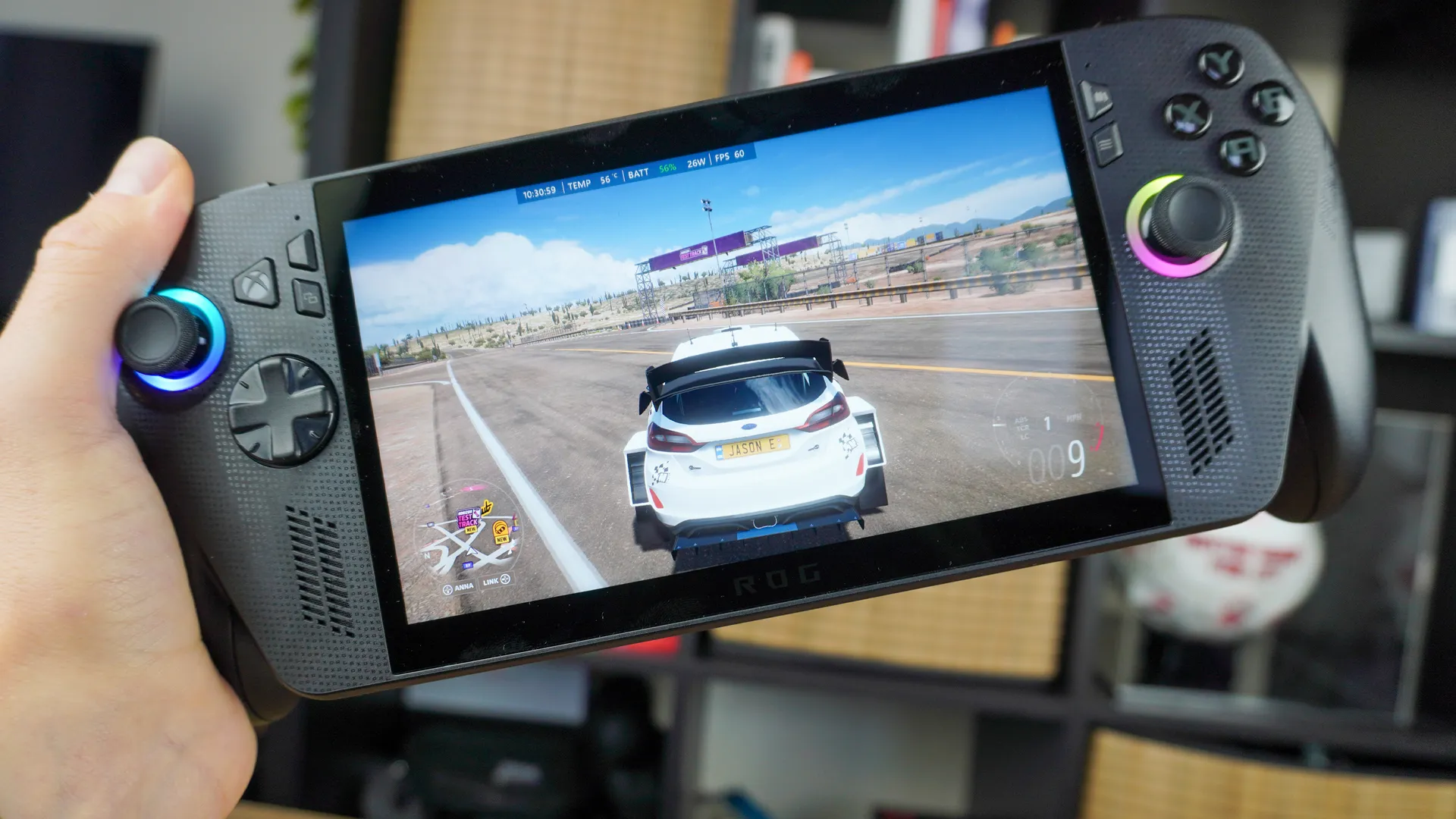
The future of handheld gaming is shifting, with the new Intel Panther Lake and its impressive Core Ultra X9 388H CPU leading the charge. For gaming handhelds, this is looking to be a game-changer, and it's already beating AMD where it matters most.
With its next-gen XeSS 3 (Xe Super Sampling) and multi-frame generation tech, Intel has made significant gains for its Arc B390 iGPU — pushing integrated graphics to new highs on laptops. And, after benchmarking the Asus Zenbook Duo with Intel Core Ultra X9, the results are clear.
While seeing Cyberpunk 2077 running at 217 frames per second (FPS) at 1080p with Ultra settings impresses, the TDP (Thermal Design Power) it uses to reach these results will be massively beneficial for the future of gaming handhelds. In fact, it's seeing better performance than AMD's Strix Halo (Ryzen Max AI+) when it comes to low power consumption.
Not only does it outclass the AMD Ryzen Max AI+ in a Framework Desktop in single-core (see the table below), but recent benchmarks from YouTuber The Phawx have shown the Intel Core ultra X9 388H delivers stronger performance at lower TDP.
Processor |
Intel Core Ultra 9 388H |
AMD Ryzen Max AI+ |
Intel Core Ultra 9 288V |
Single-core |
3031 |
2966 |
2853 |
Multi-core |
17283 |
17574 |
11125 |
According to the results, the X9 CPU with its integrated Arc B390 graphics was able to hit 46.6 FPS at just a TDP of 15W in Black Myth: Wukong with 720p resolution at low settings. Compared to the AMD Strix Halo (featuring integrated Radeon 8060S graphics), this reached 39 FPS with the same configuration.

Not only this, but Team Blue's Core Ultra X9 388H even managed to reach 30 FPS at just 10W. Considering the ROG Xbox Ally X with its AMD Ryzen AI Z2 Extreme offers up 16.6 FPS at 35W TDP in Cyberpunk 2077 at 720p and Ultra settings, at 11.9 FPS at 17W, this shows the gains Intel has made with its CPU for handheld gaming.
This supports the benchmarks we've seen in Intel's Core Ultra 3 X9 chip in the Asus Zenbook Duo, with it using 45W as opposed to an Acer Predator Triton 14 AI with RTX 5070 using 140W. Of course, with its discrete GPU, Nvidia's graphics card offers better performance, but with lower TDP, Team Blue's chip still impresses.

That's a promising outlook for upcoming gaming handhelds, and Intel has previously confirmed it will be launching a suite of handheld gaming consoles boasting Intel Core Ultra Series 3 at CES 2026.
"They are the testament of our strategy to bring what the market requires," an Intel spokesperson told Tom's Guide. "A powerful CPU, a powerful GPU, packed with great efficiency within the same solution. With our 12Xe configuration, we deliver performance that approaches discrete GPU levels in thinner, lighter, and more portable devices. This meets the needs of customers and reflects our strategic commitment to rapidly advancing the capabilities of integrated GPUs."
Multi-frame generation is a big win

Aside from improved power efficiency, Intel's XeSS 3 is already knocking it out of the park with its frame generation and resolution scaling.
This would be a major perk for upcoming gaming handhelds, and while Intel confirmed to Tom's Guide that it's coming to the desktop GPU Intel Arc B580 next month (making it the only GPU we'd recommend given the RAM price crisis happening), we asked them about multi-frame generation coming to gaming handhelds.

"Gaming handhelds are an exciting and growing segment where we have more planned, featuring Intel Arc graphics. We’ll share more later this year."
Not much to go on, but considering these chips for gaming handhelds will "feature Intel Arc graphics," in other words, the latest XeSS technology we've seen in the Arc B390, it's looking likely we'll see huge gains in frame generation in gaming handhelds, too.
Combine this with the Core Ultra X9 388H's significant performance and power efficiency gains we've seen, and the future of the best gaming handhelds is looking bright. While AMD claimed its Ryzen AI CPUs beat Intel Panther Lake for gaming and AI, we'll see what Team Red has to offer when it comes to handheld gaming.

Follow Tom's Guide on Google News and add us as a preferred source to get our up-to-date news, analysis, and reviews in your feeds.
More from Tom's Guide

