




The best 75-inch TVs are great if you enjoy having people over to watch movies and sports. You can sit further back from them (meaning more people can gather around), and the larger design means brands can pack in more tech, too.
Often, 75-inch TVs have more ports and a higher refresh rate for gaming, improved brightness (compared to smaller models) for sunlit rooms and larger (and often better) speakers, so you get more than just a bigger screen for your money. As you'll see in this guide, we're big fans of 75-inch TVs here at Tom's Guide, and we test the latest models every year to find which screens offer the most value for your setup.
That's why we recommend the TCL QM8L to most, with its Mini-LED panel offering rich colors, deep blacks and incredible brightness at a value-driven price that any viewer will appreciate. Looking for something more budget-friendly? You'll find a 75-inch TV for well under $1,000 in the Hisense QD7 and even the excellent Sony Bravia 3 II.
We have more sets worth considering, and with the holiday season bringing plenty of sales, now is a great time to give your living room the TV size it deserves. You'll find our expert buying advice and in-depth testing in this guide to help you find the best 75-inch TV for your setup.
The best 75-inch TVs available right now
Why you can trust Tom's Guide Our writers and editors spend hours analyzing and reviewing products, services, and apps to help find what's best for you. Find out more about how we test, analyze, and rate.
Best 75-inch TV overall


LG has dominated the top spot for years, but the brand has finally been unseated by an upstart from TCL. We should perhaps briefly explain why the LG C6, the successor to the previous top pick, isn’t our favorite right now. Yes, it’s a great TV, but right now it’s just too expensive.
Instead, the TCL QM8L comes in at a price comparable to the C5 that used to top the list, while offering excellent picture quality and very similar performance to LG's top-of-the-line TV. And the price just keeps dropping no matter where you look, making it a very compelling buy no matter how you swing it.
We were most impressed with the black levels found on the QM8L, which are deep and dark despite the mini-LED technology that usually lends itself to brighter colors than lovely blacks. As you might imagine, the picture is also extremely bright — one of the brightest we’ve tested.
Gamers will love the 120Hz refresh rate, and it makes those fun action movies and other intensive content look smooth and uncluttered. We also really like the addition of the USB 3.0 port on the back, which is quick enough to play high-res video.
Four HDMI ports give you plenty of places to plug in all your devices from a soundbar to a PS5, and there are even legacy port options like optical for older devices. There are only a couple of things we didn’t like. First is the color accuracy. It’s not awful, but there are better options with more accurate colors out there if colors are your jam.
The brightness also comes with a small issue — unless you crank it down, it can be overwhelming in a darker room. It’s no deal breaker, however; this is still an excellent TV which makes anything you throw at it look amazing, and its our pick for the best 75-inch TV.
- Read our full TCL QM8L review
Best budget 75-inch TV
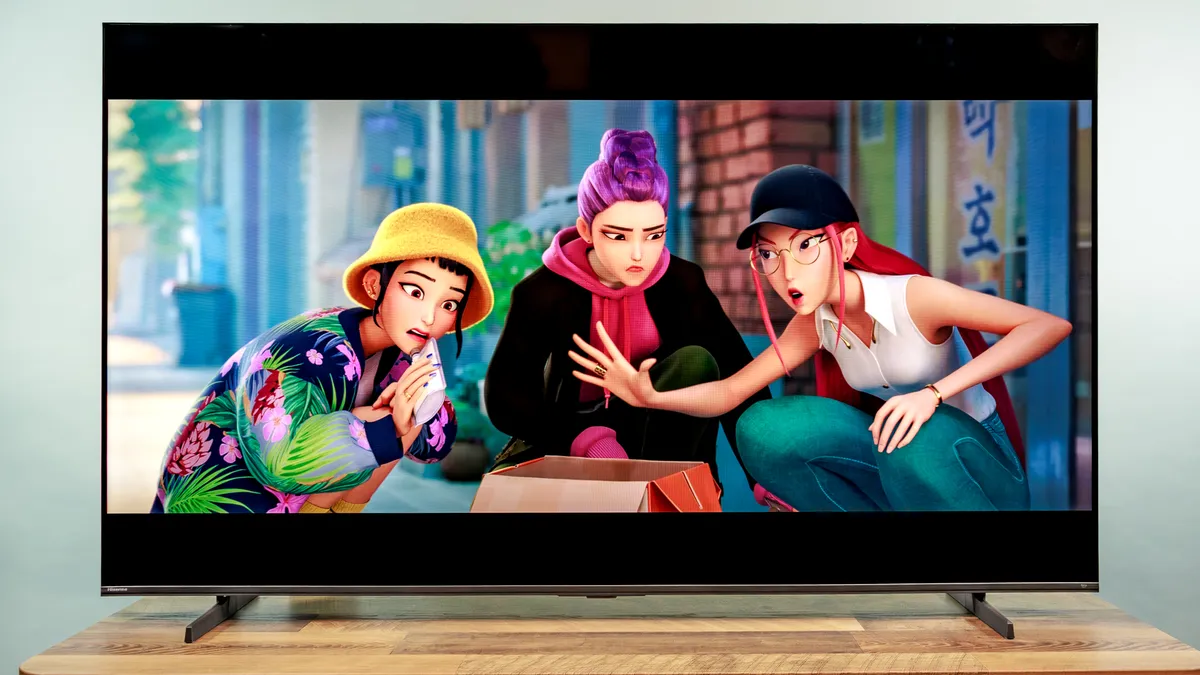

Sometimes I wonder if I made up the Hisense QD7 in a dream. It's hard to believe that something as good as this could somehow be only a little over $500, when so many of the best 75-inch TVs are over than $1,000 or while others are more than several thousand. When there's so little compromise, it's almost too easy to recommend.
One of its best attributes is the way that it handles color. The display comes with quantum dot crystals, which sound very technical but I have a good reason for telling you about them. These absorb some of the backlight and re-emit it as green and red light, which makes the on-screen picture more colorful and vibrant.
Meanwhile, the LEDs are individually controllable (by the TV, not you) so the set can adjust the contrast and brightness in specific areas of the screen. Put these two things together, and it meant that when we watched franchises like "Dune" and "Stranger Things," we could actually pick out details in all the dark and shadowy scenes.
This strength makes the QD7 a good budget 75-inch TV for live sports too. Often you have a pitch on screen where one half is in sunlight, the other in shade. The TV's handling of contrast, colors and brightness means you can still see what's going on wherever the players are.
There are only two downsides to the Hisense QD7; its 60Hz refresh rate is a little slow for fast movements or gaming (we found the motion smoothing setting helped) and that it runs Amazon's bloated and slow Fire TV operating system. This is more of an annoyance though, and shouldn't put you off this otherwise exceptional budget TV.
- Read our full Hisense QD7 review
Best 75-inch TV under $1,000

If you're looking to take a step up in brightness and gaming features over the bargain-worthy Hisense QD7 but still want value, the 75-inch Sony Bravia 3 II is an easy recommendation for the flagship features it boasts while still being just under $1,000. Okay, that's usually during a sale, but as we've seen on this TV, that happens more often than not.
Despite its price, the Bravia 3 II outperformed expectations in our lab with an impressive 2.12 Delta-E in Professional Mode for color accuracy and hit 520 nits peak HDR brightness. That rivals sets that are way above this asking price, meaning you can expect easy watching in lighter environments and crisp, colorful details.
Those colors are no joke, as when watching cartoons, the Bravia 3 II’s Vivid mode literally made SpongeBob’s skin pop with a yellow we've never seen on a non-OLED screen (it's LED). That makes watching movies and sports feel immersive rather than washed out. Even when watching a cinematic visual treat like "Project Hail Mary," the Bravia 3 II revealed small details and subtle textures.
If you're a gamer, you'll be happy to know you'll get four HDMI 2.1 ports, which even some flagship Sony TVs skip. That means you can plug in multiple consoles and a soundbar and still have ports to spare. Gaming was smooth with low input lag, and there are plenty of gamer-ready features to make playing the latest games a treat.
Of course, if your living room is flooded with sunlight every afternoon, you’ll find brighter options (like the Hisense U8QG), but for everyone else, the Bravia 3 II hits the sweet spot. If you want a 75-inch TV that nails color, feels snappy for gaming and won’t be obsolete in two years, this is where your money should go for under $1,000.
- Read our full Sony Bravia 3 II review
Best 75-inch TV for gaming

Hisense has been on a roll lately, putting out high-performance (relatively) affordable TVs over the past few years. The Hisense U75QG continues that winning streak, with a rare combination of features at this price that make it the best 75-inch TV for gaming you can pick up without breaking the bank.
The technical performance is part of it (and it really did shine in the lab tests) but more than anything, it was just a lot of fun to use for gaming sessions. It has four HDMI 2.1 ports, and an impressive 165Hz refresh rate, so it's ideal for console sessions (as those top out at 120Hz) and for PC gamers, where the reduced lag makes a big difference.
And about those lab tests — this is a very bright TV. It's four times brighter than the TCL QM7K in HDR and four times brighter in SDR than the Hisense QD7. The only TV we've tested that gets brighter is the Hisense U8QG (which is why, surprise, I've rated that model as the best 75-inch for bright rooms).
So if you need a gaming TV that can handle sunlit rooms and the darkness of the evening, this is the TV to go for. You probably shouldn't put it in direct sunlight, though. There's an anti-glare coating, which did dampen the effect of the light, but it struggled a bit. It's not a problem for most things, but isn't ideal for details in games.
Plus, every color on the screen really popped, especially in the multi-colored and bright world of "The Super Mario Bros. Movie." And while "Blade Runner 2049" might be better known for its brooding dystopian view of the world, the bright futuristic flourishes looked vibrant in all the right places.
- Read our full Hisense U75QG review
Best 75-inch TV for bright rooms

I wouldn't call the Hisense U8QG cheap, but it certainly a punches above its price (like most of Hisense's TVs do), especially when it comes to brightness. In our lab testing, we found that it outshines (sorry) almost every other model we've tried. There's no qualifiers to that — it's just impressively bright.
What we're actually testing for is peak brightness, so you don't need to worry that this set'll be overpowering in your home. But it does make it the best 75-inch TV for bright rooms, as it can hold its own against brightly lit spaces and sunlight without much effort. So if you need a TV that'll shine, the U8QG is the one.
We gave it a pretty tricky test with Christopher Nolan's "Tenet" which is visually impressive, but full of shades of black that can be hard to distinguish. Yet details hidden in the shadows were easy to see. The same was true with "Barbarian" and "Ghost In The Shell," where the colorful and shadowy moments looked crisp.
When "Tenet" came out, there was a lot of talk about how hard it was to hear the dialogue. That's true on most TVs, but the Hisense U8QG worked its magic here too, using the set's AI Sound feature, which boosts speech and sound effects. Unusually, it's also got a sizeable 72W, 4.1.20-channel audio setup, which genuinely sounded good.
For a TV that's so generous with specs and features, it's a bit of a shame that Hisense only included three HDMI 2.1 ports (in place of the four you'd find on the Hisense U75QG), but it's balanced out by the 165Hz refresh rate (higher than the TCL QM7K's 144Hz) that makes this a great option for gaming or live sports, too.
- Read our full Hisense U8QG review
Also tested
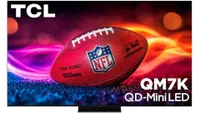
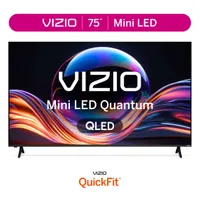
Not every TV can be the best 75-inch TV. But some come pretty close. I recommend the five options above, but if those don't quite fit what you need, these are some other TVs that are still worth your money.

Best 75-inch TVs: FAQs

Is a 75-inch TV big enough, or should I buy an 85-inch TV?
If you're debating about sizes, know that a 75-inch TV is big enough for most shared living rooms, but an 85-inch model can make more sense if you sit a long way back and have the space and budget. The best 85-inch TVs are massive screens that are amazing for watching movies, but they can also dominate a room. Be sure to choose based on your sitting distance and the size of your room.
After all, sitting too close can make the image feel blurry or disorienting. If 75 inches fits your room comfortably, it also leaves more budget for picture quality, brightness, gaming features or one of the best soundbars.
How far away should you sit from a 75-inch TV?
For a 75-inch 4K TV, around 2.3 to 3 meters is a useful starting range, but the right distance depends on your room and what feels comfortable to you. Higher-resolution 4K content can look sharp from nearer seats than older lower-resolution screens, while anyone who prefers a more clean, simple picture for easy watching may want to sit farther back.
Is a 75-inch Mini-LED TV better than an OLED TV?
Mini-LED is often the more practical choice for a bright room, while OLED is usually preferred for its pixel-level contrast and deep, inky blacks that make cinema-worthy movies even more immersive. Keep in mind that your room lighting, budget and the films, sport, or games you watch matter more than the panel label alone.
For example, the TCL QM8L shows why Mini-LED can be a compelling pick, pairing exceptional brightness with impressively deep blacks. If you mainly watch in a dark room and prioritise the most precise contrast, though, you may want to go for something like the LG C6 or Samsung S95H.
How to choose the best 75-inch TVs

I know you've found your way to our best 75-inch TVs roundup, but before you go too deep in your research, why do you want a 75-inch TV over an 85, 65, or even 43-inch TV?
You may already have looked over our guide to choosing the perfect TV size for your space and found that 75 inches is the sweet spot for your room. Or maybe you know you want to be able to watch shows and movies with the whole family or group of friends and need something you can all gather around.
But in the case of TVs, bigger isn't always better. If you end up too close to the display, the picture can look blurry or disorienting. So if you can go lower, then save yourself some money and pick the smaller size if that's what'll work best.
The best 75-inch TVs are, at risk of stating the obvious, bigger than the best 65-inch TVs, and so have more space for extra ports and peripherals, and are often brighter than much smaller sets like the best 43-inch TVs, even for the same model.
In theory, the extra space also means the speakers can be larger too. Though, in our experience, the built-in TV speakers rarely sound that good anyway (unless you go for the Hisense U8QG), so you'll probably want to add one of the best soundbars to your setup, whichever TV you choose.
How we test the best 75-inch TVs

When you go to buy a new TV from the store, it's hard to tell what it'll actually be like away from the artificial lights or press shots online. That's why we call every set into our testing lab to put it through its paces before we recommend any TV, or tell you that it's the best 75-inch TV worth your money.
The first step is to complete our technical testing. You can read more about how we test TVs, but the TL;DR is that we use specialized industry-standard equipment to measure the TV's brightness, input lag and color accuracy for an objective view of the television's performance.
This makes it easier to compare between models or when a brand releases an upgraded version of the TV, so we can check that the manufacturer's claims really stack up. Plus, it means that we can more easily recommend use cases, like when I said that the Hisense U8QG is the brightest TV in our roundup.
Once that's out of the way and the data is securely stored in our testing spreadsheets, we start to do the fun bit of the job — using the TV. We watch movies, TV shows and sports, and play games on each set to see what it's really like to use them. This means that we get to work out how they perform in real-world conditions, like bright rooms.

