





Tom's Guide Verdict
While it’s slightly expensive at launch, the 75-inch TCL QM8L TV largely delivers on the hype: Color range, black levels, brightness, and shadow and highlight detail are near the top of the field — with no sign of "blooming" halos on dark screens. Audio is solid for speakers squeezed into a thinnish panel. While the Google TV software can be personal data-hungry, key TV adjustments are exceptionally easy to access.
Pros
- +
Deep blacks without blooming
- +
Fine detail in shadows and highlights
- +
Robust and vivid color
- +
Respectable audio for a thin panel
- +
Handy Gemini voice control features
Cons
- -
"Intelligent" picture and audio modes don't seem to do much
- -
Color accuracy isn’t ideal
- -
Default brightness can be overwhelming
- -
Be careful with how much data Google TV collects
Why you can trust Tom's Guide Our writers and editors spend hours analyzing and reviewing products, services, and apps to help find what's best for you. Find out more about how we test, analyze, and rate.
Price: $2,999
Screen size: 75-inch
Resolution: 3,840 x 2,160 (4K)
HDR: Dolby Vision IQ (HDR10+, HLG), upgradeable to Dolby Vision 2 when available
Refresh rate: 144Hz
VRR: 48–288Hz (AMD FreeSync)
Ports: 4 HDMI 2.1 up to 4K/144Hz (port 1 with eARC), 1 USB 3.0, 1 USB 2.0, optical digital audio out, LAN, RF-in
Audio: 2.2-channel (Dolby Atmos, DTS Premium Sound)
Smart TV software: Google TV with Gemini AI
Size (without stand): 61.7 × 2.0 × 37.4 inches (W×D×H)
Weight (without stand): 62.6 lbs
TCL introduced a raft of complex display technologies earlier this year, but reserved them for its rather expensive X11L line (one of this year’s best TVs).
Now those technologies have made their way down to the cheaper (though not cheap) QM8L models. They include upgraded Mini-LED backlighting and smaller nanoscale color filters that have brought LED-LCD TVs up to par with OLED in a number of categories. The result is a new TV line with impressive picture quality — especially its deep blacks with fine detail, powerful dynamic range, and impressive brightness that holds up in well-lit rooms.
The QM8L compares favorably to the best 75-inch TVs available in stores right now, and while it might not be the cheapest Mini-LED on the market this year, I still recommend it for folks who want the latest in cutting-edge TV tech.
TCL QM8L review: Pricing and availability
The QM8L sits just below the flagship TCL X11L line, but comes at a significant price decrease. The 75-inch version we evaluated lists for $2,999; a 65-inch version (the most-popular size for households buying a new set) has a $2,499 price tag.

All things considered, that's a big discount from the 75-inch X11L's $7,000 price tag, but if three grand is too much for you (perfectly understandable) you can find still-impressive quality in cheaper 75-inch models from 2025, such as TCL's own 75QM6K (under $1000), or the Hisense 75U8QG (around $1600).
To get better black levels, however, you might have to move into OLED models with pricing similar to the QM8L's, such as the excellent LG C5. The 77-inch C5 originally listed for $3,699 but can now be had for less than $2000.
Like the C5 mentioned above, expect the QM8L to drop in price later this year; If that’s not something you can wait for, TCL is also launching another new TV line, the QM7L, which incorporates similar — though less high-end — screen technologies at lower prices. That 75-inch model will be available for $1,999, while a 65-inch will only set you back $1,499. We opted to test the QM8L first, but will shortly call in the QM7L for review.
TCL QM8L review: Design
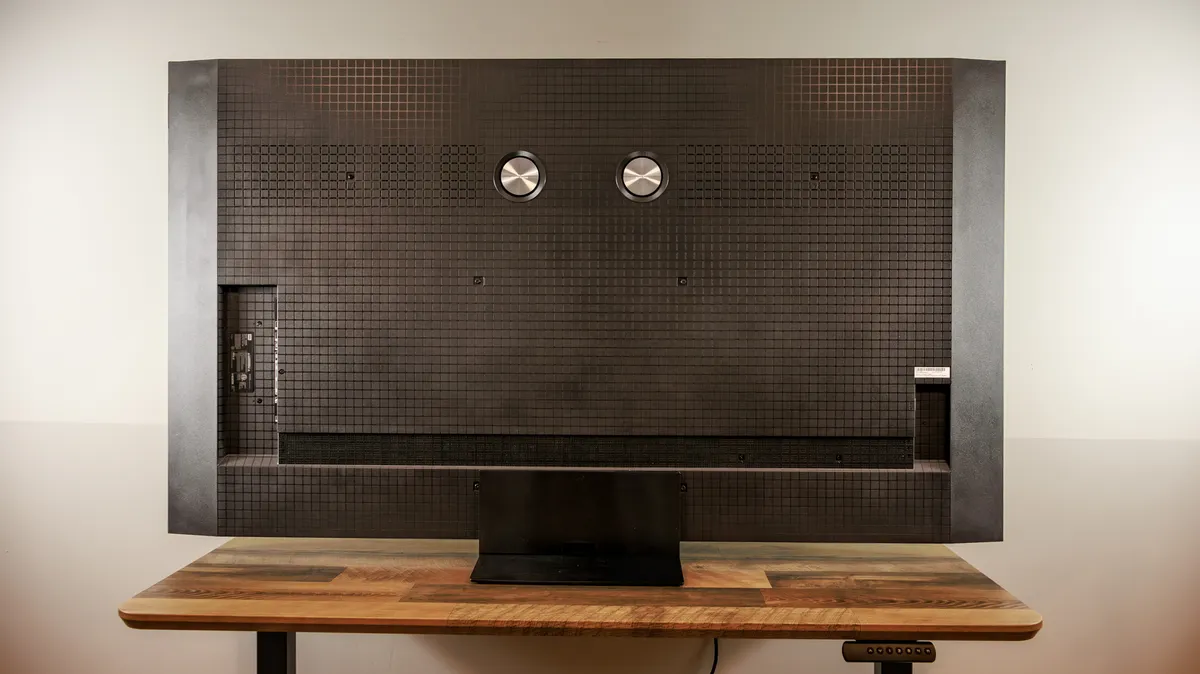
This TV is not especially skinny by modern standards, at two inches thick; but that's the reasonable trade-off for its sophisticated full-array LED backlighting behind the screen. The QM8L also leaves room for a speaker system, with mid-bass speakers for deeper tones.

As with most flat panels today, the QM8L's bezel is of negligible thickness, leaving essentially all screen and just the letters "TCL" at the bottom.

The screen sits on a central pedestal, allowing you to place it on a smaller table. (Cheaper TVs tend to have feet close to each end of the screen.) That's especially useful for the 75-inch model that measures nearly five-and-a-half feet wide.
TCL QM8L review: Ports
The QM8L TV has a full array of connectivity. It starts with four HDMI ports, all supporting the 2.1 standard that allows input up to 4K at 144Hz (the panel's max refresh rate). Most video sources top out at 120Hz, although some high-end gaming rigs do go up to 144Hz. Pair that with the 9.5ms input lag (one of the fastest we've measured), and you have a cutting-edge gaming screen.

One HDMI port features eARC, providing Dolby Atmos and DTS Premium Sound digital audio output to a soundbar or home-theater system. The QM8L also has optical S/PDIF audio output for legacy systems, however. In addition, this TV offers a range of wireless speaker options (more about them below).
The set sports a pair of USB ports. One supports the 2.0 standard, with adequate power (0.5 amp) for the best streaming sticks, such as those from Amazon and Roku (providing an option if you don't like the Google TV interface). The other supports USB 3.0, with up to 0.9 amp — generally enough to power a small external hard drive and with the bandwidth to smoothly deliver large video files from it.

There is a LAN networking port (pretty much a vestigial organ in the era of fast Wi-Fi), and the RF input attaches to a tuner supporting the latest ATSC 3.0 standard for higher-quality broadcast TV features, such as high dynamic range (HDR). It has no bearing on content from online streaming or cable-TV boxes.
Aside from the power-cable input on the right, all ports cluster on the left side of the TV, when viewed from behind.
How we test
We follow a standard testing protocol for every TV we review at Tom’s Guide. Our benchmarks include a series of technical and subjective tests designed to rate the set’s performance.

For our technical tests, we set the TV to Filmmaker Mode (usually the most accurate out of the box) and take measurements using a Jeti spectraval 1501-HiRes spectroradiometer, a Klein K10-A colorimeter, a Murideo 8K-SIX-G Metal pattern generator, and Portrait Displays’s Calman TV-calibration software. We also use a Leo Bodnar 4K Video Signal Lag Tester for determining the TV’s gaming prowess.
Subjective tests vary based on the reviewer but usually include anecdotes from a diverse selection of movies, TV shows, and other content reflecting the types of things you may actually want to watch on the TV. For a more detailed look at what we do and how we do it, check out our “How we test TVs” page.
TCL QM8L review: Performance
Image quality from the QM8L is generally excellent, with some minor caveats. Deep blacks and wide dynamic range are undisputed strengths. TCL emphasizes that this LCD-based screen is not an "OLED Killer," but it's pretty darn close. The claims for color reproduction are equally grand compared to the brand-new LG C6 OLED, though the test results are mixed.

The QM8L leverages a full-array LED backlight, with 2,584 illumination zones behind the 75-inch screen, each zone tunable to over 67 million (26-bit) discrete brightness levels. (The 75-inch X11L is more expensive in part because it has even more zones, although TCL declined to specify how many.)
That fine degree of control is combined with other features, such as microlenses to concentrate the backlight and an LCD panel that TCL says better blocks light from bleeding through. The result is amazingly dark blacks, which could appear next to extremely bright items with none of the "blooming" or ghostly halos around them. We saw this in a photo of a brilliant blue neon sign against a deep-black background. Even the brightest, overexposed parts of the sign had distinct boundaries, with no gray zones around them.

Deep black is of little value if a TV can't also retain detail in the slightly less-than-black areas. The QM8L accomplishes that task. In a photo of a woman wearing a black straw hat, for instance, the details of the weave were clearly visible, as were the strands and shading in her dark brown hair. Yet the brighter elements also shined, without being washed out.
We saw the same in a digital restoration of "8½," Federico Fellini's 1963 black-and-white fever dream of a movie. One scene, set in a dim bedroom, shows details equally fine in people's dark clothing and a brilliant white sheet. A later scene in a sun-drenched garden achieves equal fidelity across the range of shades.

Both extremes were a bit overpowering in Standard Mode, however. The film had more subtle elegance in the TV’s Movie mode. While Filmmaker mode is meant to be the most accurate setting (and the benchmark for instrument testing), I tend to find it a bit dreary on all TVs: too warm and muted. For dark room viewing, I found the slightly livelier Movie mode more enjoyable.
The QM8L leverages its technology with newer high-dynamic range material, such as Chapter 4 in the Blu-ray of "Spiderman: No Way Home." Details are perfectly clear and luminous in the firelit conversation between Peter Parker and Dr. Strange, as well as the later scene in which Strange weaves his ill-fated fiery spell in a nearly black room.

I enjoyed the broad yet subdued range of hues in "Bridgerton" (Season 1, Ep 3, 17:00-19:00), especially the riot of colorful sundresses in a glittering outdoor scene. The QM8L also captured detail well in highlights, such as strong sunlight glinting off a woman's forehead. Like this Netflix series, the QM8L supports Dolby Vision, which embeds extra data to ensure that the TV more faithfully reproduces the content. I found the nearly identical Dolby Vision Light and Dolby Vision IQ best for preserving detail for faces that were shaded in an indoor party scene. Colors in our test photos were also pleasing, such as the muted-orange ribbon on the woman's hat.
TCL QM8L review: Test results
| Row 0 - Cell 0 | TCL QM8L |
TCL QM9K |
Hisense U75QG |
LG C6 OLED |
Samsung QN90F |
Sony Bravia 9 |
SDR Brightness (10%, in nits) |
229 |
224 |
1144 |
360 |
266 |
498 |
Delta-E (lower is better) |
3.7 |
1.8 |
2.8 |
1.6 |
1.83 |
1.79 |
Rec. 709 Gamut Coverage |
99.55 |
99.44 |
99.58 |
97.80 |
99.16 |
99.17 |
HDR Brightness (10%, in nits) |
3,719 |
4,208 |
2,951 |
1,251 |
2,109 |
2980 |
UHDA-P3 Gamut Coverage |
97.97 |
97.05 |
94.9 |
99.68 |
94.5 |
95.32 |
Rec. 2020 Gamut Coverage |
90.34 |
80.29 |
76.19 |
76.13 |
77.44 |
78.02 |
Input Lag (ms) |
9.5 |
13 |
9.8 |
9.1 |
9.5 |
17 |
*As measured in Filmmaker Mode
Lab tests back up these results: an astronomical HDR brightness of 3,719 nits (measured in the 10% window method). That's one of the highest we've recorded (the top TV being over 5,000 nits) and about twice the average for TVs tested in 2025 and 2026. These results were recorded in the set's Filmmaker mode, the benchmark setting for our tests of all TVs, although it was an equally impressive 3772 nits in Standard Mode, the default setting that many people will likely watch the TV in.

Color is a more nuanced story: TCL certainly packs the technology, which it dubs SQD-Mini LED. Instead of generating light from blue LEDs as many TVs do — or a pricey trio of red, green, and blue LEDs — this TV starts with white light. It passes through a quantum-dot layer (common in modern TVs), with crystals that re-emit deeper reds and greens, before reaching the color filters in each pixel. TCL went higher-end in these aspects, as well.
The company claims that its quantum-dot crystals are engineered to produce richer shades, and that the smaller nanoparticles in its color filters (just 5nm across) can dial in better hues at the pixel level. TCL puts a number on this technology, claiming it covers 100% of the massive BT.2020 color gamut.

In our lab tests, however, we measured a bit less, at 90.34% in Filmmaker mode, which is the most color-accurate mode on this and generally all other TVs. The results were virtually identical in the Standard, Movie, and Vivid modes. It's worth noting, however, that little or no content is made to fill this color space, so the stat is more for theoretical bragging rights.
While the QM8L has big color guns, it doesn't aim them as accurately as other TVs: We saw that in Delta-E, a measure of how far a screen's colors differ from how they should appear, in which a lower number is better. In Filmmaker mode, the QM8L posted a Delta-E of 3.7. That's one of the worst in a field with a lowest measure of just 1.1 (essentially perfect) and an average of 2.5.

Few people watch TV with a colorimeter in hand, however, and the 3.7 measured in Filmmaker mode is just on the edge of perceptibility for a casual viewer. Instruments aside, the real-life experience of watching the QM8L is quite pleasant.
TCL QM8L review: Audio
TCL also claims bragging rights for the QM8L's sound system, provided by big-name audio company Bang & Olufsen. It's labeled as "2.2-channel" sound, indicating a pair of mini-subwoofers for deeper tones. However TCL describes these as mid-base drivers, not true subwoofers. The company did not respond to our request to clarify, nor to specify the wattage of the speakers.

In practice, I found performance to be on the higher-end of built-in speaker systems, but not radically better than other TVs I've heard. For instance, the Hisense QD7 (about $500 for the 65-inch model I tested or around $550 for a 75-inch) produces rumbling bass from its 30-watt stereo system.
I found the Movie audio mode to be the best in all respects. Versus Standard, it produced a clearer and richer sound in the deep, soulful voiceover of the "Stranger Things: Part 3" trailer, for instance. (That clip also showed brilliant HDR detail, too.) The aforementioned conversation was a bit crisper in "Spiderman," as well.

The difference was less dramatic in music from the "K-Pop Demon Hunters Sing Along" trailer, however. It still sounded better in Movie mode, but not by much, over Standard and Intelligent modes. Music mode also didn't yield the improvement one might expect. In fact, I scarcely noticed a difference between Standard and Intelligent modes with anything I listened to. Perhaps Intelligent was a bit clearer, but it's hard to say.
The QM8L also supports both the Dolby Atmos and DTS Premium Sound formats for enveloping spatial audio: either virtualized using the built-in speakers or in full effect with a surround sound system. The set also supports Dolby's new FlexConnect 4.1.4 system for attaching up to four wireless speakers (in addition to a wireless subwoofer) to provide true Dolby Atmos surround sound.
TCL QM8L review: Interface and remote
Navigating the QM8L's Google TV interface is a mixed experience. On the plus side, accessing device settings is as simple and intuitive as I've seen. Simply press the three-line "hamburger"-icon in the upper right of the remote to pull up a ribbon of settings at the bottom of the screen. These include brightness, picture mode, sound mode, and display & soundsettings. Tapping any one of these brings up the full set of controls for the category.


If you’re someone who’s concerned about personal data collection, I recommend going to Settings > Privacy and poking around. If you have signed in with your Google account, the TV will be collecting a lot of information on you. You can limit that by turning off location tracking, for instance, or deleting your Advertiser ID. Also take a look at what apps may be accessing other information, such as your calendar or email.
In the future, you may be able to put the remote down to do some of this. TCL plans to roll out new Google TV capabilities that allow Gemini to make adjustments based on natural language voice prompts such as, "my screen is too dark." Those features were not enabled when I tested the QM8L, however.

But I could take advantage of the current ability to ask Gemini for content recommendations, and it's up for the challenge. For instance, my colleague asked Gemini: "Can you suggest a romantic comedy that's also an action movie that's also a racing movie that also has Brad Pitt in it." Gemini suggested the 2025 film "F1," probably the best possible answer to that ridiculous request.
Although it’s not something I’ve seen reported elsewhere, I had issues initially getting Google TV set up: The Google TV app either failed to realize that I was trying to set up a TV, or it failed to transfer the wireless network settings from my phone. Signing into my Google account was also hit or miss. What's more: Setup often timed out as I was dealing with these glitches, forcing me to start all over again.

Issues aside, the Google TV interface is attractive, easy to navigate and responsive. I’m not sure if I’d say it’s better than Samsung’s Tizen or LG’s webOS platform, but those aren’t without their own set of flaws, either.
TCL QM8L review: Verdict
TCL's X11L and now its QM8L TV lines show how far LCD technology can be pushed into OLED territory. It may not quite reach perfect black-level performance, but it's getting closer. Its elegant, local-dimming white LED technology achieves far higher brightness levels than OLEDs. That huge brightness range can help blacks appear deeper than they actually are and achieve impressive high dynamic range.
Lab results for color are a bit mixed, with lackluster Delta-E in the Filmmaker mode — but the real-world effect is less significant than the numbers might indicate. The QM8L is a relatively strong performer on color fidelity in the other modes, such as Standard.
Then there's the price. It's reasonable for the cutting-edge tech and OLED-adjacent performance, but it's your call if bleeding-edge tech is worth bleeding your wallet. If not, you have two options: Select a still-good, cheaper top 75-inch TV or wait six months to a year for the price to drop. Either way, the QM8L proves SQD is here to stay.

