Update (Feb 12): Xreal responds.
The ongoing lawsuit battle between smart-glasses makers Viture and Xreal is heating up. Viture pulled a legal reverse UNO, filing a countersuit accusing Xreal of infringing on Viture's "electrochromic film technology."
The lawsuit was filed in China, where Xreal manufactures its smart glasses. A Viture spokesperson said that if the company wins the lawsuit, it "will restrict the manufacturing or export of products using this technology."
A win would affect all of Xreal's current glasses, according to Viture. It could also mean that Xreal's "manufacturing modules need to be destroyed.
Viture states that the countersuit is "truly the last step we ever wanted to pursue." The spokesperson claimed that Viture has known about potential infringement for some time but chose not to pursue anything in favor of improving its own products.
Xreal and Viture are battling it out in courts across the globe, from their home country of China to Germany and now the United States.
What is electrochromic film?
Simply put, an electrochromic film is a thin layer in the lenses of smart glasses that uses a small electrical current to control tinting. It can be used to block or let more light in. You can also see larger versions of this technology used in buildings and cars like the Polestar 4.
You can see it in action on glasses like the Viture Beast, where the 9-level electrochromic lenses can make it feel like you've put on a lens shade. But it can also shift to transparent when you look at a laptop or your phone.
We know that both the Xreal One Pro and the recently announced Asus ROG Xreal R1 glasses feature strong electrochromic lenses that are highly customizable depending on what you need in the settings.
Losing those two glasses would be massive for Xreal. Plus, the company is expected to launch its 'Project Aura' spectacles — produced in partnership with Google — this year.
Who had it first?
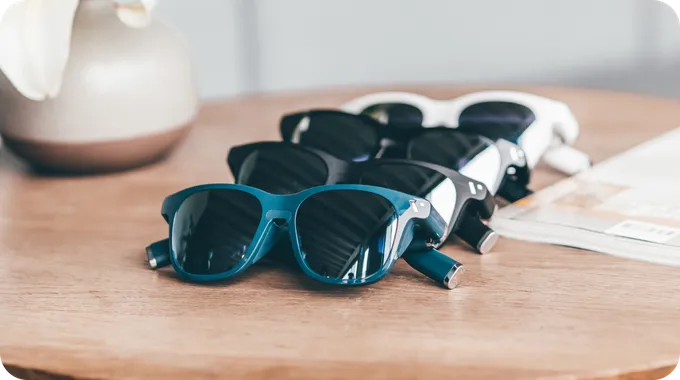
Often, when it comes to patents or retroactive patents, it all comes down to timing. So, who had electrochromic lenses first?
From what I can tell, Xreal officially introduced electrochromic technology to its spectacles with the Xreal Air 2 Pro in October 2023. We tested the Air 2 Pros and found them quite impressive, especially the electrochromic feature.
"Being able to push a button to customize the transparency of these lenses to properly opaque is mightily impressive," my colleague Jason England said.
However, from what I can tell, Viture introduced electrochromic technology in 2022 when it Kickstarted the Viture One glasses. It looks like the Viture One started landing in backers' hands around March 2023. Current Tom's Guide computing editor Jason England reviewed the specs for Laptop Magazine in July 2023.
He even commented on the electrochromic film, "I point you towards what I think is one of those more ultra-premium features you’d expect from an expensive pair of XR glasses like these: electrochromic film."
Whether this timing will affect the current lawsuits remains to be seen, but it is curious.
How we got here

In the U.S., things kicked off when Xreal filed a patent infringement lawsuit against Viture, claiming "rather than investing in original development, Viture unlawfully incorporated Xreal’s patented inventions into its AR glasses products, freeriding on Xreal’s technological breakthroughs.”
Viture fired back, calling the lawsuit "weak and questionable." A spokesperson noted that U.S. Patent No. 11,988,839 covers prior art and was previously rejected in China.
Meanwhile, in December, our friends at Android Central reported that the two smart-glasses manufacturers were engaged in another patent battle in Europe. A German court granted an injunction on Viture's glasses, which temporarily blocks its ability to sell or market products in Germany.
It could affect Viture's ability to sell in nine other countries, including France, Italy, Spain, Poland, the Netherlands, Ireland, Sweden and Belgium. Viture filed a defamation claim against Xreal, alleging that Xreal stated Viture was banned in nine countries. Allegedly, the defamation claim has been allowed to move forward.
Meanwhile, Viture has hired Cooley, a major litigation firm based in Los Angeles, to tackle the U.S. patent case.
"We believe these claims lack merit and that VITURE's market success and innovation have prompted this action, rather than any legitimate intellectual property concerns," a spokesperson told Tom's Guide.
An Xreal spokesperson inform Tom's Guide that it is aware of reports of the lawsuit but stated that the company has yet to receive any formal claims or complaints. The company is not in a position to comment we were told.
"The matter appears to relate to proceedings in China and is currently limited to China. We take intellectual property matters seriously and will respond through the appropriate legal channels if and when we receive official documentation, " the spokesperson sid.

Follow Tom's Guide on Google News and add us as a preferred source to get our up-to-date news, analysis, and reviews in your feeds.
More from Tom's Guide
- I wore Ray-Ban Meta Display smart glasses to watch the Super Bowl halftime show — and understood Bad Bunny in real time
- I swapped my Ray-Ban Metas for these $20 smart glasses just to mock them — then they actually impressed me
- I’ve been wearing the Meta Ray-Ban Display smart glasses for a week — they’re great, but they could be so much more