I’ve been a smart glasses guy for the better part of 5 years — watching them grow through their awkward design phase, as the parallel lines of AR and AI specs start to merge. It’s been a wild ride through the likes of Nreal (now Xreal), Ray-Ban Metas and more.
But now, just as smart glasses were really starting to hit their stylish stride (Even Realities G2 for example), the new Snapdragon Wear Elite chipset may have just moved the idea of what the best AI wearable is from our eyes to our ears.
We’ve been hearing rumors of a pair of AirPods equipped with cameras. I’ve been blown away by Razer’s Project Motoko headset that crams multi-modal AI tech of smart glasses into a pair of cans, and Qualcomm VP Ziad Asghar told me he’s rather excited about this new form factor that the new AI-armed silicon unlocks.
What is Snapdragon Wear Elite?

This announcement (just like many MWC 2026 announcements) got buried under a mountain of Apple March event announcements, but it’s a significant one. While Qualcomm makes a huge stack of chips to bring the best out of particular hardware form factors, Wear Elite is the one that brings all the AI smarts together.
Set to be the brain of a lot of wearables this year (including the next-generation Samsung Galaxy Watch), this re-engineered architecture brings a beasty NPU for speedy on-device AI, while lengthening the stamina with a lower wattage.
It’s the missing link for zippy local AI tasks, and in terms of the kinds of devices it’s primed to be used in, you start to see signs of intent for new product categories. But let me be clear: I bet one of these will not stand up to cultural or fashionable scrutiny.
It won’t be a pin or pendant
The Wear Elite is a bet on AI being the new UI for a lot of day-to-day tasks, but nobody — not even Qualcomm — knows what the device will be.
“To be very open, we don't know what every product looks like,” Asghar commented. “We have an idea what that product needs, but we don't know what that product might look like.”
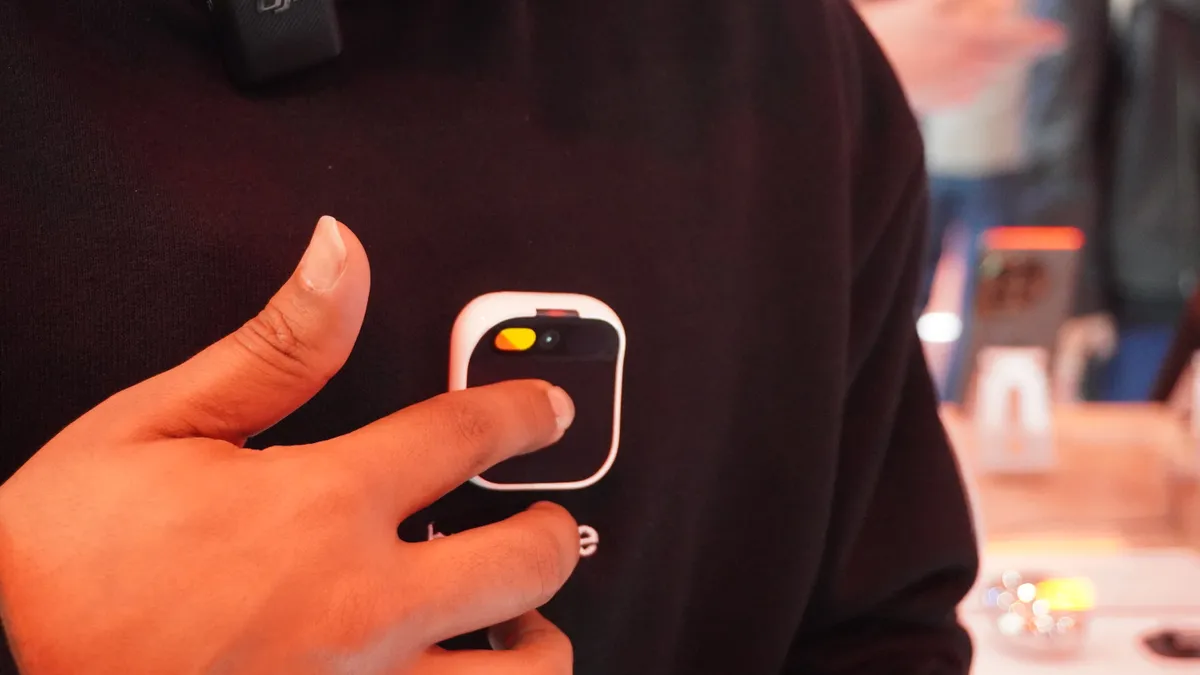
However, I think we can be pretty confident on what it won’t be: Pendants and pins. Of course, I’ll keep my mind open if we do get something great, but the cautionary tales are clear for the world to see around the Humane AI Pin and Friend Pendant.
“I think the failure of Humane is not necessarily that the product form factor was not right," Asghar said. "I think the execution of it wasn't right in my opinion.” In his mind, the issue was with user experience rather than design, but it’s more than that.

These kinds of devices are all a solution in search of a problem — replacing smartphone usage (something that takes a whole lot of convincing to do). The form factor needs to be right, in that it’s not just an additional “thing” you wear, and that’s exactly what these devices were.
We’ve tried and failed in this field, and while Ziad is right to tell me that the Snapdragon Wear Elite could’ve “fixed” the Humane AI Pin, there’s more fundamental issues here.
It could be glasses? But I fear their time is passing

Such is small windows of cultural power that just as smart glasses are entering their mainstream adoption era, camera-equipped earbuds could be ready to take it all.
“If people don’t want to wear glasses, you could have a camera in each one and now you can pretty much do everything that smart glasses can do,” Asghar said.
Approximately four billion people wear glasses, and to loosely tie another study into this, 19% have admitted to wearing fake glasses purely for fashion at least once. That’s one-in-five (I’m definitely one of them), and the idea of wearing specs for the smart tech when you don’t need to wear glasses has not caught on.

Now compare that to earbuds and headphones. Around 3.8 billion people globally use them for an average of 6-7 hours a day, and there’s no stigma to wearing them when you don’t need them. So to put this same tech into a pair of headphones or earbuds seems like a more logical buying decision for most folks.
And as the smart glasses guy, it hurts me to admit that. I hope I’m wrong, because there’s a lot of amazing things happening in this space.

Follow Tom's Guide on Google News and add us as a preferred source to get our up-to-date news, analysis, and reviews in your feeds.
More from Tom's Guide