Keeping it simple really is the key to long-term, sustainable results.
You don’t need the latest fitness trends to build strength and muscle in the gym; you just need to train smart and follow several key principles. We love to overcomplicate things when it comes to staying fit, but keeping it simple really is the key to long-term, sustainable results.
Let’s collectively cut through the BS of “fitfluencers” and return to the “old school” basics from those who honed their craft over the years when social media wasn't dictating our workout schedules, like Arnold Schwarzenegger: progressive overload (slowly increasing volume over time), enough protein and a balanced diet, and, most importantly, consistency and repetition.
These exercises work if you build them into your strength routine and keep at it. They grow muscle in all the right places, increase functional strength and allow you to progress as you get fitter and stronger. Give them a try, and let us know in the poll below which is your favorite.
1. Arnold press
I recommend a set of the best dumbbells or kettlebells for this exercise so that you can move with a full range of motion.
Created by Arnie himself, the Arnold press is a unique upper-body push movement that builds strength in your shoulders, upper chest and triceps. Why is it unique, I hear you ask? Because the rotational motion stimulates all three of the shoulder heads, known as the anterior, lateral and posterior deltoids. That means a well-rounded shoulder workout using just one move — great if you’re short on time.
Moreover, overhead presses develop your pushing power and improve core strength, as you must maintain a strong, tall torso position to press without using your legs for momentum.
The Arnold press is also functional, mimicking the daily task of lifting an object overhead. This is a great weightlifting move for your shoulder stabilizers as well; the rotator cuff works to support and protect your shoulders during movement.
2. Forward lean Bulgarian split squats
Many argue the Bulgarian split squat is designed to be done with one weight, so you can decide whether you prefer using one or two dumbbells or kettlebells for this. The BSS is a glute-focused leg exercise that hits the gluteals, quads, hamstrings, calves and hips, while testing your balance and stability.
I like to teach a slight forward lean to engage the glutes more; this means hinging at the hips and sending your chest over your thigh while maintaining a neutral spine and straight back. It shouldn't be excessive, just enough that you hit the working glute of the front leg a little bit harder.
I love this exercise; it's simple yet very effective, and you just need a bench and a weight to do it. Even using your bodyweight is super efficient for beginners.
3. Sissy squats

The sissy squat is all about the core and quads. It was supposedly popularized by the bodybuilder Vince Gironda in the 1950s and 60s, and involves isolating the quads and driving over the toes to reach a deep knee flexion. It has been a part of old school bodybuilding and modern routines since. It's also quite fun to challenge your friends and family to.
Your lower-body joints are working hard, but otherwise, this squat variation is designed to take out a lot of the hip work and drive the movement through your quads, creating serious strength and growth. Unlike a regular squat, you'll be on your tiptoes, helping to activate your calves.
You must engage your core and move slowly and with control as your knees track forward; lean back to counterbalance yourself and focus solely on your form at first.
Using a wall or squat rack for support can help you gain confidence and depth. I strongly recommend a mobility routine that warms your muscles and joints properly before trying this, too.
4. Drag curls
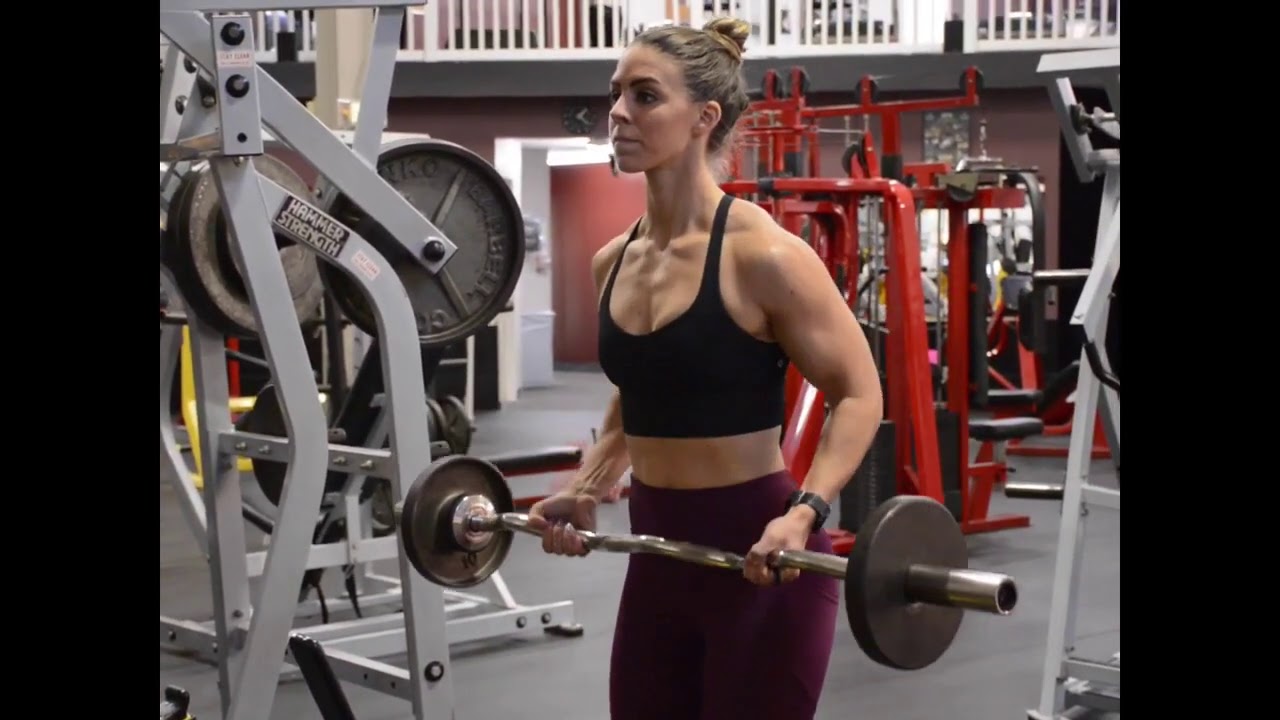
Drag curls work best with a barbell or EZ bar, but you can use dumbbells if you want. This exercise hits the biceps hard as you "drag" the bar up your body while keeping your elbows pulled back as you flex and extend. The weights should stay close to your body at all times as you focus on more of a vertical lift than the arc of a curl.
At the top, it creates a strong peak contraction and hits the long head of your biceps. Your shoulders have little to do, and you're maximizing time under tension compared with regular biceps curls.
Try to stay controlled throughout and aim for a slow negative, which basically means slowing down the lowering motion compared with the lifting motion.
- Stand with feet shoulder-width apart and hold a barbell with an underhand grip, hands shoulder-width apart
- Pull your shoulders back and down, core engaged.
- Bend your elbows and begin pulling the weight up your body, driving your elbows backward and behind you
- When your arms are fully flexed (the bar should be roughly in line with your lower chest), pause and squeeze your biceps hard
- Slowly lower the weight with control, keeping it vertical just like you did on the way up.
5. Pullovers
Pullovers are touted as a shoulder exercise, but they actually work the pecs, lats (wing-shaped muscles in your back which are large and powerful), triceps and anterior deltoids. They are also surprisingly effective for improving shoulder mobility.
The upper-body exercise uses strict movement, so keep your core engaged and try not to lift through your lower back; for advanced weightlifters, you might want to adopt a slight arch of your back as long as your core is switched on properly, but otherwise, your back should be supported by the bench.
This takes control; as the dumbbell travels upward and lowers behind you, your range of motion increases because there's nothing but air behind the bench, which makes it harder to lift and pull back to the starting position. Only travel as far as you can control the weight and build slowly. You'll feel a deep stretch during the lower and plenty of resistance during the lift.
Sets and reps
Aim for 8-12 reps and 3-4 sets of each exercise. You can pluck whichever ones you like and add them to your existing workout plan or combine all five for a full-body workout. I like to superset moves, grouping two or three into a back-to-back set, but you could go for one giant set and perform all moves as a circuit.
Comment below to let us know which you love (and which we should have included!)

Follow Tom's Guide on Google News and add us as a preferred source to get our up-to-date news, analysis, and reviews in your feeds.
More from Tom's Guide
- You don't need heavy barbell squats to strengthen your quads, glutes and hamstrings — try the pendulum squat instead
- Forget running — this 20-minute low-impact workout boosts your metabolism and builds cardio fitness
- Forget burpees —the 'Pilates burpee' is beginner-friendly and low-impact (and you’ll love it)