Drying your bedding outside during allergy season is a nightmare if you're prone to flare-ups, but drying them inside can take forever. However, this year I'm armed with a humble home appliance which has saved me time, money and efforts.
I'm talking about the dehumidifier, which allows you to easily dry your sheets, duvets covers and more indoors, no matter the season or sleep-disrupting pollen count.
Here, I delve into the details of how you can use a dehumidifier to effectively dry all your bedding, with insights from Amreen Godhrawala, a bedding expert at Puredown. Let's get straight into it...
Key takeaways
- If you don't want to dry bedding outside during allergy season, dehumidifiers are a great way to dry bedding indoors.
- While not as fast as dryers, dehumidifiers use up to 4800 watts less of energy, making it a cheaper indoor drying option.
- To help bedding dry quicker with a dehumidifier, place bedding strategically on a clothes rack and make sure to shake halfway through.
Is drying your bedding with a dehumidifier effective?
The dehumidifier works by pulling the moisture in the air, which naturally helps to draw out water from the fabric.
According to Godhrawala, this helps in preventing heat damages like pilling or shrinkage which can often be the issues you face when using a dryer.
Worried about mold in your home due to drying clothes indoors? A dehumidifier is the ultimate solution. In fact mold or mildew growth is one of the 5 tell-tale signs that you need a dehumidifier at home.

5 expert tips for drying your bedding using a dehumidifier
Before you invest in one of the best dehumidifiers in the market, these are some extra tips to heed for maximum efficiency:
Tip 1: A standard pedestal fan helps in air circulation, ensuring the dry air reaches every fold of the fabric.
Tip 2: It's better to opt for a dehumidifier with a 'laundry' or 'continuous' mode. This helps keep the compressor running even when the humidity drops.
Tip 3: Arrange your drying rack so the bedding hangs over the air outlet of the dehumidifier. This warm and dry air blowing out will act like a gentle breeze.
Tip 4: I've chosen a dehumidifier which sets off an alarm and then shuts when the water tank gets full, and this has truly been a blessing. No spills, no mess. All you have to do is empty the same to resume the drying process.
Tip 5: Make sure that you run an extra-fast spin cycle post-wash to remove as much physical water as possible before hanging.
How long does a dehumidifier take to dry bedding?
The drying time depends on various factors like the capacity of the dehumidifier, type of bedding material and the room temperature.
However in general terms cotton sheets take much less time, up to 4 to 6 hours to completely dry.
"For heavier bedding items, it may take 12 to 24 hours," says Godhrawala.

Expert tips to speed up drying bedding with a dehumidifier
It pays to stay on top off your laundry: your bed sheets are teeming with bacteria after two weeks without washing. Here's how you can drape your bedding to ensure it dries quickly and evenly, according to bedding expert Godhrawala:
Avoid folding the bedding over the bar

You may be tempted to fit as many duvet cover and bedding cases on a drying rack by keeping one item to one bar, but Godhrawala says this is a no-no.
"Instead, loop it across multiple bars of a drying rack, so that there is a gap between each fabric layer," she shares.
Always unbutton the duvet covers

When you're in a hurry, it's likely that you'll strip the duvet cover without unfastening all the buttons, but doing this can restrict essential airflow for a fast dry.
"If they remain closed, the inside will stay damp long after the outside is dry," warns Godhrawala.
Drape the sheet over the top of the clothes horse
According to Godhrawala, an effective way of trapping all the dehumidifying goodness within your clothes rack is by taking the largest piece of bedding and covering the rack (and the other bedding) completely.
"Let it hang down like a tent with the dehumidifier blowing air into the hollow center of the tent," she says.
Shake and flip halfway
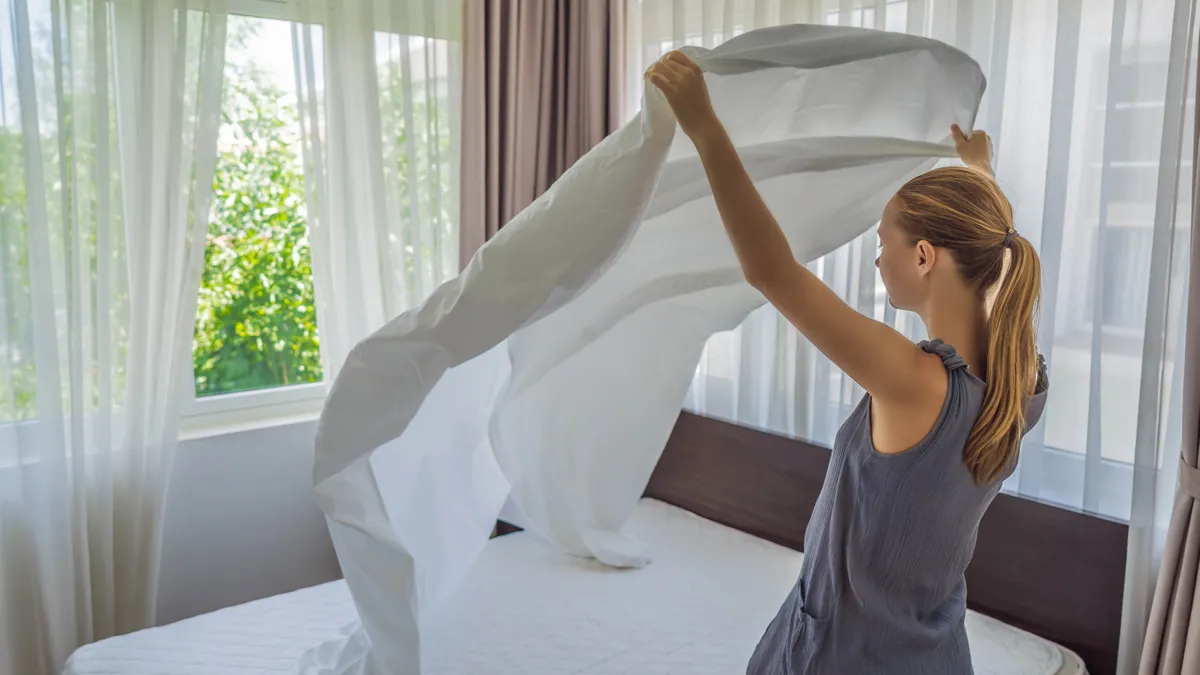
If you want some extra drying power, it helps to do your part during the drying process.
"Give the bedding a good shake and flip it over to expose the damp inner layers halfway through drying, as this speeds up the process further," Godhrawala advises.
Is it cheaper dry bedding with a dehumidifier than a dryer?

"A dehumidifier uses significantly less electricity, around 200-500 watts, compared to a tumble dryer, which takes around 2000-5000 watts," says Godhrawala.
She underlines that while drying using a dehumidifier may take long, the total energy consumption is less. What's more? This way, your bedding will last longer, thus letting you save money on replacements too.
The bottom line...
The method you use to dry bedding is entirely based on personal preference, budget, the home appliances you have, and the amount of space in your home.
While drying your bedding outdoors is quick, cheap, eco-friendly, and naturally brightening, this can pose a problem if it's allergy season and your susceptible to allergens such as pollen.
The dehumidifier, while a little more costly than using the great outdoors as your dryer, is still much cheaper and sustainable than using a dryer. However, if you lack the space for a drying rack, then a dryer may be the best option for you.