I’ve spent a long time researching induction cooking and have written a whole stack of articles for Tom’s Guide, from testing Smeg’s portable induction cooktop to tips to unlock your induction cooking potential.
While I am an advocate of induction — I’m even planning to replace my gas cooktop with an induction model when I renovate my kitchen — there’s one aspect about this cooking method that I’ve been concerned about.
I have no issues with how induction works, or even that you need magnetic cookware for heat to be transferred. My issue is whether induction cooking is safe for people with heart devices, such as pacemakers.
It's a real concern for a lot of people. Induction appliances use electromagnetic fields to heat cookware directly, resulting in faster cooking times and reduced energy waste. However, there is suspicion over whether the electromagnetic fields can disrupt these devices.
To discover the truth, I turned to medical and appliance professionals, and I'm glad to report that my worry was unfounded. Apparently, with the right care, people with heart devices can cook with induction without coming to harm.
The truth behind induction cooking and pacemakers
If you have a pacemaker or defibrillator, you may have heard concerns about how induction cooktops, or everyday devices with strong magnets, can disrupt these implants. However, there is no need to be concerned.
“The truth is simple: in rare cases, magnets can interfere with heart devices, but typically only when they’re held extremely close,” says Dr. Ami Bhatt, Chief Innovation Officer at the American College of Cardiology. “That doesn’t mean these technologies are dangerous, it just means a little awareness goes a long way.”
Designed to shield against interference
Like all electrical appliances, induction cooktops generate electromagnetic fields during operation. However, pacemakers are designed to detect and respond to electrical signals, but from the heart.
To mitigate external interference, Dan Young, Category Manager of Cooking at Miele GB, explains that pacemaker manufacturers place great emphasis on shielding and protection against everyday sources of electromagnetic interference in the home.
And Dr. Bhatt adds that shielding techniques and placing the heart device slightly deeper in the chest muscle are straightforward ways to reduce the risk.
Direct and localised heat

Another reassuring element is that induction technology is highly localized, and the electromagnetic field is contained within a small area.
Dr. Scott Cherry, Chief Medical Officer and Physician at Axion Medical, explains, “[Induction cooktops] create a contained EM field (at 20–90 kHz) that heats up special cookware and not the surface.”
And Young adds: “With a pan of an appropriate size placed centrally on the cooking zone, the electromagnetic field is concentrated in the base of the pan itself. Any leakage fields outside the pan are negligibly small and diminish rapidly with distance."
Why distance matters
The main concern you need to be aware of is distance, specifically how far away you are from the induction cooktop. To explain this further, Dr. Cherry says that EMI exposure drops markedly at about 10-12 inches from the edge of the cooktop, and that modern cardiac devices won’t respond at this distance.
Keeping your distance is, therefore, key to staying safe.
Be safety aware
There’s no reason a heart device should keep you from using an induction cooktop. “In normal domestic use, induction hobs are considered safe for the vast majority of people with modern pacemakers,” says Young.
However, all three experts advise asking your healthcare team for guidance tailored to you.
But, if you do decide to buy an induction cooktop, it’s worth following these three steps to stay safe:
- Maintain a normal upright cooking posture while using an induction cooktop, rather than leaning over the cooking area.
- Ensure the pan fully covers the cooking zone to keep everything contained.
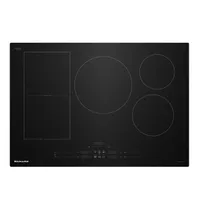
- Use the back zones for longer cooking stints, to ensure you keep your distance.

Follow Tom's Guide on Google News and add us as a preferred source to get our up-to-date news, analysis, and reviews in your feeds.
More from Tom's Guide