I've tested 30 coffee makers over the past twelve months. Some were the best espresso machines, some were just good, and some were... not-so-good. Of these coffee makers, I've tested five automatic bean-to-cups, five manual bean-to-cups, and ten compact manuals.
Which type of machine is best for you? Well, it depends on what you want from your machine. If you value convenience over anything else, I'd go for an automatic. But if you enjoy the process of making coffee, it's gotta be a manual.
If you're not sure of the difference between these types of espresso machines, that's totally reasonable. The coffee world is rife with jargon, and I know it can be really overwhelming for a beginner. I'll explain everything now.
What's the difference between an automatic bean-to-cup, a manual bean-to-cup, and a manual espresso machine?

There are two main types of espresso machines: those with a grinder and those without a grinder. An "automatic" or "superautomatic" is a machine that does everything for you: It grinds the beans, pulls the shot, and steams the milk. These would be called an automatic bean-to-cup.
Then, we get semi-automatics and manuals. These are your more traditional machines, where you have to put the coffee in the group handle, tamp, and put the group handle into the machine yourself. These come in two types: bean-to-cups (with grinder), and without grinders.
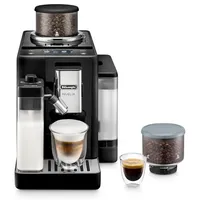
An example of an automatic machine would be the De'Longhi Rivelia just below. See the grinder at the top, and the silver piece at the front? That means the machine makes the entire coffee for you.
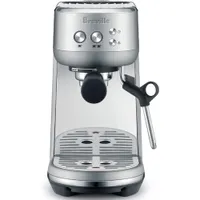
Now look at photo 2 below. It's the manual Breville Bambino Plus. This machine has no grinder, and you can see the group handle and milk jug behind it. To use this machine, you have to grind, dose, tamp the beans yourself, and then steam the milk by hand.
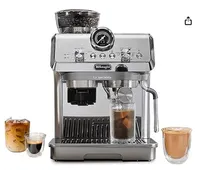
Go ahead to photo 3 now — this is a manual bean-to-cup, the De'Longhi La Specialista Arte Evo. See the grinder, but the group handle and milk jug? This machine grinds your beans for you, but you still dose, tamp, and steam manually.


Some people would say the Bambino Plus and De'Longhi La Specialistas are actually semi-automatics, not full manuals, and this is true, but the lines between semi-automatics and manuals are quite blurry. I'm not sure anyone knows the true difference. (Well, I sort of do — semi-automatic refers to the machine's ability to stop extraction by itself. But... even the most "manual" machines I've used can automatically stop extraction. So, yes, it's blurry.)
The lines are blurry, and also too complex for me to go into now. Let's just say they're manuals, because you have to manually make the coffee.
Who should use automatic bean-to-cups?

Automatic bean-to-cup espresso machines are perfect for those who value convenience over anything else.
Automatics are heckin' expensive. I've tested some $2,000 machines, like the KitchenAid KF8, and some nearly $3,000 machines, like the Jura E8. There's a premium to pay for convenience — usually a couple thousand smackaroos.
If you can afford to drop $2k on a coffee machine, I assume you've probably got a big house, which is great, because you need a huge kitchen to store these bad boys.
Of the automatics I've tested, the smallest was 17 x 7.1 x 13.2 inches (De'Longhi Rivelia), and the largest was 18.5 x 10.2 x 14.3 inches (KitchenAid KF8).
In comparison, the smallest manual espresso machine I've reviewed was the 12.6 x 5.7 x 12.5 (Casabrews 3700 Essential).
Despite the larger size and higher price, automatic bean-to-cups are beyond easy to use. Most of the time, all you have to do is put in water and coffee and press 'Go'. Automatics are ideal for time-poor, energy-poor coffee lovers who want hot, fresh coffee reliably, quickly, and consistently.
What about manual bean-to-cups?
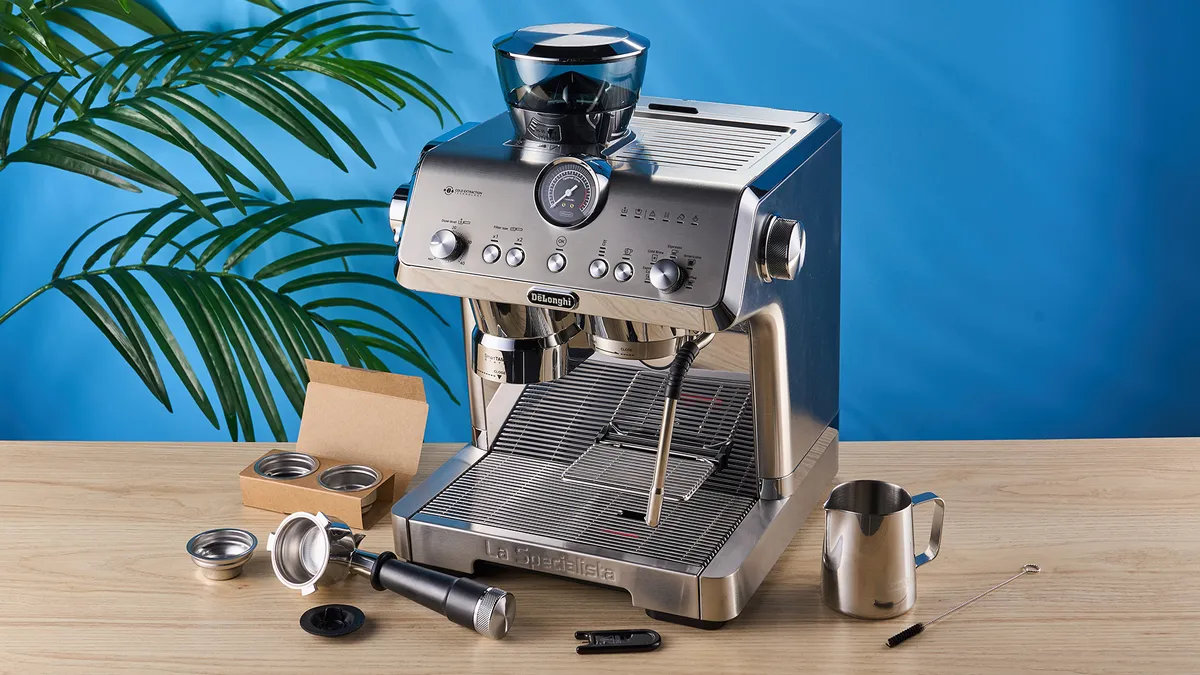
Manual bean-to-cups are manual (or semi-automatic) espresso machines with built-in grinders.
The model you see above is the fantastic De'Longhi La Specialista Opera ($899). I love this machine — it marries the convenience of a built-in grinder and mess-free tamping, but with the hands-on customization properties of a traditional pump manual machine.
Like automatic bean-to-cups, though, manual bean-to-cups are massive. The Opera, pictured above, is a broad 14.9 x 14.6 x 17.5 inches and a hefty 28 pounds. Like autos, you need a big kitchen to store a manual bean-to-cup.
As much as I loved the Opera, I had to give it up. It was simply too big, and took up too much space in my compact kitchen.
Manual bean-to-cups offer the best of both worlds, though, and is the type of machine I'd recommend for most serious coffee lovers. Although the grinders are inherently inferior when compared to standalone grinders, having a built-in grinder is usually a convenience worth sacrificing a little quality for.

I've also tested the Smeg EGF03 (pictured above), which is a touch smaller than the Opera, at a comparatively dinky 17.4 x 13.1 x 13.4 inches. I'd recommend checking out this model if you want a bean-to-cup but you're short on space.
For the best of both worlds, though, it's gotta be the De'Longhi La Specialista Arte Evo. This is the smallest and best-value all-in-one espresso machine I've ever tested —14.4 x 11.2 x 15.9 inches — and just $699.
And what about compact manuals?

Last — but certainly not least — let's go through a compact manual espresso machine. That's not the "official" term. To most people, these machines are just called "manual espresso machines," but I needed to differentiate between with-grinder and sans-grinder.
There are also prosumer sans-grinder models like the Smeg EMC02 and the Gaggia Classic, but I'm not going to talk about those now. Those types of machines aren't for beginners.
So what is a "compact manual"? These are your Breville Bambinos, your Breville Bambino Pluses, your Casabrews 3700 Essentials, your De'Longhi Stilosas, your De'Longhi Dedica Duos.
These models usually fall within the $100-$450 price range, which is much more palatable for beginners.

These models require a separate grinder, which start at around $150. You can get the Breville Dose Control Pro for just $159, which is fantastic value. The difference between pre-ground and wholebean freshly ground coffee is astronomical. If you're even a little bit into coffee, please, for the love of all things espresso, please get a grinder.
If you're strapped for cash or space (or, like me, both), then I'd recommend grabbing one of these compact manual machines and a separate grinder. For just $300, you can get the Dose Control Pro and De'Longhi Stilosa, and with a bit of practice, you'll be rivaling professional baristas in no time.
Which model suits you and your needs? Do you have money to burn and value convenience? Then I'd check out the auto bean-to-cups.
Want to craft coffee with the ease of a built-in grinder? Then a bean-to-cup manual is for you.
Interested in coffee but short on space and dollars? Go for the compact manual.

Follow Tom's Guide on Google News and add us as a preferred source to get our up-to-date news, analysis, and reviews in your feeds.
More from Tom's Guide