Since the launch of the Nintendo Switch 2 over the summer, a new (champagne) problem has entered my life. My beloved Steam Deck OLED was always the first thing added to my backpack ahead of a trip, but now I find myself having to choose between Nintendo Switch 2 and Steam Deck OLED whenever I’m heading out of my apartment for an extended period.
So, on my most recent trip (to picturesque Edinburgh, Scotland), I decided there was only one way to settle this debate for good. Take both the Nintendo Switch 2 and the Steam Deck OLED with me, and finally determine the best gaming handheld, all in the name of science!
I’ll get into the results below, breaking things down into categories, from handheld design to the games available on each system, but the top-line conclusion is that it’s a close contest, with both Switch 2 and Steam Deck making a pretty compelling case for themselves.
Switch 2 vs Steam Deck OLED: Design

A gaming handheld’s form factor is critically important. After all, you’re going to be holding the device for potentially multiple hours at a time. In this category, there’s a clear winner for me: Steam Deck OLED.
Valve’s Steam Deck OLED is a near perfectly sculpted handheld; it’s got significant weight to it, which I personally love, and thanks to the in-built ergonomic grips on either side, it's comfortable to hold in almost any position. The four customizable back buttons are a nice touch, and while I rarely use them, the two trackpads on the front are highly responsive.
Unfortunately, the Switch 2 comes up short in comparison. Its smooth design lacks grips for larger hands, and I find it a little uncomfortable to hold for extended periods. To remedy this issue, I use a d brand Killswitch case, which mimics a design much closer to a Steam Deck. But for this test, I’m only considering the features of the base Nintendo Switch 2 unit.
Winner: Steam Deck OLED
Switch 2 vs Steam Deck OLED: Game library
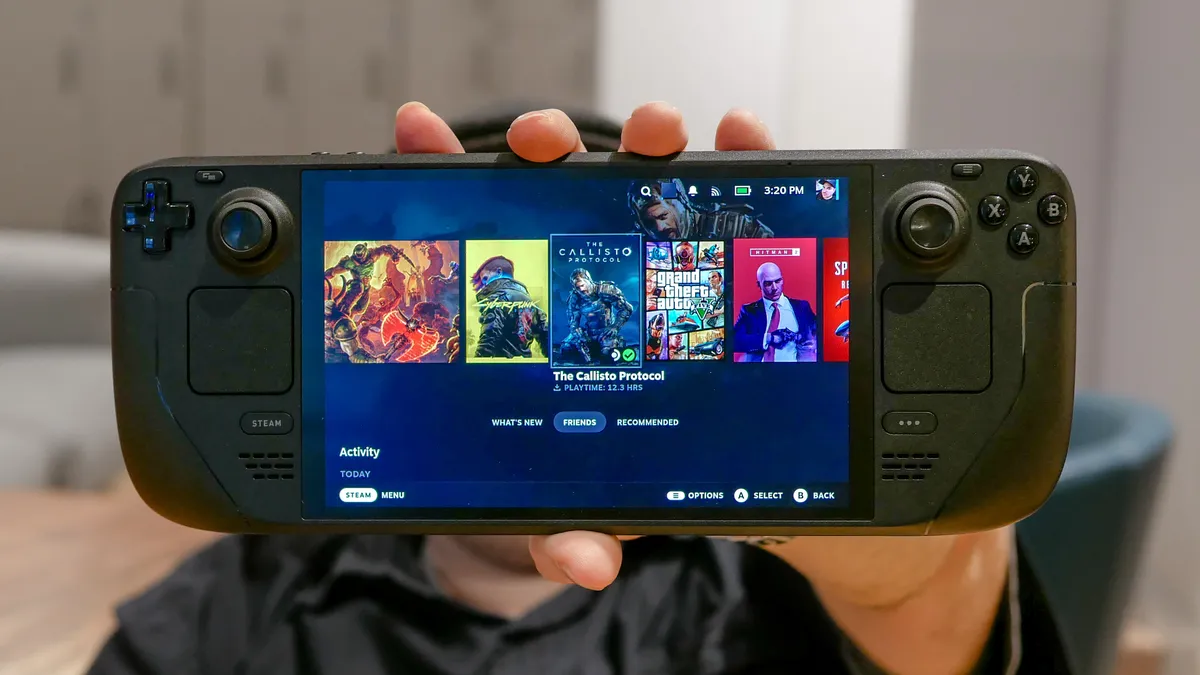
Determining which handheld has the best game library is a highly subjective call. Personal preference plays a major part in the decision.
Based purely on quantity, the Steam Deck OLED is leagues ahead of the Switch 2. Per Steam Deck HQ, there are more than 19,000 games (and counting) rated either “Verified” or “Playable" on the device, and even Steam titles listed as “Unsupported” can often be played on the Deck, such as The Witcher 2 - Assassins of Kings and Sunset Overdrive.
The Switch 2 is only six months into its lifecycle, so naturally, the library is on the smaller side, but it is growing with each passing week. The big advance Nintendo’s current flagship console has in its corner is its stable of first-party exclusives. You can’t play the likes of Mario, Zelda, Kirby, Metroid and Pokémon on any other gaming platform, handheld or not.
For me, the Steam Deck edges this category, because being able to play full-featured blockbuster games on the go is still an incredible novelty to me (I grew up on the Game Boy Color!), but the Nintendo Switch 2 does have its own solid collection of AAA ports including Cyberpunk 2077: Ultimate Edition, Hitman: World of Assassination and Star Wars: Outlaws.
So, due to the highly subjective nature of this one, I'm ruling it a draw.
Winner: Tie
Switch 2 vs Steam Deck OLED: Battery life

To test battery life, I fully charged up both handhelds and then ran them until the “low battery” warning appeared. Both had Wi-Fi switched on and AirPod Pro 2 earbuds connected. First up, I tested out Nintendo Switch 2, playing Star Wars: Outlaws.
I noted in my original Switch 2 review that battery life was relatively poor, and that proved to be the case in this secondary round of testing. Just 90 minutes into my open-world Star Wars adventuring, and the Switch 2 was warning me that my battery life was dwindling. Which isn’t a great time.
Turning to Steam Deck OLED, I opted to start a fresh playthrough of Tomb Raider: Definitive Edition, and it breezed past the 90-minute mark with the battery counter reading just over 50%. I was able to continue playing for another 80 minutes before the battery life warning indicator appeared. No contest here, Steam Deck OLED takes this key category with ease.
Winner: Steam Deck OLED
Switch 2 vs Steam Deck OLED: Extra features
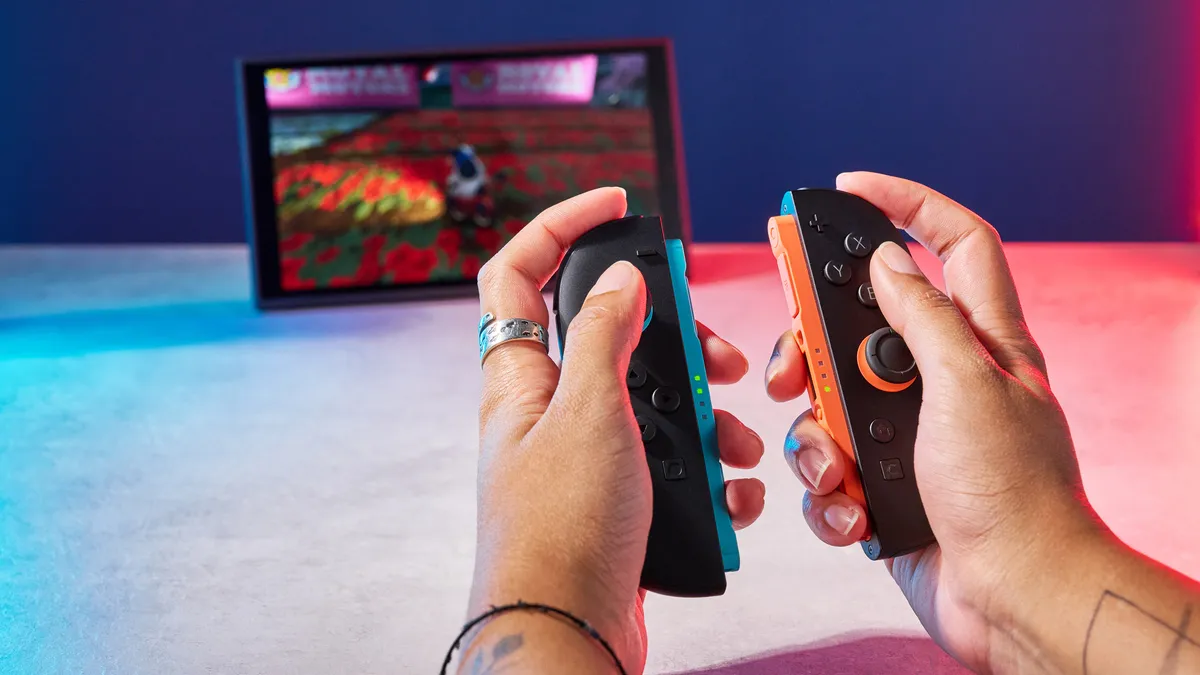
Did I create this category as a bit of a “freebie” for the Switch 2? Perhaps, but I do think it’s important to note the versatility of Nintendo’s handheld compared to Valve’s portable PC.
For this face-off, I’m not factoring in Switch 2’s included docking station, letting you seamlessly switch between playing on a TV and a handheld (I’m judging both devices purely on their handheld merit). But even with TV mode aside, Nintendo Switch 2 still offers a lot of flexibility.
The ability to instantly snap off the Joy-Con 2 controllers and make use of the Switch 2 unit’s kickstand to play in what Nintendo calls “Tabletop Mode” is nifty. This allows you to place the console on a table and give your arms a nice little rest. While the Switch 2 itself isn’t exactly heavy, it is more comfortable in Tabletop Mode than holding an entire handheld.
Steam Deck OLED, on the other hand, is a more traditional handheld gaming device; everything is built into the main unit. And the only way to replicate “Tabletop Mode” is to buy a stand (or a case with a stand feature) and connect a controller, which isn’t ideal if you want to travel light.
Winner: Nintendo Switch 2
Switch 2 vs Steam Deck OLED: Final verdict

Purely on points, Steam Deck OLED takes this bout thanks to its fantastic form factor, astonishingly deep library (half the time when I boot up my Steam Deck, just picking what to play first is a challenge), and superior battery life (based on my real-world testing). But the Nintendo Switch 2 has an awful lot going for it as well, which makes this a tough choice.
Nintendo makes some of the finest, usually family-friendly, games in the entire industry, and you can’t play masterpieces like The Legend of Zelda: Breath of the Wild anywhere else. A strong exclusive software lineup goes far in my books. Plus, the flexibility of three separate modes of play is a pretty killer feature, letting you start a game on your television and within seconds continue your progress on the Switch 2’s great 7.9-inch display.
Both device makes for a fantastic handheld gaming experience, so you can’t really go wrong with either choice. I suppose the big determining factor might be whether you want access to Nintendo's exclusive games, or whether you own one of the best gaming PCs, which in turn allows you to continue your progress in thousands of Steam games on the Deck.
Even after all this testing, it appears that my selection headache will continue for the foreseeable future. Perhaps I’ll just start traveling with an extra-large backpack and bring both handhelds with me on every trip.

Follow Tom's Guide on Google News and add us as a preferred source to get our up-to-date news, analysis, and reviews in your feeds.
More from Tom's Guide
- Nintendo Switch 2 review
- Valve just dropped a massive hint about Steam Deck 2
- Best Nintendo Switch 2 games in 2025