An exercise bike is an investment you'll want to think carefully about — the right bike will help you build lower-body strength and cardiovascular fitness; the wrong bike will become an expensive place to store clothes.
To help you make the right choice for you, we've tested the best exercise bikes on the market to help you decide which to install in your spare room or garage gym. Right now, the best exercise bike if you're looking for a community of like-minded individuals to motivate you is, unsurprisingly, the Peloton Bike+. It's been around for a while, but it's still a fantastic bike.
If you're looking for a bike with air resistance, the best choice right now is the Wattbike Air. It's an impressive bike from an impressive brand, and will help you get fit.
If you're a cyclist who prefers to be out on the road, the Zwift Ride with KICKR Core is a great choice. It feels pretty close to cycling on the road, and you'll even be able to join a virtual spin class with your mates on Zwift.
We've also found other alternatives to suit every style of cyclist and budget. Dig out your cleats and get ready to ride, but read on to find our top picks first.
Best exercise bikes you can buy right now
Why you can trust Tom's Guide Our writers and editors spend hours analyzing and reviewing products, services, and apps to help find what's best for you. Find out more about how we test, analyze, and rate.
Best air resistance exercise bike

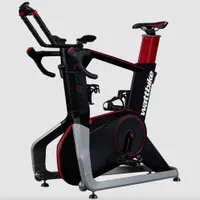
When we tested the Wattbike Air, we were (quite literally) blown away by this air resistance bike. It's similar to those you might have used in the gym, with a manual resistance wheel on the side, and is best suited for sprints and HIIT training, rather than standing out of the saddle and climbing.
The air resistance tops out at 2500W, which is higher than the Wattbike Proton’s 1800W. However, if hill climbs are your preferred exercise bike workout, then you’ll be better off with the Proton.
That said, thanks to the fantastic companion Wattbike app, if you're looking for a bike to help you boost your fitness, rather than pedal for hours, the Wattbike Air is a great choice. Erin found the app had plenty of excellent features and workouts, and was able to hone her cycling technique by using it.
It's also a subscription-free bike, which is a massive plus, and gives it an edge over other exercise bikes, such as the Peloton Bike+.
- Read our full Wattbike Air review
Best exercise bike for community

The Peloton Bike+ is the upgraded version of the Peloton Bike, the connected exercise bike that popularized virtual spin classes. The Bike+ comes packed with Peloton tech, including a large touchscreen for you to interact with the Peloton app.
While the premium bike plays a part, the experience relies heavily on the app's on-demand and live classes. It's an expensive option — the bike is $2,500, and its required membership costs $44 per month — but after testing it, we have to say that it's definitely popular for a reason.
The Peloton instructors are famed for their high-energy classes, so if you're after a way to keep motivated to train regularly, the Bike+ is a good option. Plus, aside from the software, the Bike+ actually feels like the kind of equipment you'd find in a studio.
When we visited the Peloton Studio in London and tried a 30-minute in-person class, we found it to be intense, but a lot of fun. Plus, the studio bikes still had the famed leaderboard, so he could see how his performance fared compared to all the members spinning away at home, too.
The bike also has an auto-resistance mode, where the magnetic resistance will automatically change based on the instructor's recommendations, so you don't need to worry about fiddling with menus or buttons, and can just keep peddling.
The display is also where you'll find all of your workout stats, and you can view your training history to keep track of your progress. The Bike+ has a rotating display too, so you can swivel it and do mat-based workouts instead.
It's a tech-heavy option, and an expensive one, but it's also one of the most versatile exercise bikes available right now. Peloton has also thought about the smaller details, like adding water bottle holders, USB-C charging ports, and Bluetooth.
Best real life exercise bike

If you want an exercise bike, but don't want to shell out for a smart one, the Zwift Ride is a great option. It offers great value for money, and costs half as much as a smart bike.
It’s the easiest and most enjoyable way to ride on Zwift, and after testing it out, I have to say that it's also the bike I’d buy if I were starting afresh with my indoor cycling setup.
If you're new to the Zwift app, it allows you to cycle on virtual routes alongside your friends, do workouts, and ride iconic courses. It's like social media for cyclists, and it's a great way to beat the boredom indoors.
The Zwift Ride comes with the Wahoo KICKR Core trainer, which is one of the best turbo trainers on the market. You have to connect the two together, but once riding the bike, it feels like a complete unit in the same way as other smart bikes.
The ride is smooth and very quiet — if you use a fan to keep you cool during workouts, which I highly recommend doing, you can barely hear the bike itself.
Shifting gears using the handlebar controls and Zwift Cog is seamless and quiet as well, and the KICKR CORE responds quickly to changes in the gradient when riding routes on Zwift to automatically adjust for climbs and descents.
It's closer to cycling outside than a lot of the other bikes on this list, and is a great pick.
- Read our Zwift Ride smart bike review
Best budget exercise bike

Despite its budget-friendly price, the Yosuda Indoor Cycling Stationary Bike isn't lacking in features. It comes with a display to help you keep tabs on your workout stats. It shows essential metrics like time, speed, distance, and calories.
Of course, this doesn't come close to the amount of data you can track on a smart exercise bike like the Peloton Bike+, but it's a helpful way to track your progress for a fraction of the price.
Unlike the Peloton Bike+, there are no classes to join (unless you clip on the included smartphone mount and use a workout app or free YouTube session), but it's a durable beginner-friendly bike.
When I initially set up the bike in testing, I was worried it would feel a bit unstable. Fortunately, that wasn't the case. Instead, whether I took it for a speed or distance ride, the bike stayed firmly on the ground while in use.
The friction system added enough resistance to make my workouts effective, but after a while, you'll probably want to upgrade to a machine that'll challenge your muscles a bit more. But for cardio-boosting workouts on a budget, it's a great choice.
- Read our full Yosuda Indoor Cycling Stationary Bike review
Best Peloton alternative

The Echelon EX-3 used to be in this spot, but now the Echelon EX-5s has taken its place — and for good reason, too. Like the Peloton Bike+, the EX-5s has a magnetic resistance system with 32 levels to choose from, as well as a 21.5” HD touchscreen that flips 180º.
The magnetic resistance is quiet, too, so you won't disturb others in your home or nearby neighbors, even when you're doing a high-intensity workout.
At $1,299, it's cheaper than a Peloton, but still offers elite coaching, upbeat motivation, and excellent workout performance. In testing, I was pleased with the high levels of adjustability on the bike that allowed me to customize it to myself, as well as how convenient and simple the touch-screen display was to use.
There is a drawback, though. Not only is the Echelon EX-5s more expensive upfront than other non-Peloton bikes, but you also need to purchase a membership that works out at $399 per year to get the most out of the bike. You do get access to a huge selection of workouts with this subscription, though, not just the bike sessions. So, if you're looking for a bike to replace your gym membership completely, this is an excellent choice.
Additionally, I did notice some stability issues during high-speed workouts or during exercises that required me to come off the seat. I didn't feel like I was going to fall off, but this is something to keep in mind. Also, the bike took around two hours to set up — not ideal if you were looking to get in a workout right out of the box.
Still, these are fairly small complaints. Overall, the Echelon EX-5 is a great, lower-cost alternative for those looking for the community of a Peloton but not the price tag.
How to choose the best exercise bike for you
Choosing an exercise bike for your home can be a challenge. After all, you first need to decide whether you want a standard friction-based bike or a smart one, and factor in the increased cost of a smart bike and the ongoing subscription.
However, once you've made a decision between the two styles, there are other practicalities, like the physical size of the bike, whether it can be easily stored away between sessions, and if the bike can be adjusted for your height and posture.
It's also worth thinking about the exercise bike's resistance mechanism. This will affect how much you can customize the intensity, and you can select from magnetic resistance, flywheels, and belt-driven bikes.
Magnetic resistance generally has the largest range, usually covering 100 different levels, and is the quietest, but bikes with these systems are often towards the higher price bracket too.
Also tested
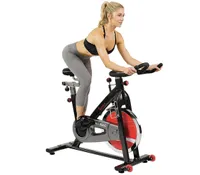
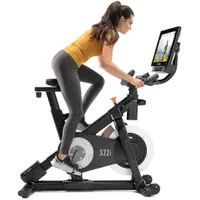
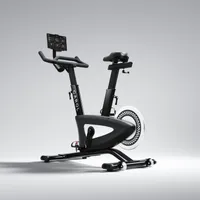
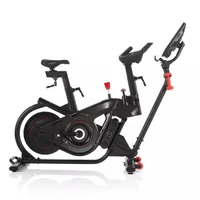
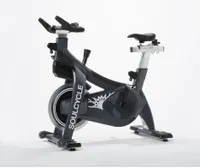
We regularly review exercise bikes, but not all of them will make the main roundup. Some come close, though. So, if you're after more options, these are the bikes we've tested that didn't quite make the cut.
Air vs magnetic exercise bikes
These two types of bikes are similar, but produce resistance differently. Air bikes essentially have a large fan, which you power through pedaling. The faster you go, the faster the fan. This makes them great for high-intensity internal training (HIIT), especially as you need to overcome the initial inertia of actually moving the physical parts.
The downside is that it's very noisy. Magnetic bikes are a lot quieter. These use magnets (surprisingly) to accurately control the resistance. So you can set it at level 10, and increase to level 11 as your performance improves. It's a more consistent experience and better suited to classes or progressive overload training.
Aside from the experience, price often factors in here, too. Air bikes are generally less expensive, as the fan mechanism isn't as complex, while magnetic bikes are more complicated and also higher cost. If you're working out at home or in a shared space, the quiet of magnetic resistance is worth the difference, though.
Upright vs recumbent vs spin exercise bikes
In our round-up, we primarily focused on spin-style exercise bikes. These are designed for you to lean forward close to the handlebars, as if cycling intensely on a road bike. These are great for intense classes of the sort Peloton deals in.
The focus of spin bikes is to allow you to pedal at higher intensity and to lift out of your seat with ease. If you don't typically use a road bike or want a more traditional cycling position, then you'd want an upright bike instead.
These do what the name suggests: the seat, pedal, and handlebar positions are designed to keep you upright, not leaning forward. This is a typical cycling position, and best for if you want to work out and raise your heart rate, but without the variability and intensity of spin classes.
Recumbent bikes are slightly different from spin or upright bikes. These allow you to lean backwards, supported by a more chair-like seat with a full back rest. This style of bike is common if you're just getting into exercise or during injury recovery sessions.
Because of your positioning, the impact on your joints is a lot lower, so it allows you to exercise without placing strain on your knees. The lower intensity also makes recumbent bikes great for graded exercise programs.
How we test the best exercise bikes
To help you determine which exercise bike is best for you, we put them to the sweat test! We install each of the bikes in our homes or workout studio for at least a month, and put them to the test over several different workouts.
Since we had the bikes to hand, we looked at how easy it was to use, move around the house, maintain, and, for the smart exercise bikes, the range of classes on offer.
Plus, we consider any extras like how many profiles you could set up, and useful accessories like phone mounts and water bottle holders. And on the smart machines, we looked at the ongoing subscription costs associated with the bike, and what you get for your money.
FAQs
Are exercise bikes good for weight loss?
If your goal is to lose weight, then exercising at home can play an important role. However, it's worth keeping in mind that physical activity only plays one part, as sleep, diet, and overall well-being also factor in.
Investing in a machine like an exercise bike can be a great way to increase your activity levels throughout the day, particularly if you're tight on time. Standard bikes allow you to just jump on and work out, so they are ideal for short sessions, like 30 minutes on an exercise bike, and extended periods.
If you're more motivated by classes, then the best smart exercise bikes are also a good place to start. Once you're set up with access to on-demand workouts, these high-intensity classes can help you make exercise a regular part of your routine, which is a key part of losing weight using an exercise bike.
Either way, cycling helps raise your heart rate, so you burn energy during your workout, and if you keep the intensity high to sustain your high heart rate, then it'll boost your metabolism (the amount of energy you burn throughout the day).
If you're looking for an accessible entry point to exercise, then you may be comparing exercise bikes vs walking. Spin classes are more intense and will burn more energy, while walking is free and can be more easily built into your daily routine by walking to work or the store, so it'll come down to your preferences and goals.
Should you buy an exercise bike or turbo trainer?
If you're trying to decide between one of the best exercise bikes and best cycling indoor trainers, we're here to help. Unlike exercise bikes, which are essentially stationary indoor bikes, cycling indoor trainers are designed to help convert your regular push bike into home workout equipment.
If you're tight on space, then an indoor cycling trainer (also known as a turbo trainer) may be the better option since you can disconnect the unit when not in use and store it away. Of course, you also need an outdoor bike to begin with.
But if you do already cycle or own a bike, then it's a more cost-effective choice, as turbo trainers are available for a fraction of the cost of many exercise bikes, especially smart bikes like the Peloton Bike.
Though for the extra money, you do get more features like displaying virtual classes and magnetic resistance systems. Plus, you can find feature-packed turbo trainers, like the $1,600 Wahoo KICKR Move, which is designed to mimic natural cycling movements and has Wi-Fi connectivity for smart features.
Generally, the ideal setup will depend on how you like to train. Some low-cost turbo trainers can be a great way to make your existing road bike pull double-duty for indoor and outdoor exercise. Stationary bikes make a great addition to your home for low-impact movement, and smart bikes are perfect if you like motivational, high-intensity virtual spin classes.
What's the difference between a spin and stationary bike?
Spin bikes are designed for high-intensity exercise and spin classes. The handlebars are placed at a distance to encourage you to learn forward or ride out of the seat. Plus, the resistance mechanism (often friction-based or magnetic) increases the intensity to increase the challenge.
Because of this, most smart bikes (those that connect to the internet for on-demand and live classes) are spin bikes, as this type of exercise lends itself well to instructor-led environments, where increasing the intensity can require additional motivation or guidance.
However, you can find some standard or non-smart exercise bikes designed for spin classes. Spin-focused bikes have spacing to the handlebars similar to those you'd find in a spin gym, to get you to lean forward, but you'll need your phone and a workout app to take classes.
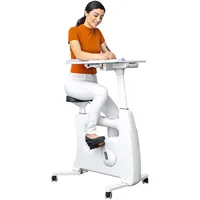
Stationary bikes encourage you to sit comfortably upright and are designed for more leisurely cardio exercise. These are ideal if you're looking to add some movement to your day, or keep your legs moving while working from home or catching up on your favorite TV shows and movies.
This style of bike is usually cheaper and is more likely to have a friction-based resistance system than a magnetic one, and you can adjust the resistance to specific levels using the workout metrics display.
Do you need an app to work out on an exercise bike?
One of Peloton's main selling points is the app, which is your gateway to the brand's high-energy classes. Many of the best exercise bikes have a display built in, or at least a phone holder, allowing you to use the machine's app. And if you buy a non-smart stationary bike, many people assume that you need to join a class to get the most from the bike.
It's seen as the default way to train on an exercise bike; take a seat, load up the app, and join a live or on-demand virtual class. This has been helped along by the popularity of spin classes, where people meet in a single space and join a high-intensity, instructor-led class often soundtracked by dance or nostalgic hits.
So if this is why you wanted an exercise bike, then you'll definitely need to factor in the ongoing subscription cost before you make a choice. If you choose a smart exercise bike, then you're generally locked into the equipment manufacturer's platform, like with Peloton, BowFlex (JRNY), and NordicTrack (iFit).
For regular exercise bikes, you can choose any of the best workout apps, but the bike won't sync to the app or allow you to automatically record your training. If that's important to you, then one of the best smartwatches would make a good addition so you can keep track of your workout stats and heart rate metrics.
However, you don't actually need an app to train on most exercise bikes. It can elevate the experience, but it's not necessary (although, if you don't take out a Peloton subscription, then the bike gets set into a feature-limited Just Ride mode).
If you'd prefer to do light exercise, take an indoor ride while you're working, on a call, or catching up on the latest books and TV shows, then you don't need an app. Plus, there's nothing stopping you from taking an intense ride; it's just a bit easier to program when someone else (like an instructor) takes the lead on when to adjust the resistance or cadence.
Are exercise bikes quiet enough for apartments or shared homes?
The Wattbike Air, for example, is pretty noisy. In testing, we were surprised by how loud it was, so it may not be suitable for communal spaces.
On the other hand, the Peloton Bike+ has a near-silent belt, so you don't need to worry about it making noise while you're working out. If you don't quite have a Peloton budget, though, the Echelon EX-5s is also a great, quiet option, and it's $1,000 cheaper than a Peloton bike.
The Zswift Ride also has a smooth, quiet ride, which in testing we found to be quieter than the average domestic fan, which is great if you want an exercise bike that's like the real thing.
The Yosuda Indoor Cycling Stationary Bike is incredibly quiet, and it's a great budget option, too, which just goes to show that you don't have to shell out for a quiet ride.
Can an exercise bike replace a gym membership?
If you're looking to save money, getting an exercise bike may seem like a good solution — while it is a higher upfront cost than a gym membership, it will likely work out cheaper over time. This is dependent on your using the equipment, of course, as well as what you were going to the gym for in the first place.
If you were mostly using the gym for cardio a few times a week, then getting an exercise bike may be a good replacement for this. If you were also doing other exercises, like strength training, then unless you're also investing in free weights, you may not find it to be worth it.
Some exercise bikes, like the Peloton Bike+, even have on-demand and live classes, which can simulate a real gym environment. However, considering the fact that the Peloton Bike+ costs $2,500, and its required membership costs $44 per month, it may not actually be a good solution if you're looking to save money.