Fancy bigger glutes this summer? "Summer glutes" are trending up, and Melissa Leach, a yoga instructor and strength and conditioning coach, says that these four simple but essential moves will strengthen yours.
You can do them at home with minimal equipment, but I recommend one of the best yoga mats. I would also consider adding load in the form of a heavy dumbbell or kettlebell if your goal is muscle growth, as you'll need to progressively overload the glutes over time to see real change.
Watch: 4-move workout for your glutes
Strong glutes are essential for maintaining good posture, mobility and back health. Your glutes act as stabilizers and are actually powerhouse muscles, given that the gluteus maximus is the largest (but most superficial) muscle in the body and acts as a hip extensor (crucial for walking, posture and running), responsible for power, strength and stability.
And that's just the maximus. You also have the minimus and medius and a deep muscle called the piriformis; all have their own roles in different types of movements, like lateral motion or providing stability. You could call your glutes the anti-gravity muscles because of this, given their role in posture and in contributing to a strong core.
If you sit for long periods or don't move around often, you may experience tight, weak hip flexors and glutes, which could lead to potential imbalances or injuries over time. This is why we want to strengthen and grow them to be powerful, not weak.
Melissa Leach explains: "Your glutes also help keep your pelvis stable, rotate the hip joints and support balance, which is why this routine is designed to hit your hip flexors and glutes and build strength and space."
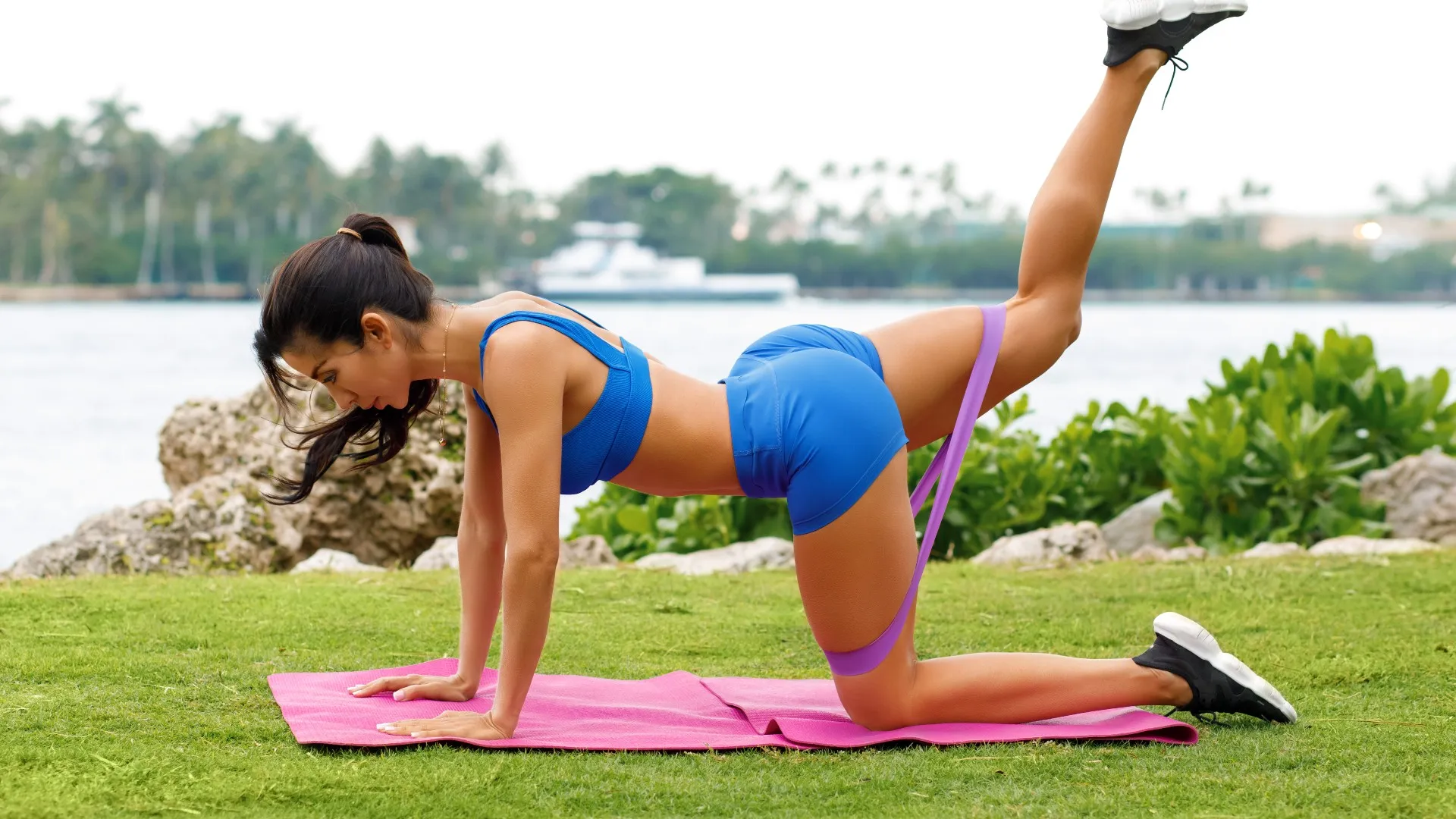
1. Donkey kicks 12-15 reps x2 sets
“This exercise is great for isolating the gluteus maximus and building strength in the hips, helping improve lower-body control and stability.
“Avoid arching your lower back as you lift; focus on keeping your hips square and the movement slow and controlled.”
How to do it:
- Start on all fours, with hands under shoulders and knees under hips
- Keep your core engaged and spine neutral
- Lift one leg, keeping the knee bent at 90 degrees, and press your foot up toward the ceiling
- Squeeze your glutes at the top, then lower slowly.
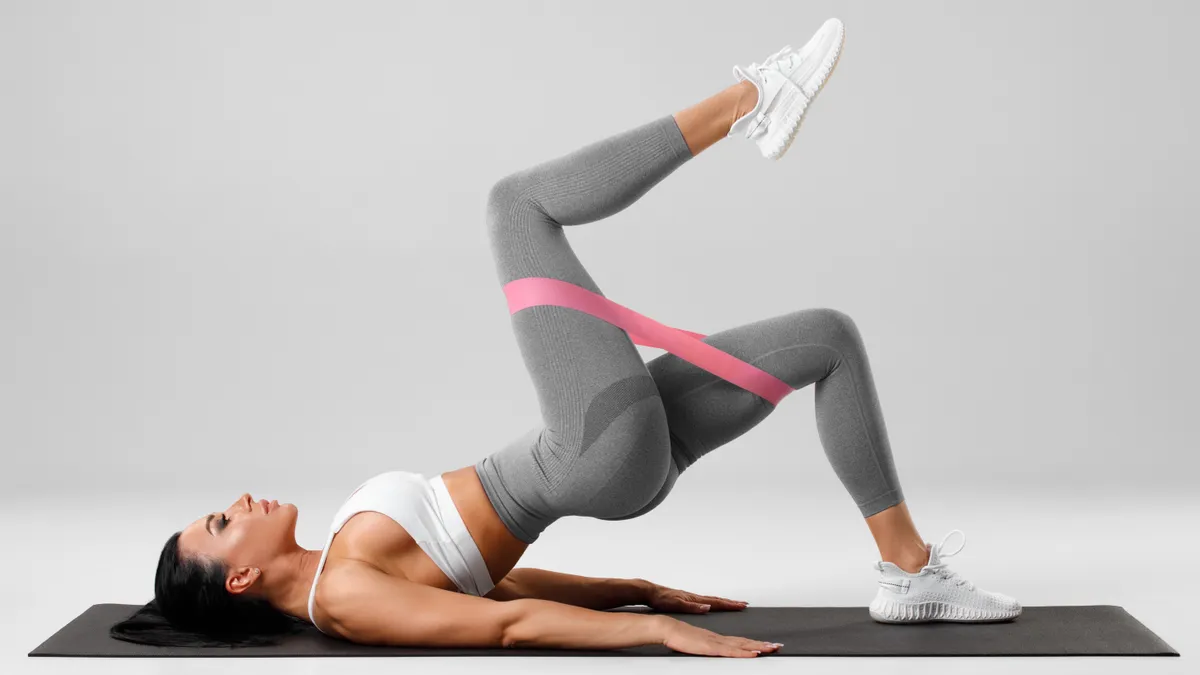
2. Pelvic curls (single leg) 12-15 reps x2 sets
“Pelvic curls help activate the glutes while also improving spinal mobility and core stability.
“Think about peeling your spine slowly off the floor rather than just quickly lifting your hips. The more controlled and slow the movement is, the more effectively you will engage your glutes and deep core muscles.”
How to do it:
- Lie on your back with knees bent, feet flat on the floor, arms resting by your sides
- Slowly tilt your pelvis upward, then roll your spine off the floor
- Lift your hips until your body forms a straight line from shoulders to knees
- Hold briefly, squeeze your glutes, then slowly lower back down
- Try with both feet resting, then see if you can lift one leg into the air during this exercise for a single-leg variation.
3. Prone heel kicks 20-30 seconds, 3-4 sets
"This move is particularly effective for activating all three muscles in the glutes while also strengthening the hamstrings and lower back, helping to strengthen the posterior chain.
"This exercise is not about height, so keep your legs close to the ground without letting them touch the floor. Maintaining constant tension is what helps build strength in the glutes and hamstrings.”
How to do it:
- Lie face down on a mat with your legs extended
- Engage your core and slightly lift both legs off the floor
- Rapidly alternate small upward kicks with your heels
- Keep the movement controlled and close to the ground.
4. Side-lying leg lifts 12-15 reps per side x2 sets
“This exercise targets the upper and side glutes, helping to stabilize and strengthen the hips and knees, while supporting better posture.
“Turn your toes slightly downward to better engage the gluteus medius, rather than letting the hip flexors take over.”
How to do it:
- Lie on your side with legs stacked and your body in a straight line
- Support your head with your arm or hand, or rest on your elbow
- Keep the top leg straight and lift it upward slowly
- Pause at the top, then lower it back down with control.
How can stronger glutes improve overall health?
Underactive glutes are common, especially as you get older or if you have a sedentary job. And it doesn't just crop up in inactive people; runners, lifters and athletes can all develop "lazy glutes," and you might not notice until the injuries or mobility issues begin to stack up.
Repeated underfiring could mean overloading other muscle groups, which leads to strain, so we want to focus on strengthening these muscles to protect the rest of the body. If your focus is to grow your glutes, these exercises can certainly help play a role; I recommend adding weight, plus reading up on hypertrophy vs strength training to ensure you are loading correctly using my guidance on sets and reps.
Alongside strength exercises, glute activation exercises that work the body through different planes of motion are also helpful. This will help you target all the muscles responsible for different actions, like lifting your leg upward, outward, backward, or in a circle.
Stronger glutes can improve mobility and balance, which are key for maintaining independence and reducing injury risk as we age.
"The glutes play a crucial role in supporting the body through everyday movement," Leach adds. "When they’re strong, they help improve stability, posture and overall strength, but when they’re weak or underused, which is increasingly common due to sedentary lifestyles, it can place significant strain on the lower back, hips and knees.
“Beyond this, stronger glutes can improve mobility and balance, which are key for maintaining independence and reducing injury risk as we age. They also support smoother, more efficient movement patterns in everyday activities like walking, climbing stairs and lifting.”
Leach recommends incorporating these exercises into your regular workout routine, even if that means just a couple of times a week, to target all three key gluteal muscles.
“It’s also important to remember that focusing on your glutes shouldn’t come at the expense of the rest of your body," she adds. "Strong glutes paired with weak legs can have the opposite effect to what we’re after, potentially causing more aches and injuries. A balanced exercise routine that targets all major muscle groups is essential.”
Follow Tom's Guide fitness below!

Follow Tom's Guide on Google News and add us as a preferred source to get our up-to-date news, analysis, and reviews in your feeds.
More from Tom's Guide