Five moves and 20 minutes are all you need to improve core strength at home without weights. Sure, lifting heavy in the gym has plenty of benefits (building strength, muscle mass, stability and power, to name a few), but you don't always need heavy weights for a powerful core workout.
Grab a yoga block and give these five moves a try. It’s perfect for beginners or anyone without weights at home. If you don't have a block, use a book instead. And I recommend the best yoga mats for support. Let's do this.
Watch: 5-move abs workout with yoga block
A strong core helps protect your lower back, and these moves are all supportive of your spine. However, if anything doesn't feel good for you, stop immediately and seek advice from a physician or personal trainer first. Especially if you're working with an injury or health condition, or if you're pregnant or postpartum.
When I can’t get to the gym, the one way I enjoy getting an ab workout is by getting creative with the equipment I do have access to — often a very light dumbbell, kettlebell, resistance band, or yoga block.
This short session focuses on muscle groups like the abs, obliques, transverse abdominis, adductors and hips, using rotation, flexion, extension and isometric holds. Think about conscious contraction using the block to help switch on your muscles.
Here are the exercises:
- Up-and-over twist: 50s on / 10s off, 45/10, 30/30, 20/10
- Butterfly tap: 50s on / 10s off, 45/10, 30/30, 20/10
- Single-leg raise with isometric hold: 50s on / 10s off, 45/10, 30/30, 20/10
- Bear plank with inner thigh pulses: 50s on/ 10s off, 45/10, 30/30, 20/10
- Around the world: 50s /10s off, 45/10, 30/30, 20/10
The first round involves working for 50 seconds, then resting for 10 seconds between moves. On the second round, you'll work for 45 seconds and take 15 off. Then you'll move to a 30/30 split for round three and a 20/10 split for the final round.
Here's where we get into the obliques, spine and hips using rotational movement. The up-and-over requires you to keep your legs pressed together as you lift them up and over the block, then back to the other side. You can bend your knees as much as you need to, but keep your hands on the mat close to your hips and lean back as you move.
Keep a long, straight spine and relax your shoulders with your chest proud. You could lift one leg up and over at a time or remove the block.
Next: butterfly taps. Press the block between your feet and give it a good squeeze to activate the outer glutes and legs. With your knees wide and legs in the air, reach up and tap the block with your hands, then lower your back to the mat again. It mimics a crunch while helping to engage the lower body, giving you a little more bang for your buck and stretching your groin.
The single-leg raise with hold uses isometric contraction of the core as you press your forearms into the block, while it rests on your thigh. With the other leg, lift and lower with control. Press your lower back into the mat and lift your shoulder blades, keeping your gaze forward with your chin tucked.
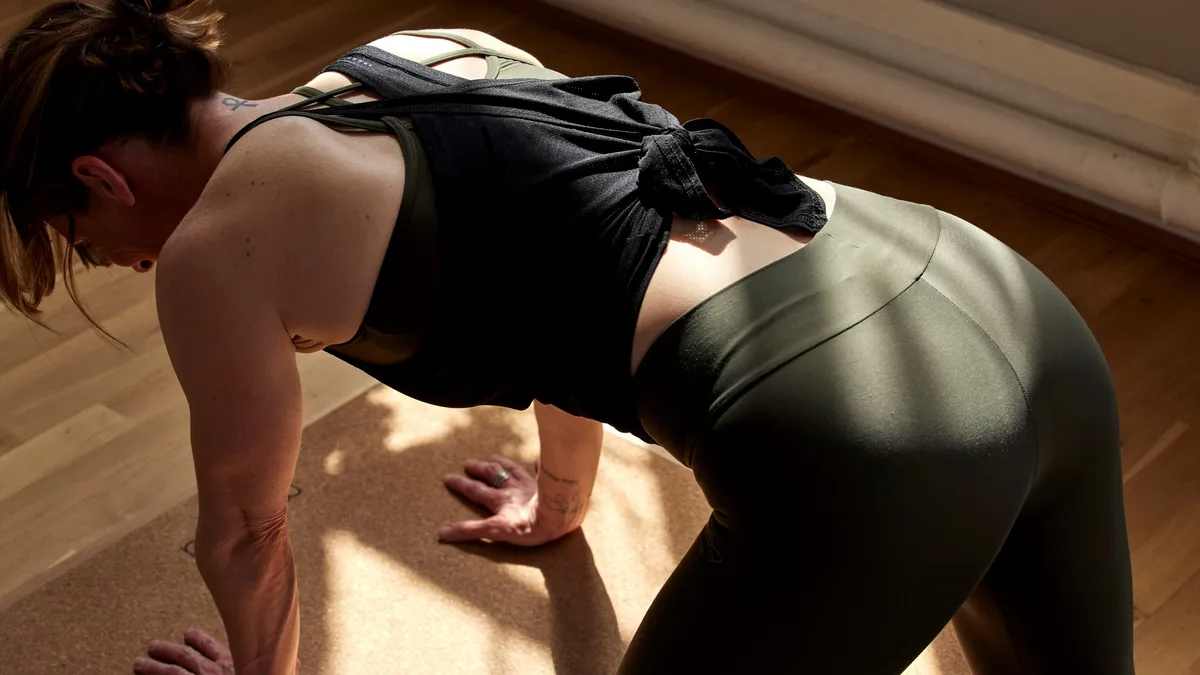
The bear plank is one of my favorite moves, as your whole body works hard to hold the position. This variation is harder on the quads than the regular plank as you hover your knees inches from the mat. Keep your back flat and push through your hands to broaden through your upper back.
You'll position the block between your thighs and squeeze it throughout to engage your inner thighs and improve overall core contraction while you hold the plank.
The final exercise can be performed with straight legs or bent knees, depending on your ability and hamstring flexibility. As you draw your thighs and chest toward each other, pass the block behind your legs and exchange the block to the other hand; as you lean back and lower your legs, pass the block again. Move in both directions.
What are the benefits of the yoga block ab workout?
We hit the core from many angles during this short routine.
I’ve put together a handy guide on abs vs core muscles, which explains the difference between the types of muscles that make up your core, but as a general rule of thumb, try to work as many muscle groups as you can, including the deeper, stabilizer muscles like the transverse and internal obliques, as well as the more superficial abs.
Rotational movements hit the internal and external obliques, while leg raises recruit the hip flexors, abs and deeper core muscles that help stabilize your spine. Of course, there are many exercises, muscle groups and movement patterns to consider, so I like subbing moves out every few months for the best abs exercises for sciatica if my back feels peaky, and I strongly recommend checking those out if you struggle with tightness or pain.
Follow Tom's Guide fitness on Instagram for more workouts, routines, tips, and tricks.

More from Tom's Guide
- No, not sit-ups or crunches — this is the one low-impact exercise you should try to strengthen your core instead
- Pilates instructor shares a 20-minute Pilates workout for developing healthy hips and strengthening your lower body
- 3 strength exercises you can do with a yoga block that aren't ab exercises