Value Electronics — an esteemed, US-based A/V retailer — held its annual TV Shootout last week, pitting many of the year’s best TVs against one another in a series of tests designed to measure picture quality. OLED TVs competed in their own contest, which included the Samsung S95H, the Sony Bravia 8 II and the LG G6.
Despite some tough competition, Samsung’s flagship OLED took home the crown, besting LG and Sony’s top OLED models across several performance categories. Having seen all of the competing OLEDs, I’m not surprised by the results; the S95H received our coveted five-star rating on account of its gobsmackingly gorgeous picture.
There’s just one problem: The Samsung S95H carries a sticker price that’ll make you stumble towards the nearest fainting couch. King of OLED TVs? Sure, I can buy that. But I won’t be able to afford the S95H itself anytime soon. Fortunately, there’s a mid-range OLED waiting in the wings with a lower price and wider appeal: the LG C6.
The LG C6 vs Samsung S95H: by the numbers

The fine folks at Value Electronics put the year’s top OLEDs through a series of tests that measured in-depth performance metrics like shadow detail, low-luminance color saturation, skin tone accuracy and more.
It’s worth mentioning that Value Electronics’ TV Shootout is operated and aimed at A/V specialists, home theater enthusiasts and all-around hobbyists. As a result, their tests (the results of which can be perused at eCoustics) dive deeper in the finer details of these displays’ capabilities.
Despite the fact that LG’s mid-range C6 OLED didn’t compete at Value Electronics’ TV Shootout, we’ve conducted our own tests on the C6 and the Samsung S95H. Here’s how they stack up:
| Header Cell - Column 0 | LG C6 |
Samsung S95H |
|---|---|---|
SDR Brightness (10%, in nits) |
355 |
253 |
Delta-E (lower is better) |
1.5 |
2.2 |
HDR Brightness (10%, in nits) |
1,355 |
2,721 |
UHDA-P3 Gamut Coverage |
99.77% |
99.92% |
Rec.2020 Gamut Coverage |
75.92% |
89.6% |
Input latency (milliseconds) |
9.1 |
9.7 |
Both of these sets deliver the performance benefits that OLED TVs are known for: perfect black levels and pixel-level dimming. As a result, pretty much everything looks terrific on both TVs.
In addition to some higher-end features and components, the S95H's secret sauce is its quantum dot-enhanced OLED display. This is the reason its color volume is so impressive compared to the LG C6, and a big reason why its HDR highlight brightness is nearly double.
Samsung's picture processing at the flagship level can't be ignored, either. Value Electronics' methodology is designed to put a microscope on the small stuff, like how smoothly color gradients transition from one shade to another, or how effective a TV is at displaying dark, hard-to-render colors.
I can't sit here and tell you that the LG C6 is a better-performing TV than the S95H. The difference in a side-by-side comparison would be undeniable. But for most viewers, the LG C6 is about 80% as impressive-looking as the S95H, and the gulf in price is much more significant.
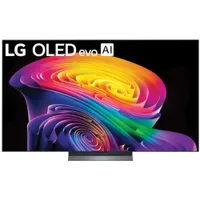
The C6's 1,300+ nits of HDR highlight brightness is plenty good for most viewing environments. More importantly, the self-emissive nature of OLED means that the C6 gets more out of its highlight brightness than an LCD/LED TV with similar brightness. It's one of the reasons why there's a much smaller perceivable performance gap between mid-range and flagship-level OLEDs when compared to LCD lineups.
The C6 is also equipped with nearly every streaming- and gaming-related feature you'll find on the S95H. Plus, if you're a home theater completionist, you'll appreciate the C6's inclusion of Dolby Vision support — something you won't find on any Samsung TV.
You might also find that the C6's traditional design is better suited for your living space. The S95H features a divisive metal frame that can't be removed. It looks more natural when the S95H is wall-mounted, but when it's on a table, I find it to be more than a little distracting.
As a TV expert, you won't catch me claiming that the S95H isn't as impressive as the C6, or even that the S95H isn't worthy of Value Electronics' crown. But for most people, it's a much more sensible option, and I'm willing to bet that it'll be the more popular choice in 2026.

Follow Tom's Guide on Google News and add us as a preferred source to get our up-to-date news, analysis, and reviews in your feeds.
More from Tom's Guide