I recently tried Bryan Johnson's tips for anti-aging. And while drinking lemon water and going for a walk before work have significantly helped to start each day feeling physically better, the color-coded Google Calendar staring back at me is inevitably causing some gray hairs.
But after reading about Elon Musk's favorite mental model of First Principles Thinking, I decided to give it a try. Musk famously used these principles to realize that the raw materials of a rocket only cost 2% of the finished product, leading him to build SpaceX. I wondered: What if I stripped the "raw materials" of my productivity down to the physics?
Because I'm not a rocket scientist, I gave the job to ChatGPT. I told the AI: "Ignore every productivity 'hack' ever written. Use First Principles Thinking to deconstruct the concept of a 'workday.' What are the fundamental truths of human output, and how can we rebuild a schedule from scratch based only on biology and physics?"
The AI’s response was a cold, hard slap in the face to my weekly grind. Here's what happened and how it double my deep work focus.
Deconstructing the myths
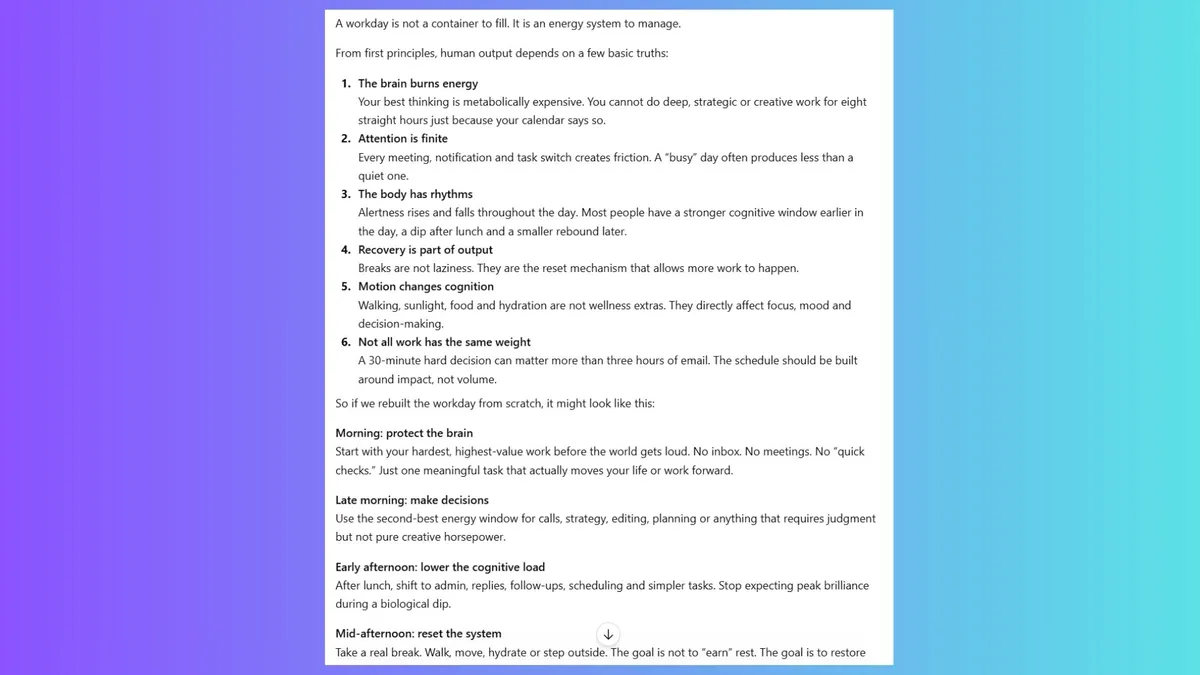
The AI identified that the work day was meant to be managed, not a container to fill. I took this as, not every minute needs to be filled, leave time for creativity and breaks. From there, it broke my workday into three "First Principle" truths:
- Energy is finite: Cognitive "fuel" (glucose and neurotransmitters) depletes with every decision.
- The law of diminishing returns: After a certain threshold, an hour of work produces less than an hour of value.
- The 'trunk' vs. the 'leaves': 80% of my tasks were "leaves"—busy work that didn't actually support the "trunk" of my career.
Implementing the 'SpaceX' schedule

I have to say, I was really surprised the way ChatGPT actually gave me the SpaceX schedule to follow. Instead of a to-do list, it helped me build a "function-first" protocol. Here is what happened when I applied it for a week:
- I killed the 'Early Bird' Mandate. I read a lot of business and self-help books and many of them make me feel guilty for not waking up at 5:00 A.M. My specific biology requires 7.5 hours of sleep for peak cognitive function. I don't usually get that, but I'm not interested in waking up any earlier. Getting rid of the idea that I had to get up early helped to reduce brain fog since I wasn't fighting my internal physics.
- The '3-Unit' output limit. ChatGPT made me understand that a productive day doesn't mean a list of checked boxes on a to-do list. According to the First Principles system, deep work requires high "activation energy." So, once you're in the flow, switching tasks is a massive energy tax. So, now, I pick two major things that move the needle. Once they are done, I'm "allowed" to stop. By practicing that, I got more done in 4 hours than I used to in 10.
- The 'information meat' filter. Staying informed all day by checking emails and Slack constantly is an instant time-suck. When every notification is a context switch, it can cost 20 minutes of valuable focus time. Now, I batch my communication and check at certain scheduled times (and only respond to certain people I mark as VIP). My stress levels have plummeted.
The verdict

The most radical part of the First Principles experiment wasn't the schedule. It was actually quite easy to implement and I didn't have to make huge adjustments. But the mental freedom was noticeable within days.
I wasn't comparing myself to others or even a busier version of myself. When you reason by First Principles, you only care about the physics of the result, which is mentally freeing in itself.
If my "raw materials" (sleep, focused blocks, and clear goals) are handled, the "form" of how my day looks doesn't matter. I'm not trying to build something different or add to a flawed system, I'm simply applying phsyics to get a project, email or decision from point A to point B.
Love him or hate him, there's a reason why Elon Musk is a trillionaire. His rules and principles work when applied well.
The shift that changed everything
My burnout wasn’t caused by a lack of discipline. If anything, I had too much of it; I was forcing myself into a system that looked productive on paper but completely ignored how my brain actually works. The real problem was my “mental architecture.” I had built my days on rules that worked for other people, but not necessarily for me. So while there was structure, there wasn't a foundation.
First principles flipped that. Instead of asking, “What does a productive person’s day look like?” I started asking, “What does my brain actually need to produce meaningful work?” That shift changed everything.
By asking ChatGPT to help boil down life to the fundamentals (energy, attention, impact), I was about to tweak my schedule and rebuild what works for me from the ground up.
Anyone can use Elon's principles, just ask ChatGPT how to help you design a day that works for you instead of against you. Let me know in the comments what you think of Elon's First Principle's. I'd love to know if you try this idea with your own schedule.

Follow Tom's Guide on Google News and add us as a preferred source to get our up-to-date news, analysis, and reviews in your feeds. Subscribe to Tom's Guide on YouTube and follow us on TikTok.
More from Tom’s Guide