I'm a total newbie when it comes to the benefits of solar panels, but I just got my first taste of free power after a weekend camping trip with the Jackery Explorer Solar Generator 2000 ($999 @ Amazon), and I'm hooked. Roughly the size of one of the best drink coolers (just a darn sight heavier), this portable power station gave me all the electricity I needed during 48 hours away from the grid and still had some left to spare.
If you've not yet taken the plunge on a solar generator then there are plenty of affordable alternatives to get you started, but I can't fault the usefulness of the Jackery Explorer and plan to make it a mainstay of future camping trips.
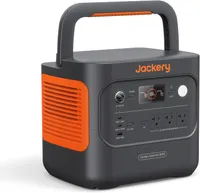
At a buck shy of a grand without the solar panels you’re going to want to accessorize it with, the Jackery Explorer 2000 is something of an upfront cost. Amazon sells the 200W panels for $429 each, so buying both together will set you back $1,428. The retailer is also is selling a bundle of the power station with two panels for $1,639 — which saves you a bit of cash if you want to double up. But leaving that aside, Jackery also has a range of different power stations with varying capacities at different price points. For example, the Jackery Explorer 500v2 is a more wallet-friendly $399 (discounted to $359 at time of writing).
These prices may give you reason to pause. But, like any form of renewable energy, it’s an investment rather than a sunk cost. For example, campsites in the UK will charge you anything between £5 and £15 extra per night for a pitch with an electrical hookup. So over the course of a three-day weekend, I could save up to £45 ($61) just by bringing the Jackery Explorer instead. If I do this three times over the summer, that’s up to £135 ($184) saved.

And even when I’m not using it for camping, like my colleague Tom, it’s providing additional power to my garage for free. Okay, so all that is a bit of an oversimplification, but Jackery’s batteries are slated to last up to 10 years with 80% remaining after 4,000 full charge cycles. So there’s a good chance that over the course of a decade, you’ll make your money back. Eventually.
What you get

I packed the Jackery Explorer 2000 into the car for a three-day trip during the height of summer. We were in the middle of a UK-wide heatwave, with temperatures sitting around 32°C (89.6°F) and just a few wispy clouds populating the sky. So, it was the perfect testing ground for a portable solar power station.
The Explorer weighs 39.5lbs (17.9kgs), which is impressive for the 2042Wh capacity but still prohibitive for carrying large distances — so keep that in mind if you park the car a long way from where you pitch camp. Jackery does say the Explorer 2000 is “41% lighter and 34% smaller than conventional 2kWh LiFePo4 portable power stations” as it uses the same CTB (Cell-to-Body) technology you’ll find in the best electric cars. There’s a very helpful carry handle, and I was able to bring it easily back and forth between the inside of my tent and the seating area we’d created to socialize.
I tend to travel light, so the only electronics I really needed to worry about were a pair of smartphones, a Bluetooth speaker, an electric kettle and a pump for inflating a mattress. The phones and speaker were serviced by the two USB-C ports (one 30W and one 100W) and one USB-A (18W) port, while the kettle plugged into one of the two AC 2,200W sockets on the front. High-wattage devices like that kettle are going to empty the battery quickly, but more on that later. My British model has two AC sockets, but the American version packs three — bonus points to Uncle Sam. Finally, the pump could be plugged into the DC 12 V input as if I was using my car’s cigarette lighter.
The controls on the Jackery Explorer 2000 are extremely simple to use. Hold down the power button for a few seconds to wake it up, and then the remaining buttons let you toggle between the AC and DC outputs. There’s also a built-in LED light with three modes: Low Light, High Light and SOS. Meanwhile, the LCD display tells you the current percentage, input/output power and your remaining charge time. It’s all remarkably simple to use, which is exactly what you want when you’re struggling to get a campsite set up in time for dinner.
How I used it

Over the course of two nights, I kept all the phones topped off and used the pump three times (I need a new air mattress) while I boiled the kettle at least six or seven times. At around 9pm, I switched on the LED light and kept it up for a couple of hours until it was bedtime at around 11pm.
I started the weekend with a full charge of 100% and when it was time to pack up and go home, I was down to 42%. I kept the Explorer 2000 topped up for a few hours here and there, but mostly I relied on the accumulated charge from the mains that I put into the battery before leaving the house.
As mentioned, the only real draw on the power was the kettle, which was pulling pretty much the full 2,200W output to run and easily dropping the battery down several percentage points each time I used it.

If you’re looking at a multi-day trip with energy-hungry devices like one of the best electric bikes or electric stoves, you’re going to run out of power far quicker than I did.
What’s more, I didn’t have anything like a fridge continuously running from the Explorer 2000 — I just pulled it out when required. If you’re powering a portable refrigerator at 90W, you can expect to get about 15 hours of runtime. My usage was relatively tame, but if you’re planning more adventurous multi-day trips, you’re going to need to get the most from your solar panels.
Charging: solar vs the mains

You don’t necessarily have to buy the official Jackery solar panels, but if you opt for a (cheaper) third-party option from Amazon, you’re going to need an adaptor. Jackery’s 200W solar panels connect via an included DC8020 solar charging cable that plugs directly into the side of the power station and it begins charging right away. A side note here is that it does so very quietly — if you get right down next to it, you can hear a faint whirr. But I’d bet the average hiker could leave this running next to them and fall asleep without being disturbed.
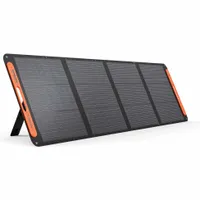
The good news is that, like the power station itself, the solar panel is extremely easy to use. All you need to do is unfold it, pull the kickstands away from their velcro fastening and connect them to the power station.
At a full 400W solar input from two panels, Jackery says you can charge the Explorer 2000 up in five-and-a-half hours. I, meanwhile, had only a single 100W panel with me. The good news was, as mentioned, it was a very sunny weekend, and I was easily able to get the full 100W input from the panel. Generally speaking, you get around four to six peak sun hours per day. At 100W, it'd take me around 20 hours to fully charge the power station, which probably equates to around four days of charging.

On the other hand, connecting it to the mains juices the power station from empty to full in just 1.7 hours. You can enable emergency charging via the Jackery app to cut that down even further to 1.33 hours — or from 0-80% in 52 minutes.
So, yes, solar is free, but it’s also time-consuming and heavily reliant on where you are. Despite this summer’s efforts, the U.K. is not known for sunshine, and if you’re staying somewhere with a lot of cloud cover or underneath foliage, this option won’t be as readily available to you. My advice would be to opt for a 200W solar panel if you can stretch to it, to maximise the amount of energy you can harvest when the sun does come out.
You’re always going to lose some energy through conversion and thermal dissipation when you’re pulling power from the sun. So you need to be mindful of not wasting the opportunity to power up when you can. The distinct benefit of having such a portable solution means it's not a chore to set up, even for an hour or so. I was able to get the panels out of the car and have the power station topping up (albeit slowly) in under thirty seconds.
One thing to add is that Jackery's panels are IP68 water and dust-resistant, so you don’t have to treat them with kid gloves during a weekend in the wilderness.
Final thoughts

There’s a lot more to the Jackery Explorer 2000 than I’ve gone into here. Things like the durability testing, the rigorous battery management system and the five-year warranty are all worthy of praise. But the main thing I found was that the system was reliable and easy to use for someone with almost no prior knowledge of portable power beyond the best battery packs you get for your phone.
That’s important because although it’s great to have portable power to keep your iPhone charged up on a camping trip, portable generators can go much further. When Hurricane Beryl knocked out power for my colleague Anthony Spadafora back in 2024, he was able to give his mother-in-law a portable generator to keep her freezer and lights running for awhile in the ensuing power outage. It may be 2026, but power outages are not a thing of the past and if you’ve got a device like the Jackery Explorer 2000 on hand, it gives you a measure of protection to keep vital services powered on.
And that’s an investment that’s worth making right now. Even if it spends most of the year keeping the Bluetooth speaker in your garage topped up.

Follow Tom's Guide on Google News and add us as a preferred source to get our up-to-date news, analysis, and reviews in your feeds. Subscribe to Tom's Guide on YouTube and follow us on TikTok.
More from Tom's Guide