I’ve been practicing Pilates for the past 15 years, and one exercise that stands out from the rest for really blasting the muscles in your midsection is the Pilates teaser. It’s a notoriously difficult move to master, but when performed with good form, it’ll work your deep core muscles, as well as your spinal mobility. Read on to find out why it’s got a place in my practice, and how to progress the move.
As a reminder, what works for me might not be right for you and your body. If you’re a complete beginner, you probably won’t want to jump in with the Pilates teaser; if you’re pregnant or postpartum, or recovering from an injury, it’s always best to seek personalized advice from a qualified professional.
What is the Pilates teaser?
The Pilates teaser is a tricky ab exercise that requires the deepest muscles in your core, the transverse abdominis, to fire up and stabilize your spine as you lift your body. It’s performed with just your bodyweight; you might want to use one of the best yoga mats to make things more comfortable.
Here’s how to do it:
- Lie flat on your back and extend your arms overhead. Keep your lower back pressed into the floor and squeeze your abs, sucking your belly button into your spine, zipping your abs up and in.
- Extend your legs and squeeze your thighs together. If this is too challenging, start with your legs in the tabletop position instead.
- Lift your arms towards the ceiling and tuck your chin towards your chest. Peel your spine off the mat, one vertebrae at a time. The lift should be coming from your core, not your shoulders.
- As you’re lifting your upper body, simultaneously move your legs to a 45-degree angle.
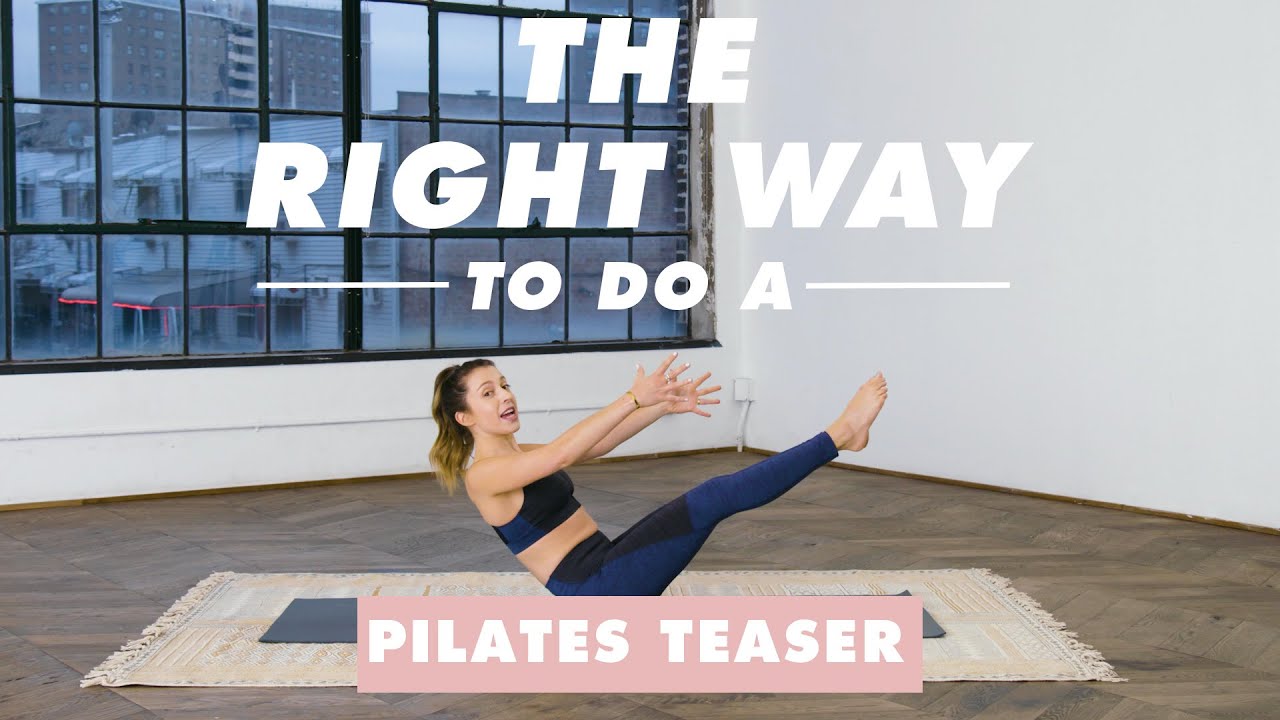
- Reach your fingers towards your toes; your body should be in a V-shape. Straighten your back to avoid slumping, and balance here for three counts. Keep your shoulders down and away from your ears.
- Tuck your pelvis and scoop in your abs, then slowly lower your spine back toward the mat one inch at a time.
- At the same time, slowly lower your legs, so that your head and heels reach the mat together.
You can see a video of Pilates instructor Chloe Gregor demonstrating the move below.
What are the benefits?
A lot is going on during this exercise, so here’s what it’s actually doing for your body:
Deep ab work
This move really requires the deepest layers of your core to fire up to protect your spine throughout the move. This builds functional core strength, not six-pack abs, but it means your core is better at protecting your lower back from injury during everyday activities.

Prevents lower back pain
When performing the teaser with good form, you’ll be peeling your spine off the mat, and slowly lowering down to your exercise mat one vertebrae at a time. This exercise in itself decompresses the spine and helps improve the health of the intervertebral discs.
It helps to teach your spine to flex, which is key to preventing lower back pain. Even if you’re a beginner, if you spend a lot of time sitting down behind a desk, practice this gentle peeling off the mat by doing exercises like the Pilates roll-up.
Builds hip flexor strength
Finally, if, like me, you suffer from tight hip flexors, this is a great exercise to build up to. The hip flexors keep the legs stable in this move, while maintaining a neutral pelvis. This can build functional strength in the hip flexor muscles, which are essential for walking and running.
What are the progressions?
This move is already pretty tricky, but if you’ve mastered the bodyweight variety, you can increase the intensity by adding a Pilates ring or Pilates ball. Squeeze the ring or ball between your thighs or your palms.
The lower-body variety will help you engage deep pelvic floor muscles during the move, and squeezing the ring between your hands will help engage your pecs and abs. You can also try adding weight by holding a set of light dumbbells or wearing ankle weights.
Follow Tom's Guide fitness on Instagram for more workouts, routines, tips, and tricks.
Pilates essentials we love



Follow Tom's Guide on Google News and add us as a preferred source to get our up-to-date news, analysis, and reviews in your feeds.
More from Tom's Guide
- Not sit-ups, planks, or crunches: I do this simple Pilates exercise every single day to build a strong and stable core and work on my hip flexor mobility
- Not sit-ups or lunges — I use this simple Pilates exercise to sculpt strong obliques, inner thighs and hip stabilizers
- 'I’m a Pilates instructor, and I recommend these 5 core exercises to help older clients build strength and improve posture'