The perennial unwanted Christmas gift, most of us unwrapped a pair of socks this holiday season (I got three.) While you might be tempted to confine them to the back of your drawer, I urge you to save your socks from relegation by incorporating them into your bedtime routine.
Yes, much-maligned bed socks do help you sleep, particularly if you've found your rest disrupted by chilly weather. With warm feet you can drift off faster and stay asleep longer, year-round. Let's explore why you should wear socks to bed, so when you thank grandma for the gift you really mean it.
Turn your unwanted socks into an effective sleep aid
“At night your body needs to cool down to optimize the release of melatonin," explains Sammy Margo, Chartered Physiotherapist and Dreams Sleep Expert. "But if your feet are too cold, this could cause night awakenings and disturbed sleep."
"Research has shown that adding a pair of socks may help to improve your peripheral circulation which can result in a lower core temperature."
Dr. Olalekan Otulana, GP and physician at Cassioburt Court, explained to us that socks can help you sleep even in summer because warm feet encourage the blood vessels to dilate.
"This signals to your body that it is time to shift heat outwards and cool down internally, essentially helping your core temperature lower more efficiently."

And as your circadian rhythm recognizes a lower core temperature as a signal to get sleepy, this cooling effect helps you to fall asleep fast.
Keeping your feet wrapped also helps you maintain a stable body temperature throughout the night, so you're less likely to be woken up at 3am by cold snaps or night sweats.
"A steady, warm environment for your feet can reduce disruptions, making your sleep more continuous," advised Dr. Chelsea Perry of the American Academy of Sleep Medicine when asked how socks help us sleep.
Plus, if you overspent during the holiday season, utilizing bed socks might help you save on your bills. Margo points out with your feet warm; "you can turn the thermostat down a little lower too."
If you're still struggling to maintain a comfortable temperature overnight (and through to the morning), check out our guide to how to set your thermostat overnight for better sleep.
Which socks are best?
"The ideal pair of socks need to be loose and made of natural fibers such as cotton, cashmere or merino wool for warmth and breathability.," advises Margo.
Breathable materials keep you cozy without overheating, helping along the temperature-regulating process known as distal vasodilation (you'll want to remember that term for your 'thank you' cards).

Antibacterial socks are also a good idea, particularly if — to put it delicately — you have a tendency towards foot fungus. With breathable, antibacterial materials you can prevent waking up in the night with itchy feet.
And in the winter, opt for thick socks to prevent heat escaping and quickly warm your frozen toes.
Socks to avoid
There's not exactly a bad bed sock that you should steer clear of but certain sock types might not deliver the snooze supporting experience you crave.
First, nothing too tight, This can impact circulation, making distal vasodilation less effective.
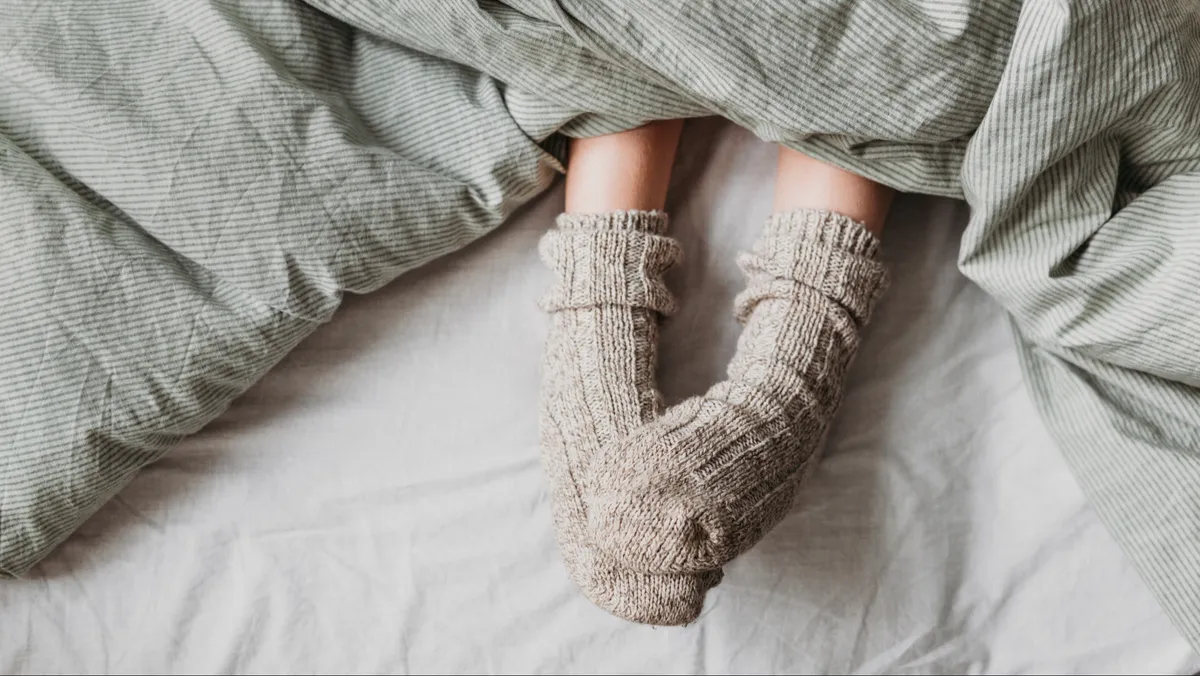
On a similar note, avoid socks that are too lose, as they're likely to slip off in the night.
As mentioned, breathable fabrics are best. So if you've been given a pair of socks that make your feet sweat just looking at them (there's always one family member who goes gift shopping at the gas station), save them for another occasion.
But I hate wearing socks to bed?
Yes, it can take a few nights to adjust to wearing bed socks. We learn to recognize habits as a signal it's time to sleep. Changes to that system can leave you tossing and turning.
To better get used to the sensation, try Incorporating socks into your bedtime routine. I recommend pairing them with another common and often unwanted Christmas gift — lotions and creams.

Massage a soothing cream into your feet while engaging in some calming breathing, put your socks on and you should be ready to drop off.
(And if you're wondering what to do with that basket of candles and lotions, we also have advice on how to use an aromatherapy set for better sleep.)
One final tip...
Don't clamber into bed wearing the same socks you've had on all day.
There's no science behind it, it's just gross. Your socks will have collected all kinds of bacteria and sweat during the day, which you're now transferring to your bed.
Your mattress can harbor germs if not properly cared for and not only can a dirty bed make you sick, it can also cause the materials in your mattress to break down, resulting in a sagging, uncomfortable sleep surface.

(If that sounds all-too familiar, check out our guide to the best mattresses of 2026 to find the perfect replacement.)
So change your socks before bed.
And there's another benefit to designated bed socks: when grandma asks why she never sees you in your Christmas present, you have a valid explanation. You wear them all the time... at night... when no one's around to see it.

Follow Tom's Guide on Google News and add us as a preferred source to get our up-to-date news, analysis, and reviews in your feeds.