




If the majority of Christmas movies are to be believed, the holidays are the most wonderful time of year. And while we don’t want to be the Grinch that attempts to ruin the festivities, it is true that the holiday blues are very real for many people.
Research has found that Christmas can be associated with negative emotions, stress and even sleepless nights.
To find out more about the causes, how holiday blues and stress can impact your sleep and what you can do at night to unwind and rest well, we’ve spoken to UKCP psychotherapist and author of How To Be Awake, Heather Darwall-Smith and EMDR Certified Therapist and CEO at Soul Song Therpay Group, Yuki Shida.
What has the research found?
- The term 'holiday blues' is thought to originate from a 1955 paper about 'holiday syndrome'
- One study found that people surveyed had more negative emotions and less satisfaction around Christmas than at other times of year
- Surveys and polls in the US and UK have found higher stress and poorer mental health over the holiday period
The term 'holiday syndrome' was introduced by a psychiatrist and psychoanalyst called James P. Cattell in a 1955 paper published in Psychoanalytic Review where he described it as featuring symptoms including "diffuse anxiety, helplessness, possessiveness, irritability," during the period between Thanksgiving and shortly after New Year.
This term has since been cited as the origin of what we now call the holiday blues.
While the holiday blues are not a clinical diagnosis, Darwall-Smith explains, "research consistently shows increases in stress, low mood and anxiety during this period."
Plus, studies have shown that people experience more negative emotions and less satisfaction during the holidays.
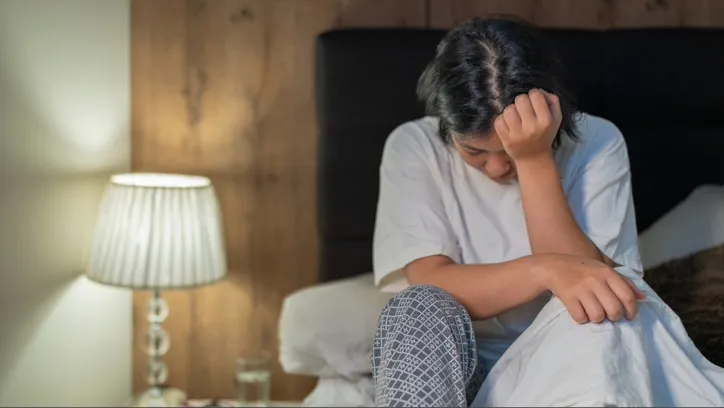
Professor Mutz suggested that these results could be due to the stresses in the lead up to Christmas. It’s quite possible he was correct, since a 2023 survey by the American Psychological Association found that 41% of Americans say their stress increases at Christmas compared to other times of the year.
How does holiday stress affect our sleep?
As well as the results from the above UK poll, a 2024 Sleepopolis Holiday Stress Survey found that 30% of Americans say they get less sleep during the holidays. So how exactly is this festive stress causing our sleep woes?
“Holiday stress activates the nervous system, making your body alert rather than calm and rested. This makes it physiologically harder to shift into the relaxed state needed for sleep,” explains Shida.
Holiday stress activates the nervous system, making your body alert rather than calm and rested
While Darwall-Smith adds that “cognitive arousal also plays a role: minds tend to replay conversations, to-do lists and family tensions just as the lights go out."
"Research consistently links stress and emotional load with longer sleep onset, lighter sleep and more night-time awakenings,” she adds.
Both experts noted that there are a variety of lifestyle factors that can influence changes in sleep during the holidays, including consuming more alcohol or sugar, later evenings and irregular routines and increased screen time.
“This can lead to difficulty falling asleep, less deep restorative sleep, and more nighttime awakenings,” Shida says.

6 expert-backed ways to de-stress at night for better sleep
To help you counteract the holiday blues and stress, Shida and Darwall-Smith have shared their top tips for unwinding at night, and we’ve added some Tom’s Guide-approved suggestions, too.
1. Create a consistent wind-down ritual...
"A consistent routine helps signal the nervous system that it's time to transition out of stress mode," says Shida.
You might have heard of this referred to as a nighttime routine, but don't worry, it isn't another complex task to add to your plate over the holidays. The idea is to create a simple sequence of activities you find relaxing ahead of bedtime.
"This could include dimming lights, gentle stretching, reading, or listening to calming music for 20–30 minutes before bed," Shida suggests.
Just make sure they're easy to do each night and calming for you personally.
2. ...Or at least have a familiar bedtime anchor
A consistent nighttime routine is ideal, but we understand your holiday schedule may not allow for that. If that's the case, Darwall-Smith suggests keeping one small, recognisable part it, as this "can be surprisingly stabilising."
The psychotherapist says that this could be "the same music, the same herbal tea or the same wind-down activity. Familiarity sends a signal of safety, which supports easier settling at night."
You might want to consider a few pages of your latest book, as research shows that reading for just six minutes before bed can reduce your stress by 68%.
3. Try breathing exercises and progressive muscle relaxation

If you're feeling your stress peak before bedtime, you can try gentle breathing and progressive muscle relaxation.
The latter is a technique that "helps to maintain restorative sleep quality through tensing and releasing muscles, and slow breathing and mindfulness" Dr. Hana Patel has previously told us, also explaining that it is "often used to help relieve stress, anxiety, and insomnia."
And for a specific breathing technique for relaxation, the 4-7-8 breathing method, popularized by Dr. Andrew Weil, has been described by his team as a "perfect, portable stress antidote."
It involves breathing in for four seconds, holding that breath for seven seconds and exhaling for a count of eight seconds, and helps activate the parasympathetic nervous system.
4. Soothe yourself with sleep meditation
According to Stanford Medicine's advice on managing holiday stress, researchers at their Center on Stress and Health have found that meditation is one of the techniques that can be used to calm the body and mind, and therefore reduce stress.
Sleep meditation (any form of meditation you practice ahead of going to bed at night) is a useful tool you can use at bedtime during the holidays.
It helps "by activating the parasympathetic nervous system — your body’s 'rest-and-digest' mode," Dr. Leah Kaylor has previously explained to us, adding that "this is the opposite of the 'fight-or-flight' stress response driven by the sympathetic nervous system."
You can find out more about types of sleep meditations, including visualization, body scan meditation, guided mediation and mindfulness meditation in our guide to sleep meditation and how it works.
And, you can even find specific guided sleep meditations that are intended to tackle holiday stress, like Insight Timer's Releasing Holiday Anxiety For Sleep.
5. Do a “brain dump” before bed

Whether you're running through everything you still need to prepare before your holiday celebrations, concerned about finances or feeling anxious about festive plans, performing a 'brain dump' can help you sleep more easily, Shida says.
This works by externalizing your mental load
"Write down worries, unfinished tasks, or plans for the next day in a notebook and then close the notebook," she explains.
"This works by externalizing your mental load and representing that you are 'closing' those thoughts and putting them away for later."
6. Shrink the day back to its actual size
"Christmas Day often expands to mythic proportions," says Darwall-Smith, feeling so significant that it consumes our minds. But she suggests a "a helpful psychological reset" you can do to help improve your sleep:
"Gently remind yourself that it is, in reality, a single 24-hour period with a beginning, middle and end."
"Mentally placing it back into the calendar rather than on a pedestal can reduce anticipatory stress and help the nervous system stand down," she adds.
