As someone who lives in the UK, I’ve only really had cause to use the term ‘heat training’ ironically for most of my life. The very idea seems absurd when heading out for a run under cloudy skies in sub-70℉ (21.1℃) conditions, which is what we often call summer.
However, this year the UK is experiencing the longest and hottest heatwave of my life, and as someone who runs every day, adapting to and dealing with the heat has become a real part of my marathon training.
The temperature has been over 80℉ (26.6℃) on many of my runs for weeks, and it’s peaked at around 95℉ (35℃). As a result, I finally had the chance to test the CORE 2, a thermal sensor you can attach to a heart rate chest strap that monitors skin and body temperature and beams the info live to an app and wearables.
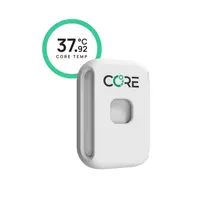
This sensor is often used by athletes trying to adapt to the heat, often before having to compete in scorching conditions. That’s not my main aim — hopefully it will have cooled off before the Frankfurt Marathon, which I'm running in late October — but I still found the data useful, and I picked up a lot of new knowledge about how heat affects the body, and there are benefits to heat training even if you plan to race in cold conditions.
Here are five things I learned running with the CORE 2 thermal sensor every day for a month.
Core temperature doesn’t always track with skin temperature

The CORE 2 sensor shows your core and skin temperature live — I added the Connect IQ data field for it so I could see these stats on my Garmin Forerunner 970.
Of these stats, core temperature is a stronger indicator of the state of your body during exercise and rises more consistently in line with effort and heat.
I was surprised to see how much skin temperature could fluctuate and even drop during activities, owing to factors like sweat and wind cooling the skin.

For example, on this 15-mile Sunday long run, my core temperature rose consistently throughout the workout, while my skin temperature dropped, and even during very hard workouts, my skin temperature might not be that high owing to profuse sweating.
I found this all fascinating, and it shows that you need to get in deep and get those core temperature readings to get useful insights into the body during workouts.
That’s not to say skin temperature sensors on wearables are useless — they are important for measuring skin temperature overnight, which can help predict illness and help track the menstrual cycle.
It takes time for the core to cool down after hard runs

On my hardest hot run with the sensor — an afternoon track workout in blazing sunshine — I hit a core body temperature of 101.8℉ (38.7℃). I also hit over 100℉ (37.7℃) on an easy run when the outside temperature was around 95℉ (35℃).
On both these occasions, I wore the sensor for a while after I hit this peak to see how long it takes to come down, and I noticed it took a while, even when I was jogging at an easy pace after the workout for my cool down.
After the workout, it took 50 minutes for my body to drop back down to its normal core temperature, even though I couldn’t feel that heat anymore.
The takeaway for me was to bear that in mind with my recovery and what I have planned straight after workouts. I used a cooling towel after another workout to help me drop my temperature, and it’s hard to beat a shower where you gradually lower the water temperature.
Get under tree cover when you can
I’m lucky enough to live by a big forest and for most of my runs during the heatwave I’ve been heading under tree cover, which I find makes a huge difference.
It was good to see that, backed up by the sensor data, most notably on the 95℉ (35℃) day, when I spent the first half hour on the road with no cover before heading into the forest. My core temperature rose sharply on the road but plateaued once I was in the forest, even though I felt like I was working harder on undulating trails.

The advice for running in the heat is always to do your runs early in the day and ideally in the shade, and using this sensor has driven that point home to me over the past month.
I can do a full hour in 85℉ (29.4℃) heat in the forest and stay in the lowest heat strain zone on the CORE 2 sensor, whereas if I’m exposed on the road, the same pace and heart rate quickly moves me into higher zones.
Easy efforts need to be scaled back

Captain Obvious will be the first to tell you that running is harder in the heat, so you need to adjust your pace, but once again, even as an experienced runner, I found it useful to have that data laid out before me during runs.
I’ve been running for over a decade, and I do know my body so I can run to feel pretty accurately, but I’m not accustomed to heat, and I did find the sensor useful in showing that easy runs needed to be scaled back to actually be easy, especially when the temperature was over 90℉ (32.2℃).
Having the data on my wrist meant that I could see if I strayed out of the lowest heat zone on an easy run and reduce my pace. I saved my heat adaptations for harder run days.
Heat acclimation takes dedication

The best use for the CORE 2 sensor is to monitor your response to heat training and help yourself acclimatize to it, especially ahead of tackling events in hot conditions.
That’s not really what I was using it for — I was just learning about how heat affects the body, and if anything, trying to avoid getting too hot — but I did think that running every day through a heatwave would boost my heat acclimation.
It turns out you have to really focus and work hard to do this, because I’m still ranked a ‘Thermal Rookie’ in the CORE app and only 4% acclimatized, because I have aimed to run under tree cover and early in the day when possible.
Only workouts directly in the sun really moved the needle for me on acclimatization, and if you're aiming to do this, you’ll have to work hard through dedicated sessions in hot conditions to push your body to adapt.
There are reasons to do this kind of heat training even if you plan to race in cool conditions, because it can also help improve things like your VO2max and lactate threshold, so I might start enjoying lie-ins and getting out for my runs in the sun.

Follow Tom's Guide on Google News and add us as a preferred source to get our up-to-date news, analysis, and reviews in your feeds.
More from Tom's Guide
- Rheon running shorts are being used by top road, track and trail runners — I spoke to an expert to find out more about the tech
- I tested shoes from 5 up-and-coming running brands — here are the ones worth your money
- No squats! I just tried this 8-minute chair workout, and it’s perfect for seniors, beginners, and anyone looking to build strength without impact