Electric cars got more expensive this year to buy, and it’s not just due to the federal EV tax credits expiring this past September. Even without that, the average cost of EVs in the U.S. hit $57,245 in the most recent report from Kelly Blue Book. That’s a staggering amount considering that the national average wage index for 2024 was $69,846.57.
They certainly don’t come cheap, but there are still models out there that have starting prices that are way less. One of the biggest reasons why the EV revolution has stalled is how all-electric powered vehicles continue to command premium prices over ICE (Internal Combustion Engine) vehicles.
I’ve driven more than 40 different electric vehicles this year, and these are the top 5 most affordable ones. What’s interesting from my testing, too, is that the most affordable electric vehicles happen to also be some of the most efficient EVs as well. So you’ll get outstanding mileage out of each charge.
Nissan Leaf


- Base trim MSRP: $29,990
- Price tested: $41,930
- Most surprising feature: Refreshing redesign
The 2026 Nissan Leaf got a much deserved makeover, complete with a striking, more modern design that makes it look way cooler to drive on the road than previous iterations. Yet, the most astounding part of the 2026 Nissan Leaf is that it’s the cheapest electric vehicle you can buy with a starting cost of $29,990, which turns out to offer an equally impressive 300 miles of range.
The price jumps up to $41,930 for the sportier, more premium Platnium+ FWD trim that packs a panoramic glass roof, head-up display, powered liftgate, heated seats, and more. For something so affordable, I’m beyond impressed that I got an average efficiency of 3.6 mi/kWh — while also clocking in one of the fastest Level 1 charging speeds I’ve recorded with an average rate of 4.24 mi/hr.
Read our full review: Nissan Leaf
Fiat 500e


- Base trim MSRP: $30,500
- Price tested: $35,500
- Most surprising feature: Fast Level 1 charging speed
Larger vehicles naturally cost more, so it comes as no surprise that the smallest EV you can buy in the U.S. is also one of the most affordable. Even though its size may not suit everyone, the Fiat 500e is a tiny, but surprisingly peppy all-electric vehicle that’s most suitable for city driving.
Despite its starting price of $30,500, it’s a tough sell given its diminutive size compared to all the others on this list. You’re compromising most on space and comfort, as this two-door vehicle has a tiny backseat with virtually no legroom — and an even tinier trunk. However, it makes up for the lack of space with its ridiculously good efficiency that makes good of each charge. Even better, it offers the fastest Level 1 charging speed I’ve tested this year with its average rate of 5.06 mi/hr.
Read our full review: Fiat 500e
Hyundai Kona Electric


- Base trim MSRP: $32,975
- Price tested: $39,880
- Most surprising feature: Class-leading efficiency
Coming in third is one of my personal favorites, the Hyundai Kona Electric with a starting price of $32,975 for the base SE trim. That goes up to $39,880 for the sportier N Line trim I drove for a week, which features a larger 64.8 kWh and more powerful electric motor that puts out a 201 hp performance.
I really recommend paying the extra money for the N Line trim because it’s the most efficient EV I’ve tested all year with its average of 4.3 mi/kWh. You’re also getting a much sportier interior too, complete with bucket seats, slick ambient lights, and Bose premium audio. The only downside to the Kona Electric is tight legroom of the back seats.
Read our full review: Hyundai Kona Electric
Chevrolet Equinox EV

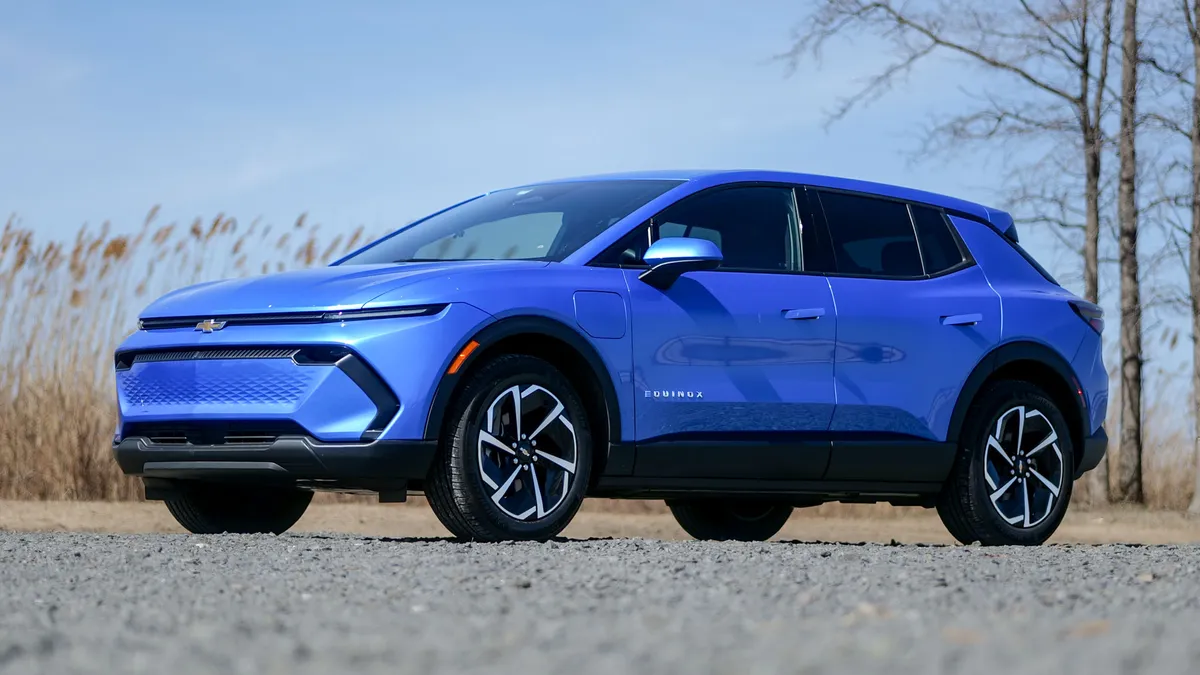


- Base trim MSRP: $33,600
- Price tested: $34,995
- Most surprising feature: Larger size
While all the previous models are some of the most efficient, the Chevrolet Equinox offers the most range out of the bunch with upwards of 319 miles of range. That’s important because the base LT trim is accompanied by an attractive MSRP of $33,600, which is practically what I ended up driving for a week.
Another important thing to know is that the Chevrolet Equinox EV is the largest EV on this list, so it offers a bit more utility with its ample legroom, storage space, and trunk size. Since you’re paying little for this EV, it does skimp out on some of the comforts — like having manual seats everywhere, no wireless charger for a phone, and one of the choppiest looking backup cameras I’ve tested.
Read our full review: Chevrolet Equinox EV
Subaru Solterra


- Base trim MSRP: $38,495
- Price tested: $45,555
- Most surprising feature: NACS charging port
And finally, there’s the 2026 Subaru Solterra — which I claim to be the most improved EV I’ve tested all year. That’s because it’s a marked improvement over the previous year’s model, beating it in areas like efficiency, sleeker design, and a more futureproof NACs charging port.
It starts out at $38,495 for the base trim, and just like the Equinox, offers way more space to comfortably fit up to 5 people. The exact trim I tested, the Touring XT, brings the price up to a whopping $45,555 — but even that’s less than what the average EV costs. Obviously it’s the most expensive out of the bunch, but something I’d buy realistically because of how well it performs.
Like I mentioned, it’s the most improved EV I’ve tested in every way imaginable, including its sleek design. What I’m most astounded by is the 4.2 mi/kWh efficiency I got after driving it for a week. For a compact crossover SUV, it’s not something I expect because it’s just as good as the Fiat 500e and Hyundai Kona Electric.
Read our full review: Subaru Solterra

Follow Tom's Guide on Google News and add us as a preferred source to get our up-to-date news, analysis, and reviews in your feeds.
More from Tom's Guide
- I'm not anxious that it's getting darker earlier with this thermal camera for my car — here's why
- I just test drove the new Nissan Leaf — and it's irresistible at under $30,000
- CrabWalking with the GMC Sierra EV is the weirdest thing I’ve ever done with a car — and it’s actually pretty useful