
 Club Benefits





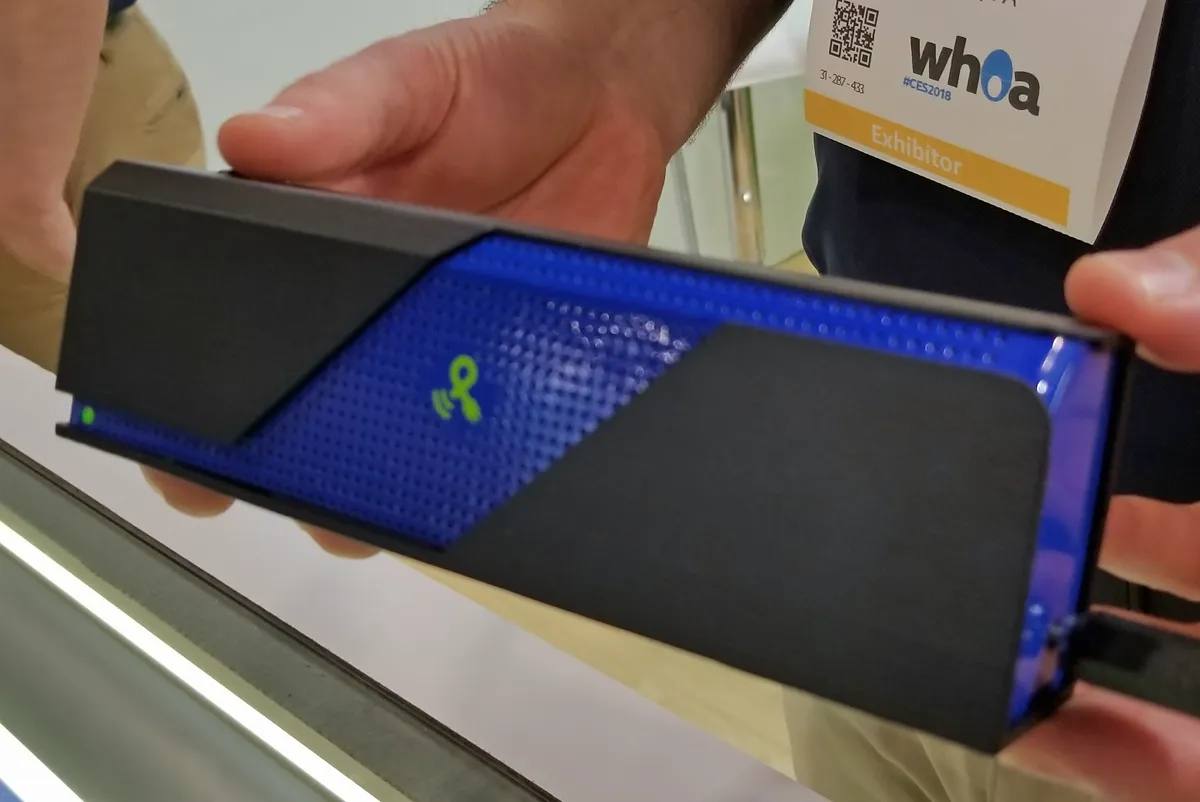
Today, "wireless charging" means plopping your device down on a pad and walking away for a while. However, starting later this year, you may be able to get electricity the same way you get data: over the air. Available later this year for around $50, Powercast's TX91503 PowerSpot is a transmitter that can send electricity to up to 20 devices that are three feet (or possibly even further) away.

I got a chance to see PowerSpot in action at Powercast's CES 2018 booth and it looks like a game changer. The attractive, blue and green rectangle could easily be mistaken for a Bluetooth speaker and can fit easily under your TV or in your entertainment center. Then, while you sit on the couch with devices in your hands or pockets, the PowerSpot charges them.
According to Powercast, the transmitter should only reach devices that are up to 3-feet away, but my demo showed that the company is being conservative in its estimate. At the booth, the company had a set of circuit boards with LED lights on them where each board represented a device.
As I moved the board closer to the transmitter, its light got brighter, representing a stronger signal and, as I pulled it further away, it got dimmer. I was able to walk back six or seven feet before the light on my board completely faded.
The PowerSpot emits a modest 1 watt of power, which is the maximum amount allowed by the FCC, which has officially approved the transmitter. To receive electricity from the PowerSpot, your device will need to have a tiny, built-in receiver chip and antenna.

Powercast Principal Engineer Eric Biel said that the company is working with device makers to build the chips into their upcoming products. You'll see the technology first in game controllers, wireless earbuds, fitness bands and smartwatches. Because 1 watt of power isn't enough to charge a phone in any reasonable period of time, you probably won't see a receiver in a handset.
The company claims that a smartwatch should take 6 to 8 hours to charge. So, if you have a PowerSpot in your bedroom and leave your fitness band on the nightstand, it should be all juiced up when you wake in the morning.
However, charging from zero to a hundred percent is not the ideal use case. PowerSpot can keep topping off devices while you use them. Imagine a game controller that you use on the couch in your living room and then put down when you're done. It might never even come close to running out of power.
Consumers who are worried about safety shouldn't be too concerned, because according to Biel, the average smartphone is capable of emitting twice as much energy. The transmitter only broadcasts power when it sees a device in range, he said.
Biel also said that, if and when the FCC changes it regulations to allow more power, his company will be ready to create transmitter that emit a lot more wattage, allowing for faster charging on higher-capacity devices. He also said that, if you have two transmitters in the same room, you might get up to 2 watts of power, but his company doesn't recommend doing something that gets around the FCC's safety guidelines.
We look forward to seeing how PowerSpot works with real devices when it launches later this year. If device manufacturers embrace the technology, it could change the way we think about charging.
