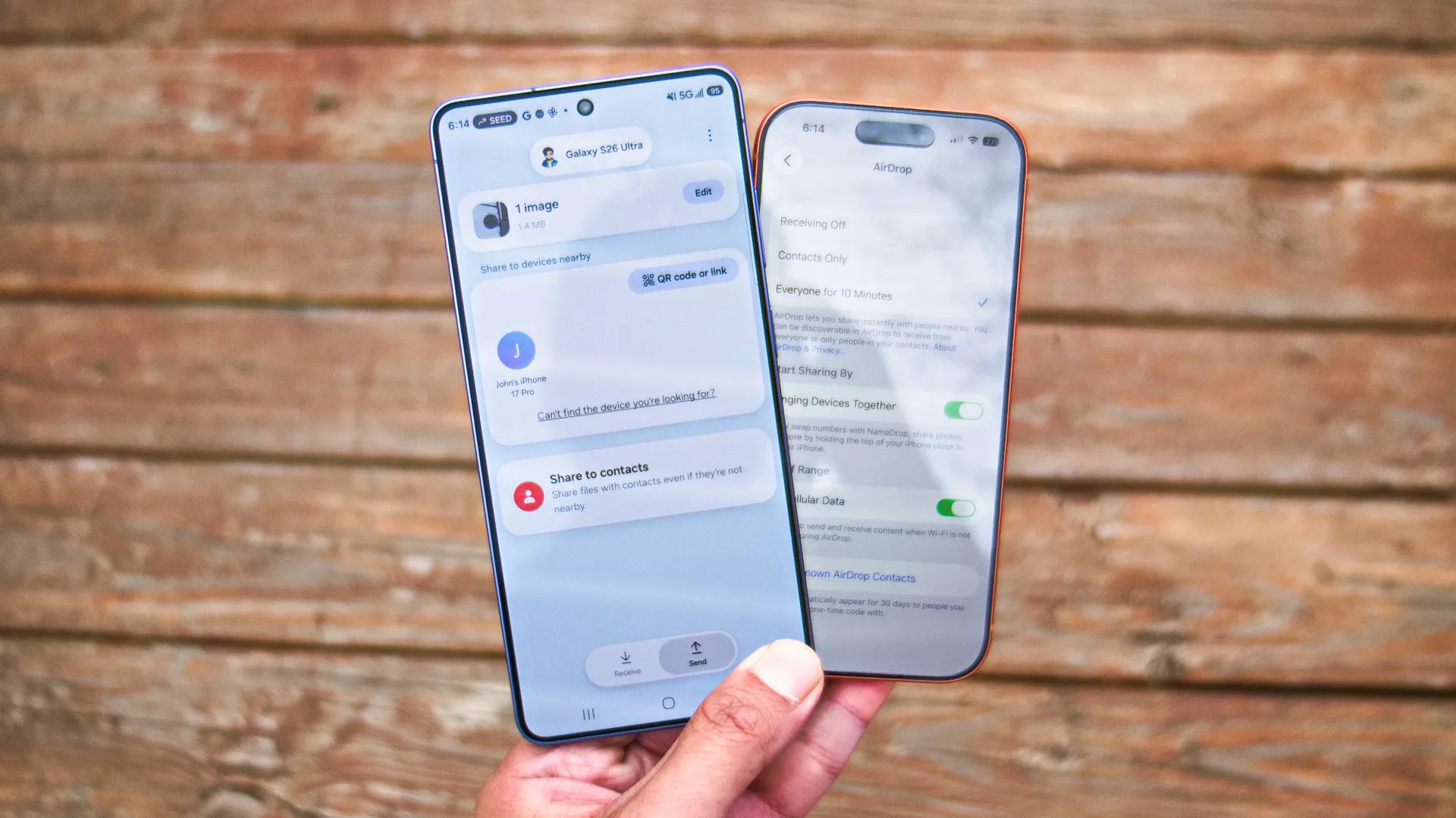
Last November, Google did something I always thought was impossible: it managed to break through a crack in Apple's walled garden and make QuickShare compatible with Apple's AirDrop. This allows QuickShare to connect with AirDrop, making file sharing between Android and iPhone completely painless. Most importantly, it doesn't only work in one direction: iPhone users can share files with Android with the same level of ease.
The only real problem is that Quick Share/AirDrop support was not universally added to Android overnight. It relied on the phone makers themselves to enable support, meaning only Google Pixel phones supported the change at the time. But four months is quite a long time, and things have changed a lot.
Samsung recently confirmed it will follow Google's lead by adding AirDrop via Quick Share support to the Galaxy S26 and a select number of other Galaxy phones. This means two of the biggest names in Android now have even closer ties with Apple devices.
As someone who has always struggled to efficiently transfer files between my Android phone and iPad, this is something I am very excited about.
It's all surprisingly easy to pull off
When it comes to integrating into the Apple ecosystem, I've always been skeptical of the options available. It often feels like there's a catch involved because Apple maintains such an iron grip on its products and refuses to let any non-Apple devices muddy the waters.
I was very happy to find that this isn't the case with AirDrop and Quick Share. The process was so seamless and simple that the average user probably won't realize how big a deal it actually is. Sending photos from my Pixel 10 Pro to my iPad, and back again, was as easy as sending photos to my Windows PC or a completely different Android device.

I can honestly say there was no tangible difference — and if I hadn't known any better — I wouldn't have realized Quick Share and AirDrop weren't the same thing. All I had to do was find the photo or file I wanted, hit the share button, select Quick Share, and I could see my iPad sitting in the list of available devices.
It was easily the fastest and most convenient file transfer I've ever managed involving Apple and non-Apple hardware. The only hurdle was making my Android and iDevices visible to each other, which was quickly rectified, even if there was no permanent solution.
Sadly, I was unable to share between my iPad and Windows 11. So while Apple's walled garden has begun to let some Android devices sneak through, better connectivity with Windows still seems to be out of the question.
No more workarounds

I've been working across Android and iOS/iPadOS for a long time, and the lack of interconnectivity has always frustrated me. If I have pictures or files on an iPad, getting them to an Android phone (and Windows) has always required a middleman.
I was once a big fan of the app Pushbullet to handle this, especially since I could send stuff to all of my devices at once. Sadly, the app was removed from the Apple App Store over six years ago for a variety of reasons, including the developers' unwillingness to add a "Sign in with Apple" option. Without Pushbullet, the boundaries between Apple and non-Apple became significantly more troublesome to cross.
Over the past few years, the middleman has been Google Photos. Google's ability to disseminate its apps just about everywhere meant I could automatically back up any photos and videos I took and instantly gain access to them on all of my devices — regardless of who actually made them. But there have been times when I needed to send something that didn't play nicely with Google Photos.
In those instances, I either had to resort to email, which has size limitations, or upload to Google Drive and deal with painfully slow upload and download times. Neither of those options is particularly convenient, especially if you're in a rush.
The fact that Quick Share and AirDrop are now interoperable (on some devices, at least) means that none of this matters anymore. The act of sending files and photos between the two ecosystems is now as painless as you could really ask for.
iPhones are now more open than ever

It's incredible just how much more open iPhones have become over the past few years. It seems as though Apple is slowly opening up to the fact that there are people who don't own iPhones. This means a lot of its best first-party software features are more accessible than they've ever been. Heck, even RCS messaging offers a lot of what iMessage can do, and Apple recently started testing encryption on messages sent to Android phones.
Even if Apple isn't actively distributing that software to other platforms, it's allowing the likes of Google to build something that matches up with what Apple has been doing. I can't wait to see Quick Share to AirDrop connectivity come to even more devices. Pixels and Samsung Galaxies are a good start, but there's no shortage of Android manufacturers out there who should get in on the action.
Who knows? Maybe one day we'll even see Quick Share on Windows gain the ability to send files to iPhones and iPads. Now that the cracks in AirDrop's exclusivity have started to form, I can't wait to see what happens next.

Follow Tom's Guide on Google News and add us as a preferred source to get our up-to-date news, analysis, and reviews in your feeds.
More from Tom's Guide