Tom's Guide Verdict
The Khadas Mind 2S is a unique device that successfully turns a mini PC into a truly portable workstation with plenty of power under the hood. It’s significantly faster than the original and handles demanding workloads with ease. While the $1,599 price is steep and the fan can get noisy under pressure, it is the only mini PC that lets you carry this much power in your pocket and instantly transform it into a desktop or gaming rig with one of Khadas’ docks.
Reasons to buy
- +
Powerful internals
- +
Sleek, ultra-compact design
- +
Great selection of full-sized rear ports
- +
Easily expandable with optional docks
Reasons to avoid
- -
Expensive for a mini PC
- -
Can get loud under heavy load
Why you can trust Tom's Guide Our writers and editors spend hours analyzing and reviewing products, services, and apps to help find what's best for you. Find out more about how we test, analyze, and rate.
The Khadas Mind 2S is unlike any mini PC I’ve tested yet. Despite its smaller, pocketable size, it features full-sized ports around back and enough power under the hood that it felt more like a workstation than a mini PC when plugged in at my desk.
After reviewing the original Khadas Mind, I was eager to get my hands on this new, upgraded model. While it now features an upgraded Intel Core Ultra 7 255H processor, 64GB of LPDDR5X RAM and comes with a 2TB SSD, Khadas still managed to make it fit inside the same-sized case.
Although it is on the expensive side at $1,599, there aren’t any optional upgrades to worry about as those are the specs you get with the only configuration of the Mind 2S. Then, if that’s a bit out of your price range or more power than you can handle, you could always pick up the significantly cheaper Mind 2 which starts at $799. Either way, you’re still getting the same sleek design and excellent port selection. If you need more ports or even more power, you can always expand its capabilities with one of Khadas’ optional Mind docks.
I’ve used this PC at home, while traveling and even with AR glasses for the past 10 months and in my opinion, it’s easily one of the best mini PCs you can get today. Read on though to see if this pocketable powerhouse is for you or if you’d be better off with something less portable and more stationary.
Khadas Mind 2S: Cheat Sheet

- What is it? A powerful yet pocketable mini PC that feels more like a workstation than your typical device in this category.
- Who is it for? Those who want workstation-class power in a small, quiet package with the option to add more ports or even dedicated graphics via the Khadas ecosystem.
- What does it cost? The Khadas Mind 2S costs $1,599, but the standard Khadas Mind 2 starts at $799 and comes in three configurations.
- What do we like? Its sleek unibody-style aluminum enclosure, the slim "carry-anywhere" design, the versatile port selection, the easy-access SSD slot on the bottom, and the expansive modular dock ecosystem.
- What don’t we like? The significant price jump between the Mind 2 and Mind 2S and that it can get slightly noisy under heavy load.
Khadas Mind 2S: Specs
| Header Cell - Column 0 | Khadas Mind 2 |
Khadas 2S (as tested) |
|---|---|---|
Price |
||
CPU |
Intel Core Ultra 5 125H, Intel Core Ultra 7 155H |
Intel Core Ultra 7 255H |
GPU |
Intel Arc |
Intel Arc 140T GPU |
RAM |
16GB LPDDR5, 32GB LPDDR5, 64GB LPDDR5X |
64GB LPDDR5X |
Storage |
512GB SSD, 1TB SSD, 2TB SSD |
2TB SSD |
Ports |
1 x Thunderbolt 4, 1 x USB4, 1 x HDMI 2.1, 2 x USB-A |
1 x Thunderbolt 4, 1 x USB4, 1 x HDMI 2.1, 2 x USB-A |
Connectivity |
Wi-Fi 6E, Bluetooth 5.3 |
Wi-Fi 6E, Bluetooth 5.3 |
Battery |
Built-in 5.55Wh battery (25-hour standby time) |
Built-in 5.55Wh battery (25-hour standby time) |
Size |
5.75 × 4.13 × 0.79 inches |
5.75 × 4.13 × 0.79 inches |
Weight |
0.96 pounds (435 grams) |
0.96 pounds (435 grams) |
Khadas Mind 2S: The Ups
The Mind 2S retains everything that made the original a standout — its ultra-compact, premium build — but adds a significant spec bump that pushes it into true workstation territory. While the design is still a win, it’s the massive jump in internal power that truly makes this new model shine.
Sleek, premium and pocketable

At 5.75 x 4.13 x 0.79 inches, the Mind 2S is the exact same size as the original Mind mini PC. Despite using the same case, Khadas has made some changes to the device’s internals.
For instance, while the original Mind had a solid cooling setup, this new model features a pure copper vapor chamber liquid cooling system. Likewise, the PCIe connector on the bottom of the Mind 2S has been upgraded to PCIe 5.0 which doubles its bandwidth to 256GT/S but more on that later.

Around back, the port selection appears identical to the original Mind at first glance. However, Khadas has upgraded the ports on the Mind 2S and you now get two high-speed USB-A ports, an HDMI 2.1 port, a USB 4 port and a Thunderbolt 4 port. Given the Mind 2S’ tiny size, this is quite the selection of ports.

For instance, when I ditched my laptop for the Mind 2S with a pair of Xreal One AR glasses, I was able to power the device using a large portable powerbank, connect the glasses via the other USB-C port and use one of the USB-A ports for my low-profile mechanical keyboard’s 2.4 GHz dongle. All with one port to spare since I used a smaller trackball mouse that connected via Bluetooth with that setup.
The Mind 2S is a very versatile mini PC but it’s the upgraded chipset and all of the extra RAM Khadas added this time around that makes a difference.
Now with more power

The Khadas Mind was no slouch in terms of power, but the Mind 2S takes things to a whole new level. Unlike the standard Mind 2, which uses Intel’s Series 1 Meteor Lake chips, the Mind 2S is equipped with a Core Ultra 7 255H chip from Intel’s Series 2 Arrow Lake-H family. Not to be confused with the hyper-efficient Lunar Lake chips found in many of today’s ultra-thin laptops, Arrow Lake-H is all about raw performance and heavy multi-tasking.
The reason Khadas went with Arrow Lake over Lunar Lake is clear: the company has always positioned the Mind 2S as a workstation in a mini PC’s body. With 16 cores and 16 threads, the Ultra 7 255H offers double the core count of a typical Lunar Lake chip. This architectural choice is also what allowed Khadas to outfit the Mind 2S with a massive 64GB of RAM, whereas Lunar Lake is physically capped at 32GB. Power draw is another big factor; the Mind 2S can pull up to 115W under load, providing the kind of sustained performance you’d normally expect from a much larger desktop.
| Header Cell - Column 0 | Khadas Mind 2S |
Mac mini M4 |
Geekom A9 Max |
|---|---|---|---|
Geekbench 6.5 single-core |
2890 |
3838 |
2976 |
Geekbench 6.5 multi-core |
14532 |
14838 |
15140 |
25GB file copy test (MBps) |
2501.33 |
3017.3 |
1749.79 |
Handbrake (Mins:Secs) |
4:33 |
4:42 |
3:24 |
As you can see in the table above, the Mind 2S performed great across the board. It kept pace with the much larger Geekom A9 Max in both single and multi-core tests and even managed to beat out the Mac mini M4 by nine seconds in our video encoding test using Handbrake. Given that the Mind 2S has a significantly smaller footprint than its rivals, I’m quite impressed by how well it fared in our testing lab.
In addition to more cores and threads, the chipset Khadas picked for the Mind 2S has another trick up its sleeve for when you’re not using it purely as a workstation.
Not just for work
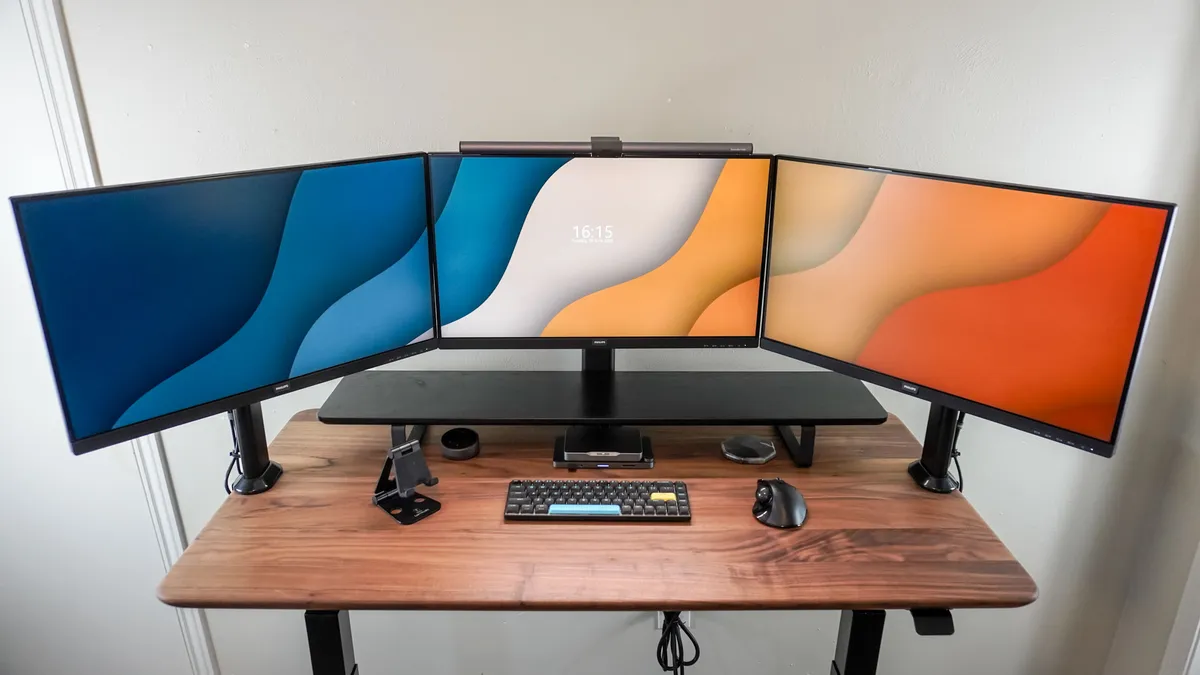
Ever since Khadas first sent over the Mind 2S, I’ve been using it both on the go with AR glasses and at home. Thanks to its unique form factor and the fact that it’s powered using a standard USB-C power adapter, this mini PC has found its way into quite a few of my desk setups—including my first triple-monitor one I put together last spring.
The Mind 2S has easily been able to handle my daily workload, which consists of multiple Chrome windows with dozens of tabs open in each and some heavy photo editing. However, when using it at that triple-monitor setup, curiosity got the best of me and I decided to see what it would be like to game on it.

Even with three 1080p monitors and using Intel’s Graphics Software to stitch them together into a single display, the Mind 2S was able to run loads of older titles flawlessly. I credit this to the Intel Arc 140T iGPU inside its Core Ultra 7 255H chip.
One of the biggest perks of having 64GB of RAM is that I was able to use the Shared GPU Memory Override in the Intel Graphics Command Center to set aside 32GB of memory specifically for the iGPU. This essentially gave the Mind 2S more "VRAM" than many dedicated gaming laptops, which helped immensely with texture-heavy games.
Now, don’t expect the Mind 2S to be a gaming-focused mini PC like the Asus ROG NUC 970 or the AtomMan G7 Ti. However, if you’re playing less demanding games at 1080p and don’t mind turning down a few settings here and there, you can absolutely game on it. But if you want to take things to the next level graphics-wise, Khadas has that covered too.
Instantly expandable

Before we get into the optional Mind Dock and Mind Graphics Dock, the Mind 2S has another trick up its sleeve. If the 2TB of onboard storage isn’t enough, all you have to do is flip this mini PC over and push down on the magnetic cover to reveal a free M.2 2230 slot.

The slot supports up to a 2TB SSD, allowing you to essentially double your storage capacity in seconds. It’s an impressive inclusion for a PC you can slip in your pocket. Speaking of portability, the Mind 2S also features an integrated 5.55Wh battery. While it isn't meant for working on the go, it allows the device to enter a low-power standby mode for up to 25 hours when unplugged. This lets you move the PC between docks or rooms without having to save your work or reboot.

Besides that SSD slot, the bottom of the Mind 2S features Khadas’ proprietary Mind Link connector. This 122-pin interface has been upgraded to PCIe 5.0 x8 on the 2S, to make it even faster. The Mind Dock adds a fingerprint scanner, a volume knob, and a wealth of extra ports, while the Mind Graphics dock houses a desktop-grade GPU.

I haven't tested the new Mind Graphics 2 yet, but I spent a lot of time with the original model. One second I was working with the mini PC powered by my monitor’s USB-C port, and the next I was playing Final Fantasy XV with a desktop Nvidia RTX 4060 Ti. The upcoming Mind Graphics 2 will push this even further with an RTX 5060 Ti that takes full advantage of the 2S’s faster PCIe 5.0 bandwidth.

I will admit that both the Mind Dock at $179 and the Mind Graphics docks which range from $849 to $1,349 are on the expensive side for optional accessories. Still, they take what was already a fantastic mini PC and transform it into a legitimate desktop replacement.
You can absolutely use the Mind 2S on its own, but the ecosystem is what truly makes it feel like the future of computing. Oh, and did I mention Khadas recently released its new Mind xPlay accessory for $399? It essentially turns this mini PC into a laptop, complete with its own display, keyboard, and trackpad.
Khadas Mind 2S: The Downs
The Mind 2S is a powerful computer and the perfect follow-up to Khadas’ original Mind but it’s not without its downsides, both of which stem from its much smaller form factor compared to other, less expensive mini PCs.
Not quite silent (especially under load)

For the most part, you won’t really hear the Mind 2S while you’re working. It has a slight, and by no means annoying, hum when using it for less-demanding tasks like web browsing or standard office work. In fact, I’m quite impressed by how quiet it is, given it’s less than an inch thick.
When you push the Mind 2S with heavy workloads like video editing, though, it can get noisy. For instance, when I tried running some more demanding games using its integrated graphics, the fan spun up something fierce. It's a high-pitched whir that lets you know the internal cooling is working overtime to keep that powerful Arrow Lake chip from overheating.
While it's by no means a dealbreaker, if you want a dead-silent mini PC, the Mac mini M4 is still the gold standard. The Minix Elite EU715-AI is another good option if you want something that runs Windows and stays practically silent during your workday, though you do sacrifice the cutting-edge performance and the unique modularity of the Khadas Mind for peace and quiet.
Paying a premium for pocketable power

Let’s face it: $1,599 is a steep price to pay for a mini PC. This is especially true when you can pick up an equally powerful Geekom A9 Max for several hundred dollars less, or even a base Mac mini M4 at a fraction of the cost. With the Mind 2S, you’re essentially paying a "form factor tax."
In addition to this high up-front price, if you want to push the Mind 2S to its limits as a workstation or a gaming PC, adding a Mind Dock and the new Mind Graphics 2 pushes the total price past the $3,000 mark. At that point, you’re firmly in the territory of high-end gaming desktops or premium workstation laptops — both of which offer similar raw power and with the latter, portability.
If you don’t plan on taking advantage of the Mind 2S’s unique modular capabilities and pocketable nature, it will likely be overkill for most people. Fortunately, the standard Mind 2 is significantly cheaper, with a starting price of $799. It gives you all the perks of the Khadas ecosystem and that signature build quality without the same initial sticker shock.
Khadas Mind 2S: Verdict
The Khadas Mind 2S continues to impress me with its sleek design, powerful internals, and its place as the newest addition to Khadas’ growing Mind ecosystem. Despite its pocketable size, you still get full-sized ports and expandable storage. Likewise, thanks to its internal battery, this is the kind of mini PC you could actually bring with you to work and then back home in the evening — all without ever powering it down.
At $1,599, the Mind 2S certainly won’t be for everyone. In fact, I’d consider it a "special edition" device for existing Khadas Mind fans who want the maximum amount of power in this specific form factor today. Then again, with the Mind Pro now available for pre-order at $1,799, it might be worth waiting and paying a bit more for that next-gen Panther Lake chip if you're chasing the absolute ceiling of performance.
Still, if you want a seriously fast, dockable mini PC you can carry in your pocket right now, the Mind 2S is a fantastic machine that stays true to the solid foundation laid by the original Khadas Mind.