One of the features announced when the Echo Dot Max and Echo Studio launched was the ability to use multiple smart speakers to create a surround-sound setup with your Fire TV device. While this concept isn’t new — you could do something similar with older Echo devices, as well as other some of the best smart speakers, like the Apple HomePod — I was curious to see how it would work with Amazon’s newest devices.
So when Amazon sent me four Echo Dot Maxes, four Echo Studios and a Fire TV Stick 4X Max, to try it out, I wanted to see how it might stack up against the best soundbars. Here’s how it went.
What you’ll need — and how much it’ll cost
In order to use the Echo Dot Max or Echo Studio for a home theater setup, you’ll need either a Fire TV Stick 4K (2nd gen), Fire TV Stick 4K Max (2nd gen), Fire TV Stick 4K Plus, or Fire TV Cube (3rd gen). Strangely, this setup doesn’t work with any of Amazon’s new Omni TVs not its Fire TV soundbar, which would seem to be a natural fit for this type of application.
You can connect up to five smart speakers (Amazon recommends at least three), but they have to be all the same device. I had hoped that I could use two Echo Studios as my front channels and two Echo Dot Maxes as my rear channels, but sadly, I could not. And, if you want Dolby Atmos, you’ll need to spring for the Echo Studio, as it’s not supported by the Echo Dot Max.
So, if you don’t need or care for Atmos, you’re looking at a $440 investment if you want four Echo Dot Maxes plus the Fire TV Stick 4K. If you happen to still have an Echo Sub (Amazon stopped selling it a few years ago), you can pair it as well for deeper bass.
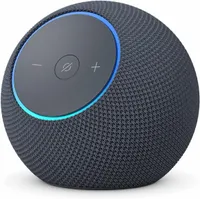
if you want Atmos, it’ll cost at least $926 — four Echo Studios and the Fire TV Stick 4K Plus. At that price, you’re not too far away from some of the best Dolby Atmos soundbars, like the Sonos Arc Ultra.

Of course, as I write this, both the Echo Dot Max and Echo Studio are currently on sale for $20 and $30 off, respectively, so your total cost for four Maxes would come out to $316, while four Studios would run you $756.
Getting things running
Setup was fairly easy, and was completed all through the Fire TV interface. After I positioned the speakers around the room, I opened “Display & Sounds,” then selected “Alexa Home Theater.” From there, a short video gives you a brief explanation as to how it works, and then you next select the speakers you want to add.
After that’s done, the Fire TV runs a test whereby it plays a series of tones out of each speaker, so as to calibrate them for your room. In all, it took around 10 minutes.
One thing to note: Because of their spherical shapes, the Echo Dot Max and Echo Studio are a lot taller than most soundbars. If your TV is sitting on a console (as mine is), you may need to raise your set up a few inches, or else the tops of the speakers will block part of the picture. It's not as big an issue if you're watching a letterboxed movie, but for all other content that fills the screen, the tops of the speakers will be noticeable.
How it sounded
While the four Echo Dot Max speakers don’t support Atmos, they still managed to provide a subtle improvement, giving scenes greater depth and more immersive experience. The dogfighting scenes “Top Gun: Maverick” gained a bit more oomph as the F/A-18s flew across the screen. When I watched “Avatar 2: The Way of Water,” I heard the ambient sounds of wildlife around me as the Na’vi traipsed through the forests of Pandora. In all, it was a pleasing, if not overwhelming, improvement.
When I swapped out the Echo Dot Maxes for the Echo Studios, things changed — in a big way. Now, when I watched “Top Gun,” it felt like I was in the cockpit, and could really hear and feel the fighters as they whooshed through the sky. The extra bass offered by the Studios also helped to increase the depth of the experience in a more visceral way. I could feel my couch trembling beneath me.
Similarly, when I streamed movies from Disney+, like “Star Wars Episode IX: Rise of Skywalker,” it really felt like I was back in the movie theater as TIE fighters and X-Wings roared all around my head. The Emperor’s voice echoing through the cavernous halls of Exegol was truly creepy.
Plus, the larger speakers in the Echo Studios really let me crank things up to the max, so much so that by wife — two stories below me and through a closed door — told me to turn it down.
Would I recommend it?
If you're paying full freight for a set of four Echo Studios, I would steer you instead to one of the best Dolby Atmos soundbars like the Sonos Arc Ultra, which goes for $1,099 at its regular price (though right now it's just $879 on Amazon).
However, at their discounted price, the Echo Studios can make for an effective Dolby Atmos home theater. The two major trade-offs are that you're committed to using a Fire TV stick (among the best streaming devices, Amazon's ad-laden interface is our least favorite), and if your TV sits on a table, you'll have to raise it up a few inches or move the speakers to either side so that they don't block the picture.
Bear in mind that you can create a surround-sound system with as few as three speakers, so you could bring the cost down even further. But where's the fun in that?

Follow Tom's Guide on Google News and add us as a preferred source to get our up-to-date news, analysis, and reviews in your feeds.
More from Tom's Guide