One of my favorite CES memories is spending eight hours working with a professional THX Home Installation trainer to understand the dynamics of sound. We reviewed how to best place subwoofers to reduce standing waves in a room and angle speakers for the widest sound dispersion.
But not everyone gets to spend a full day learning how to make their speaker system really, truly sound its best. Heck, some people don’t even have a few hours to spend on it.
That’s where the LG Sound Suite audio system comes in. Thanks to Dolby Atmos FlexConnect, you can put satellite speakers anywhere in the room and get calibrated spatial audio sound tuned to wherever you want to sit. It's just become available on LG's website and it's changed the way I think about surround sound.
Who needs channel-based audio anyways?
If you have a passing familiarity with speaker systems, you’re probably used to seeing them described by the number of channels they have.
A 5.1 system describes a setup with left and right channel speakers, plus one center channel, two back satellite speakers and a subwoofer. A 7.1 system adds two extra speakers to the mix... so on and so forth.
The speakers don't need to be placed in a regular configuration — the system calibrates itself to your living environment.
That’s not quite how LG Sound Suite works. The speakers don't need to be placed in a regular configuration — the system calibrates itself to your living environment.
Say you only buy two LG M7 surround speakers. You might want to put them on either side of your couch, where they’ll work like regular left and right paired speakers.
But rather than the traditional placement, you could also put one behind you to the left on a table and the other in front of you somewhere. Well, guess what? You can do that, too, and it won’t sound weird.
If, next week, you decide to get a new end table and want to move the front speaker onto it, there are no cords that need to be re-measured and cut or settings to change. You simply re-run the calibration tool on either your LG TV, the ThinQ AI app on your phone, or via the Sound Suite Soundbar. Voila, your system is now reconfigured to the new layout.

Dolby Atmos in any room with any speaker configuration
There are several pieces of technology at play to make the system work so seamlessly. The first is Dolby Atmos FlexConnect, which adapts the sound depending on how many speakers you currently have set up. The other is Sound Follow, an LG technology that uses ultra-wideband to get the speaker levels just right for wherever you’re sitting.
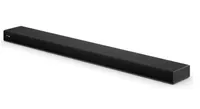
In my CES 2026 demo, LG had four M7 surround speakers and a W7 subwoofer connected to the Sound Suite H7 soundbar. Each surround speaker was set up in a normal configuration (to the left, right and behind me) and I got immersive spatial audio from where I was sitting.
The system recognized there was a change and re-calibrated itself on the fly. Within 30 seconds, the system was once again balanced.
Halfway through the demo, the demonstrator picked up one of the surround speakers and moved it right next to where I was sitting. Normally, moving a speaker this close would require you to re-calibrate the whole system. If you don’t, the closest speaker will sound significantly louder than the others and ruin the mix.
That didn’t happen. Instead, the system recognized there was a change and re-calibrated itself on the fly. Within 30 seconds, the system was once again balanced.
Versatility and convenience at a cost
The LG Sound Suite demo was impressive. I’ve been walking around CES just thinking how much time FlexConnect would save me when setting up a new system, and every wired surround sound speaker now just feels like a load of extra work that I don’t want to deal with.
Unfortunately, given the cost of the LG Sound Suite, I’ll still have a few more years of setting up my surround system the old-fashioned way — it’s just too expensive for me right out of the gate.
The Sound Suite H7 soundbar, for example, will set you back $999. Each of the four M7 surround speakers comes in at $399 apiece, while the W7 subwoofer is $599. That means the cost of the system I was listening to was well over $3,000.
That’s not unreasonable — especially considering a Sonos Arc Ultra starts at $1,099 — but wired surround systems can be had for half the price or less.
Overall, LG Sound Suite is among the coolest audio technologies I’ve yet to hear at CES 2026 and I really respect all the engineering that had to go into it. Still, at this price, I probably won’t be able to get it in my own home for another few years.

Follow Tom's Guide on Google News and add us as a preferred source to get our up-to-date news, analysis, and reviews in your feeds.
More from Tom's Guide