




The Hisense U6QF is often our go-to pick as a budget Mini-LED TV, offering great performance for the price and tons of features, including the full range of HDR formats. It suffers from slight motion processing issues, light blooming, and suboptimal viewing angles.
Pros
- High brightness, especially with HDR content
- Good color performance
- Superb value proposition
Cons
- Some problems with fast action, light bloom, viewing angles
- Amazon Fire TV platform
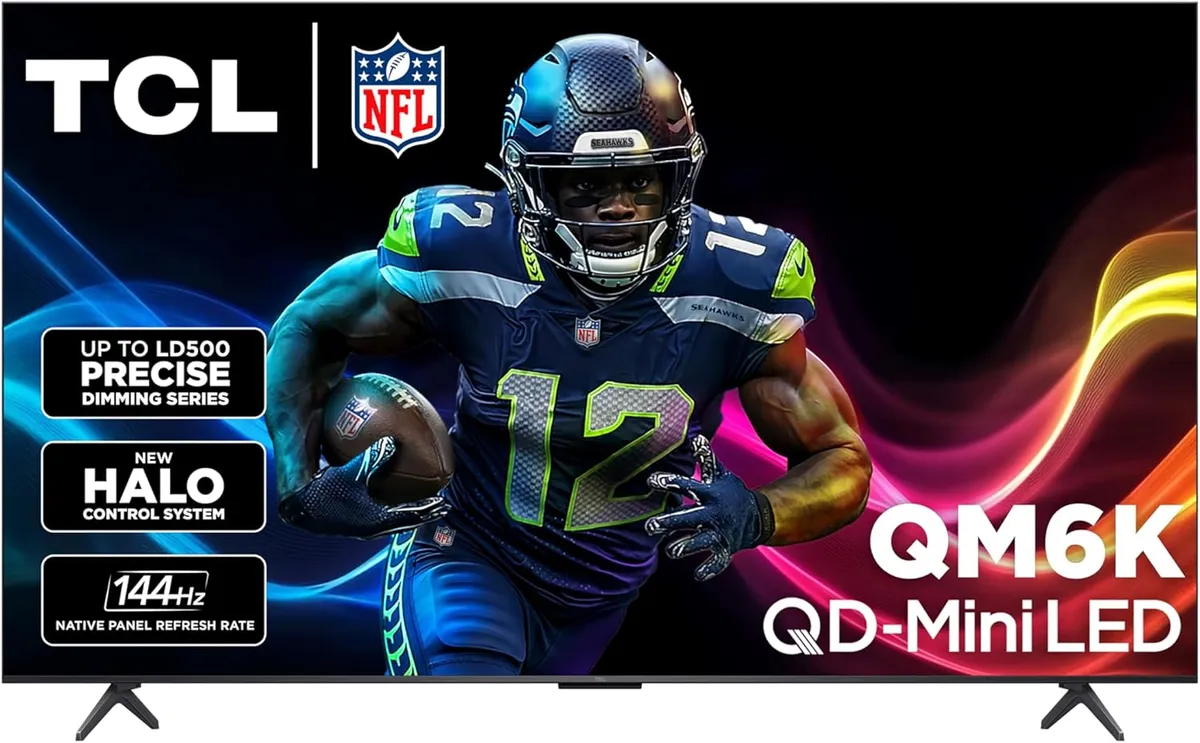
TCL's QM6K is built to be a gamer's delight, offering robust features on a 144Hz refresh rate and just enough performance to make HDR movies look crisp. However, it lacks higher brightness metrics to handle bright rooms.
Pros
- Loaded with features
- Excellent picture quality
- Relatively sleek design for the price point
Cons
- Sound performance is inconsistent
- Glare reduction could be better
The Hisense U6QF Mini-LED TV and the TCL QM6K Mini-LED TV are among the cheapest Mini-LED TVs released in 2025. Despite their affordable pricing, they're still packed with tons of features for cinephiles and gamers, plus they look great to boot.
With Black Friday and Cyber Monday deals well behind us, you might be wondering which of these two inexpensive Mini-LED TVs is the right buy. That's why we're putting them head-to-head in a battle to see which is the best budget TV money can buy.
Hisense U65QG vs TCL QM6K: Specs compared
| Header Cell - Column 0 | Hisense U65QF |
TCL QM6K |
|---|---|---|
Sizes |
55", 65", 75", 85", 100" |
55", 65", 75", 85", 98" |
Ports |
2x HDMI 2.1 |
2x HDMI 2.1 |
Resolution |
3,840 x 2,160p |
3,840 x 2,160p |
Refresh rate |
144Hz |
144Hz |
HDR |
Dolby Vision, HDR10+, HDR10, HLG |
Dolby Vision, HDR10+, HDR10, HLG |
Smart TV software |
Fire TV |
Google TV |
ATSC 3.0 support? |
Yes |
No |
Processor |
Hi-View AI Engine Processor |
AiPQ Pro Processor |
Hisense U75QG vs TCL QM7K: Design

They're basically identical in terms of size and weight.
Both Mini-LED models are particularly sleek with thin bezels. They're basically identical in terms of size and weight, with the U65QF measuring 3 inches in depth and weighing 42lbs while the TCL QM6K measures 2.2 inches in depth and weighs 37lbs. If anything, the QM6K is slimmer by a hair, but you wouldn't see a noticeable difference between the two.
The QM6K and U65QF are equipped with two V-shaped legs that are easily attachable, however they don't look as good as pedestal stands or prove as practical, making it harder to fit on top of smaller furniture. That said, you can also wall mount either set using their VESA patterns; the QM6K is 300 x 300mm, and the U65QF is 400 x 400mm, both for the 65-inch models.
TCL and Hisense are known for delivering remarkable brightness metrics in their Mini-LED sets, and that's no different with these models. While this is often more than enough to handle glare, some sets will offer anti-glare coating on the panel. However, only the TCL model has it with a special matte HVA panel.

Don't expect wall-thumping sound from either TV. Given the sticker price for both models, you won't walk away with an immersive soundstage. The 65-inch Hisense U65QF is equipped with just 40W of output on a 2.1-channel system, and the QM6K is identical but offers a built-in subwoofer. While you get Dolby Atmos support on both TVs, you'll need one of the best soundbars for the full experience.
Note that the speaker configurations will vary across sizes, so you could eke out a bit more power and additional channels on 75-inch and 85-inch models. However, you'll still get a more immersive experience from a dedicated audio system or soundbar, which is recommended.
As for remotes, I like Hisense's more than TCL's. Hisense remotes offer backlit buttons on a lightweight design and a silver chrome finish, which stands out. The QM6K is a bit rudimentary, but slightly more ergonomic. It's painted fully black and is much smaller than the Hisense remote.
It's hard to draw a conclusive victor for design, given the similarities between the Mini-LED TVs in audio and build quality. I'm going to give the win to the TCL QM6K due to its slightly thinner design, but both TVs are practically identical.
Winner: TCL QM6K
Hisense U65QF vs TCL QM6K: Performance

Before diving into their individual performance, here's a look at how these two Mini-LED TVs performed in our lab tests.
| Header Cell - Column 0 | Hisense U65QF |
TCL QM6K |
|---|---|---|
SDR Brightness (10%, in nits) |
653 |
265 |
Delta-E (lower is better) |
1.8 |
2.3 |
HDR Brightness (10%, in nits) |
968 |
695 |
UHDA-P3 Gamut Coverage |
95.65% |
94.71% |
Rec. 2020 Gamut Coverage |
71.26% |
71.23% |
Input latency (milliseconds) |
13.2 |
13.1 |
As you can see, neither the Hisense U65QF nor the TCL QM6K deliver show stopping performance. You get what you pay for, and while they might be rich with features, they aren't exactly the cream of the crop when it comes to their metrics.
However, both TVs are largely neck and neck in color performance. They share similar values across the board, whether we're discussing color accuracy or color coverage. You can see this in both their UHDA-P3 gamut and Rec 2020 gamut coverage, which is borderline identical in value.
It's also represented in their respective Delta-E scores, a measurement of their color accuracy. The lower this score is, the better the color accuracy, which means the Hisense model technically wins this bout with a score of 1.8 over the QM6K's 2.3. However, it would be nearly impossible to tell any major differences between them, as most of the scores are largely negligible.
However, their luminance is another thing entirely. The U65QF offers far better brightness in both SDR and HDR, which is great, given it supports the full range of HDR formats and is equipped with an ATSC 3.0 tuner. This means you get good brightness control in general TV broadcasts as well as in HDR content, which isn't true for the QM6K.
At 968 nits in HDR, the U65QF outshines the TCL QM6K. Even in Filmmaker mode (which we recommend above all other modes), the Hisense model still topples the QM6K by offering 946 nits against 559 nits. The same is true in SDR, as well.

Speaking from experience, TV tester Matthew Murray, who reviewed the Hisense U65QG, noted how "More conventionally lit and brighter movies had no trouble at all" on the set. He also highlighted that "although glare and reflections on the screen were noticeable with the U65QF, they weren't bad enough to be disruptive."
The same can't be said of the TCL QM6K, which was negatively impacted by glare despite having a special screen to counter it. The major takeaway is that the QM6K "shines in Filmmaker mode," as Malcolm McMillan reports in his review; however, the format isn't available for every occasion. He adds that the QM6K produces exceptional picture quality, "So long as you use the right picture settings," which doesn't bode well for most users.
Overall, both TVs offer great picture quality, but lack hardware improvements that make experiencing movies and shows even better. This comes with the territory for most inexpensive Mini-LED models, with blooming, poor off-angle viewing, and glare being the most common culprits, which is true for both sets.
However, since the QM6QF handles glare with improved precision and offers far better performance metrics, it takes the win in performance.
Winner: Hisense U65QF
Hisense U65QF vs TCL QM6K: Smart platform and features
Here's the other major difference: Although the TCL QM6K runs Google TV, the Hisense U65QF Mini-LED TV is actually built on Fire TV. This sets it apart from the TCL model (and even other Hisense Mini-LEDs) giving it a slight variance in app support and integrations, with a standout feature being Alexa Plus support.
That said, the Hisense U6QF is one of the few 2025 TVs with Alexa Plus access outside of a few select Panasonic sets and Amazon models. That means you can try special features with Prime Video and some automated smart home functionality, including the recently launched scene jumping feature.
Similar to Google TV, Fire TV also offers a bunch of free content. It also gets access to all of the best streaming services, so you won't miss out on your favorite shows and movies. Beyond streaming content, Fire TV is also home to some of the best cloud gaming services, including Xbox Game Pass, GeForce Now, and Amazon Luna.
Still, Google TV is no slouch and it's routinely called out as one of the best smart platforms. It's quick and snappy, offers one of the best search functionalities in the industry, and is home to its own slew of free channels and content. You really can't go wrong with the platform, but there's no doubt it is missing several key features that Fire TV offers.

Following in the footsteps of the TCL QM7K, the cheaper QM6K is also without an ATSC 3.0 tuner, while the Hisense U65QG is equipped with one. This gives the Hisense model a broader range of coverage for free OTA channels with Nextgen TV access and 4K broadcasts. You'll still have to wait a while for 4K broadcasts to be more widely available, but it doesn't hurt to have the future-proofed spec available.
Another standout feature of the Hisense U65QF is its support for Wi-Fi 6 versus Wi-Fi 5, offered by the TCL model. You may experience slightly better Wi-Fi speeds and improved stability on the U65QF, but these enhancements will be negligible for the most part. Additionally, I recommend hard-wiring your TV to the router for optimal performance when streaming content, whether it's cloud gaming or general entertainment.
Although we tend to side with Google TV for its reliability and slew of features, I think Fire TV is the better choice in this faceoff. Plus, the Hisense U65QF offers slightly better hardware upgrades over its rival, giving it an edge in the competition.
Winner: Hisense U65QF
Hisense U65QF vs TCL QM6K: Outlook
| Header Cell - Column 0 | Hisense U65QF |
TCL QM6K |
|---|---|---|
Specs (25) |
23 |
21 |
Design (25) |
20 |
19 |
Performance (25) |
23 |
21 |
Features (25) |
24 |
22 |
Total Score (100) |
90 |
83 |
In all fairness, you can't go wrong with either of these inexpensive Mini-LED TVs, but if I were deciding which model to pick, I'd go for the Hisense U65QF. Some of the standout features that make it a worthy choice over its opposition include serviceable glare mitigation, Wi-Fi 6 support, access to Alexa Plus, and better performance.
When it comes to sticker price, the U65QF still comes out on top. At the time of writing, the 65-inch Hisense U65QF is $547 at Amazon, while the 65-inch TCL QM6K is $649 at Best Buy. That's a $100 premium for a TV that might show slightly better motion processing performance.
My money is still on the Hisense U6QF. It's a great value, offering a suite of features for gamers and movie lovers alike, all built on top of an excellent platform.
More from Tom's Guide

